In the lobby area of the TivoliVredenburg contemporary music venue, shrieking electronics by IEMA Ensemble sliced through a cloud of bar chatter, transforming the third space into a zone for surprising music. This is what Gaudeamus Festival is all about: For 80 years, it has filled the city of Utrecht with newly commissioned music and an approach rooted in curiosity. The focus of The Netherlands’ leading experimental music festival has been supporting the composers of today, having awarded such esteemed artists as Pauline Oliveros and Unsuk Chin. As this year’s edition sought to capture the breadth of the musical moment and the range of compositional practices happening right now, the festival served as a showcase for the wins, failures, styles, genres, and everything else that defines experimental music.
Gaudeamus Festival serves two purposes: to present five days of new music, and to select the winner of the annual Gaudeamus Award, a $5,000 commission for a promising young composer. For the former, the festival presented a broad range of ensembles from across the globe, leading experimental musicians, multidisciplinary works, and participatory programs that invited the audience to become part of the process. For the latter, this year’s nominees, Matthew Grouse, Robin Haigh, Yaz Lancaster, and Golnaz Shariatzadeh, represented a cross-section of today’s music scene, and their works were scattered throughout the Festival’s program.
Like most festivals, Gaudeamus was jam-packed, and no two experiences could possibly look the same. But as the days progressed, a few themes emerged, namely experimental song; spectral, timbral, and textural-focused composition; immersive works; drone and minimalism; and a tongue-in-cheek approach to writing new music. Despite its scope, the festival often maintained a light atmosphere, with each moment feeling more like a space for incubation than a moment for perfection. After all, composing is just as much about the successes as the misfires. Gaudeamus emphasized that both are essential to the artistic process.
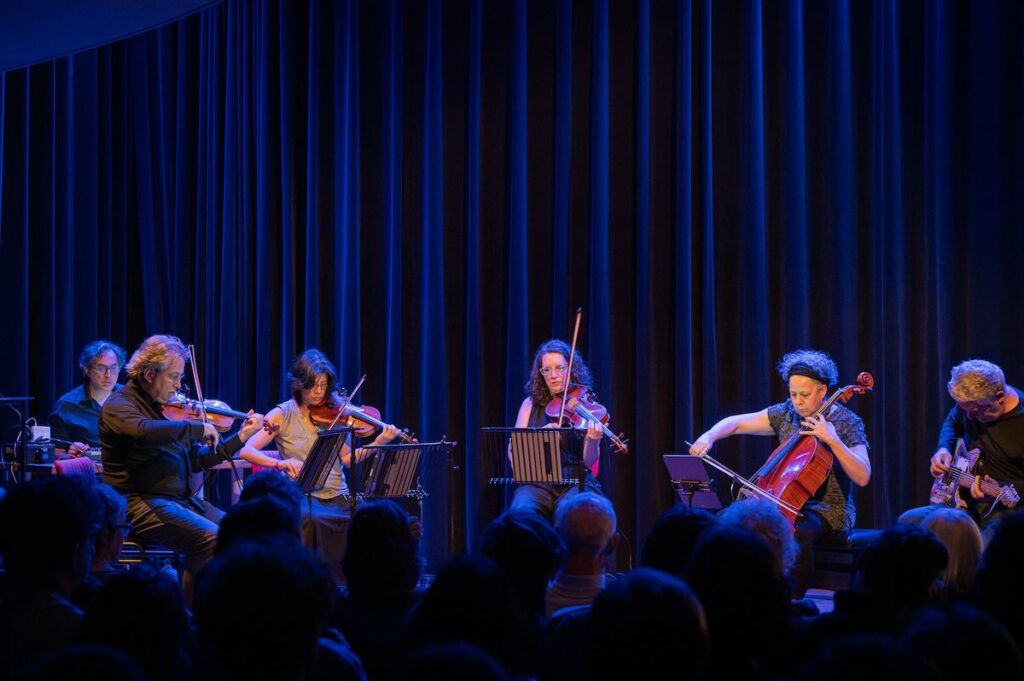
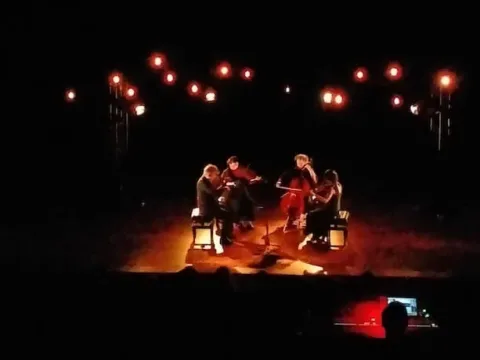
Premieres and new pieces were at the core of each day of programming. Most notable were performances by Quatuor Bozzini, who, at one concert, presented 16 consecutive short pieces for the quartet, electric guitar, and electronics, creating an unbroken stream of textural sound. Overall, the most successful pieces for the quartet highlighted the ensemble’s mastery of quiet, unadorned music, like Julia Mermelstein’s Brush (in open air) (in resin), which moved through a series of wispy, stretched-out pitches, and Robin Haigh’s feathery and dance-like String Quartet No. 2. Contrastingly, Zosha Di Castri’s Delve presented a mix of whistles and virtuosic riffs that didn’t mesh with the quartet’s meditative approach.
Texture was also at the center of new pieces by Golnaz Shariatzadeh — whose Blue Womb presented harrowing shreds of sound — and during Yuheng Chen’s captivating Goodbye, Cinema – for Ensemble with Amplified Objects, which was an ever-evolving, swarming mass. Other pieces felt weighed down by concept: Paul Scully’s Personal Best sought to bridge sports and music by challenging the composer to make his best 3K running time while the group performed his piece, and Matthew Grouse’s ctrl+Y commented on mundane office life through disjointed keyboard, voices, percussion, and electronics. Both pieces felt lackluster, forgoing cohesion, melody, and harmony in favor of an existential concept.
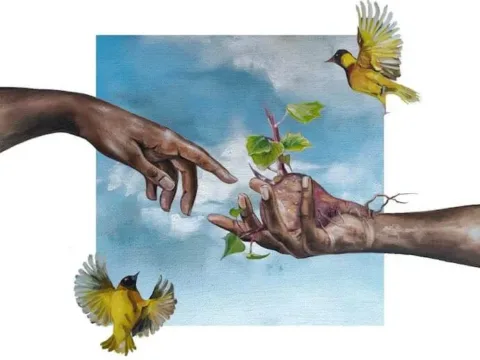
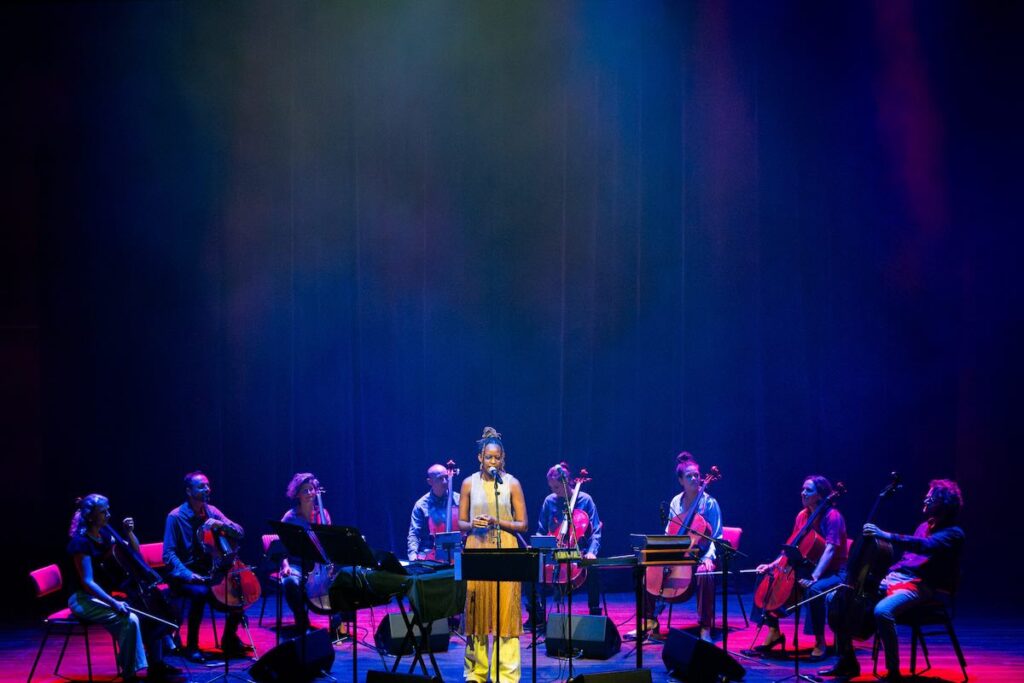
Other composers expanded the possibilities of the song cycle, and while these performances were all rooted in powerful storytelling, they each offered a different approach. Nyokabi Kariũki’s Birdsongs from Kĩrĩnyaga grew from birdsongs that have lived in East Africa for millions of years — far longer than humans. Her work, while always lush, traversed a variety of vocal techniques and instrumentations, weaving spoken words, soaring vocals, field recordings, and resonant strings performed by Cello Octet Amsterdam.
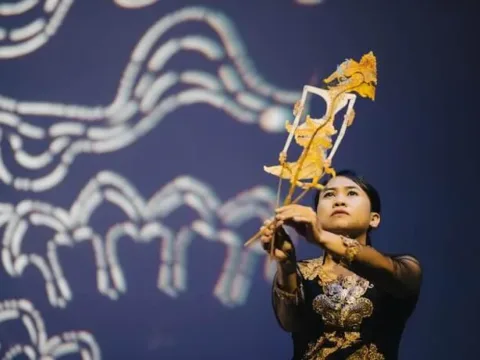
Peni Candra Rini’s Rara – Allegories of the Southern Sea drew from the mythology of East Java and bridged song with puppetry. At the center was Rini’s commanding vocal skill: she squealed and glided in equal measure, venturing from the quietest whispers into the loudest shrieks at the drop of a hat. M Alberto’s RADIO VITÓ explored the history of resistance globally and in The Netherlands through a suite of songs that swerved between searing spoken word, recordings of interviews and speeches by different activists, and free, explosive melodies, with a defiance palpable in every phrase.
Elsewhere, song took the form of dreamy electronics in the vein of currently popular artists like ML Buch, but many of these performances fell flat despite their immersive potential. During Mári Mákó’s Cylyre — which featured her hand-designed, metallic chrome string instrument that sounded like a futuristic lyre — electronics trudged and stayed in one place so long they felt stuck in time, while vocals felt disembodied and out-of-place. The art installation disappear, a collaboration between Kenza Koutchoukali, Tessa Douwstra (LUWTEN), and Marlou Breuls, took on the loneliness of grief, but instead of probing the depths of that isolation, the work filled the space with a gentle and soothing pulse rather than a ghostly memory.
Drone and noise were also a prominent part of the festival, with several artists bringing their own takes on the genre. The New York-based duo medium. (Yaz Lancaster and gg200bpm) filled a small club room with crashing sound emanating from electronics and distorted violin, so thunderous that it rocked the space and all of us as we sat sprawled on the floor. Like a blown-out take on Éliane Radigue, they stayed on just a couple of notes and let them crescendo until they burst.
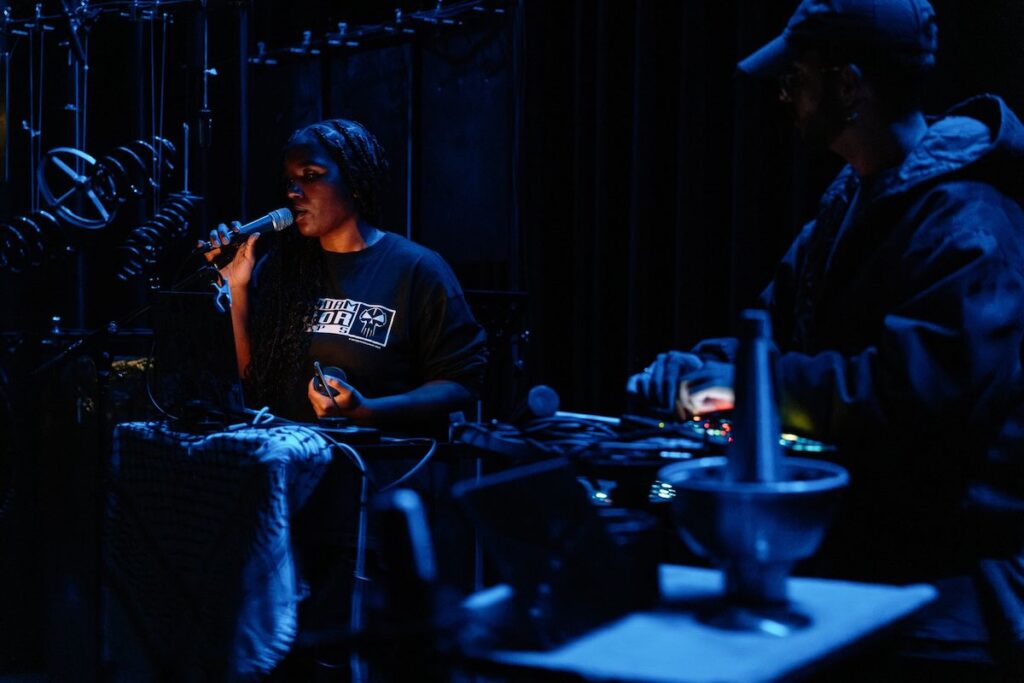
Another acoustic-electronic duo, Aho Ssan and Resina, worked with similar techniques but focused instead on compact song forms. Resina’s long-held cello tones often matched a deep bass beat coming from Ssan’s electronics; other times, the two played hazy pop songs rooted in dance rhythms and Resina’s fluttering voice. The set’s best moments came when their noise filled the room and white lights shuttered from the stage, creating a lightning-like effect.
Less entrancing was the cello duo of Audréanne Filion and Laurence Gaudreau, whose gossamer music lacked direction until the two wove a hair of dissonance into their winding notes, introducing a bit of tension into their otherwise serene hums. And, a set by Anushka Chkheidze, who mixes organ melodies with electronics, had some shining moments of Philip Glass-like repetition, but dissolved into kitschy EDM-influenced rhythms.
The week’s best performance came on Saturday night, when Los Thuthanaka, the collaborative project of siblings Chuquimamani-Condori and Joshua Chuquimia Crampton, took the stage. The set began with a hiccup — Chuquimamani-Condori needed new batteries for their keytar — but that didn’t stop the night. The duo performed songs from their critically acclaimed record in a nearly perfect rendition, and their psychedelic noise and dance music, born from Indigenous Andean folk music, Cumbia rhythms, and cathartic riffs, reached a true pinnacle of release.
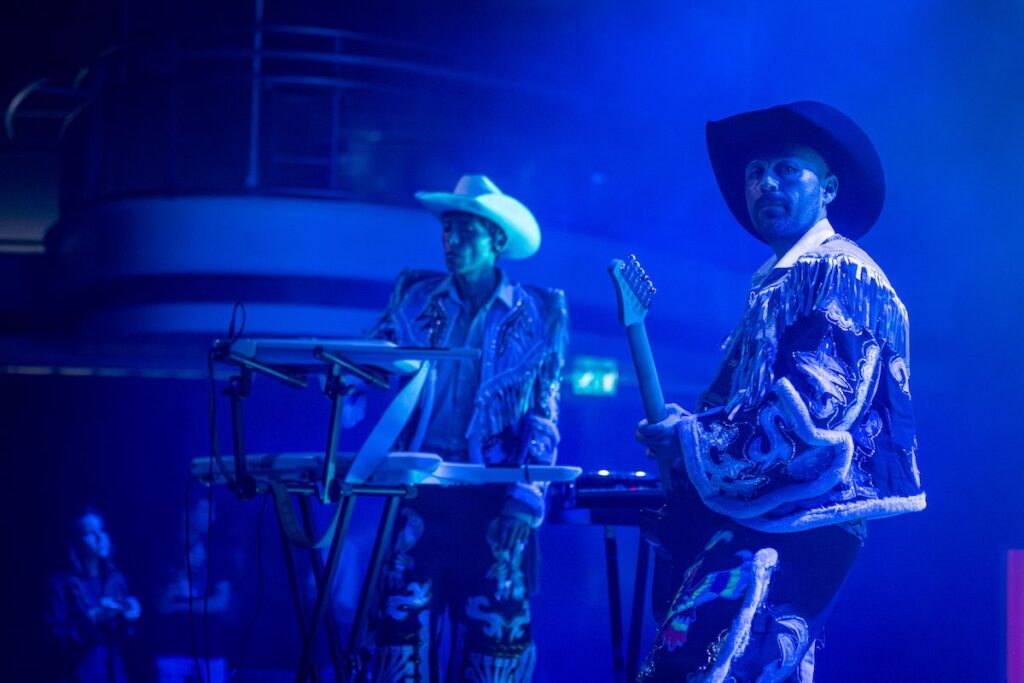
Many of their melodies involve the two playing in unison with each other, racing through interwoven, repeating dissonant patterns, and in performance they were completely in-sync. Light swirled around them as the full room danced to the beat, swaying, stomping, and waving their arms. It was the first moment of true unity at the festival, channeling the power of experimentation in noise and dance to bring a room of people together through the shared experience of catharsis. At its peak, Gaudeamus offers us this reminder of what music does best: create places to join in curiosity, to search for something previously unknown and leave changed by each other and by sound.
I CARE IF YOU LISTEN is an editorially-independent program of the American Composers Forum, and is made possible thanks to generous donor and institutional support. Opinions expressed are solely those of the author and may not represent the views of ICIYL or ACF.
You can support the work of ICIYL with a tax-deductible gift to ACF. For more on ACF, visit composersforum.org.