On Thursday, Sep. 18, Roulette Intermedium felt more like walking into someone’s home than a concert venue. Multimedia sound artist Selwa Abd, performing her new work “ASL: صل ⴰⵙⵍ” under the artist name Bergsonist, greeted us with food and drink upon entry. The space was anything but sterile — tables intimately draped in patterned woven fabrics held North African breads, teas, and treats. It extended a warm, personal invitation into the Indigenous roots of her Amazigh heritage, enhancing the archival materials that drove her performance and a focus of her current practice.
The concert began with Moe Elgrad under a single blue light. Playing in the tradition of Gnawa sacred music, Elgrad molded the space with his guembri, a three-stringed lute carved out of a log. The spiritual practice traditionally establishes links between community members, dead and alive, and was used to open communication with the divine in search of spiritual healing. Barely unable to stop tearing away at the msemmen served at the door, I felt connected, a part of the community and open to receiving the new music.
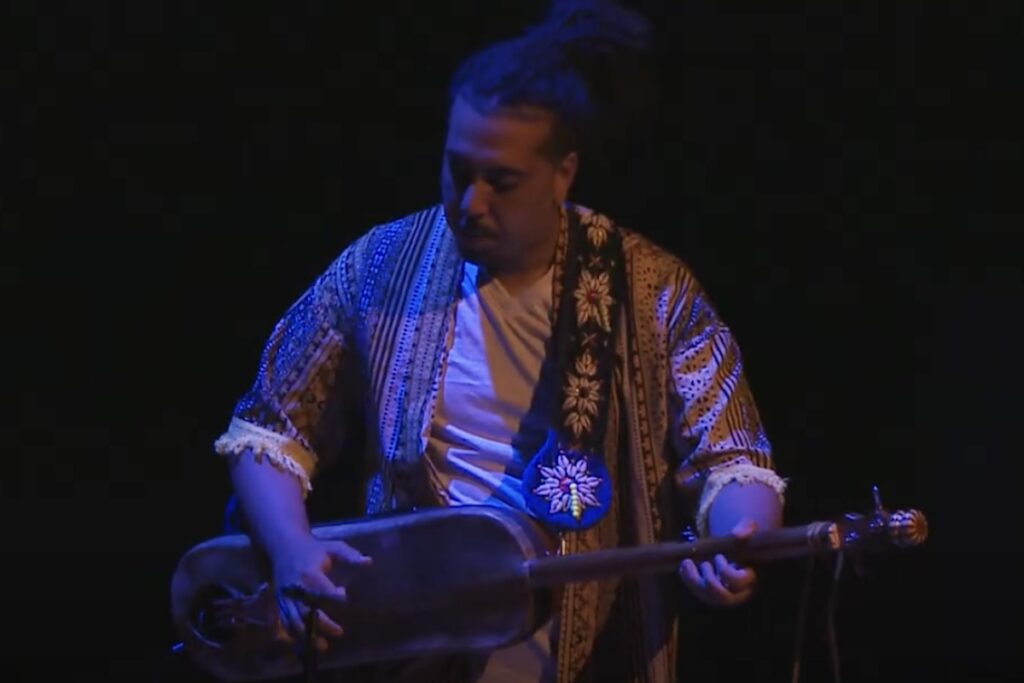
Elgrad started with a small cluster of anchor notes, scurried and unmetered. Faint percussive ricochets from his knuckles dusted on top like harmonics — a traditional use of the instrument — and whittled away at the canoe-shaped wood as though he were sculpting an idea. The continuous line picked up more notes along the way, too quickly to grab hold of at first, but steadily becoming more audible through repetition. When Elgrad landed on a pedal tone that defined a pulse, it became clear that the musical idea wasn’t being formed in real time — it had been there all along, each seemingly abstract line falling into place. He rested there, setting the trance for the evening’s all-out hypnosis.
Bergsonist eased in underneath Elgrad’s vamp with light but ghoulish electronic chords, the organ-like sound and sustain giving them an ethereal sense of infinite time. “ASL: صل ⴰⵙⵍ” tells a genealogical story: not based on a linear chronology, but rather the way time folds in on itself to link the present to the past, demonstrating how present-day urban environments are shaped by a colonial past.
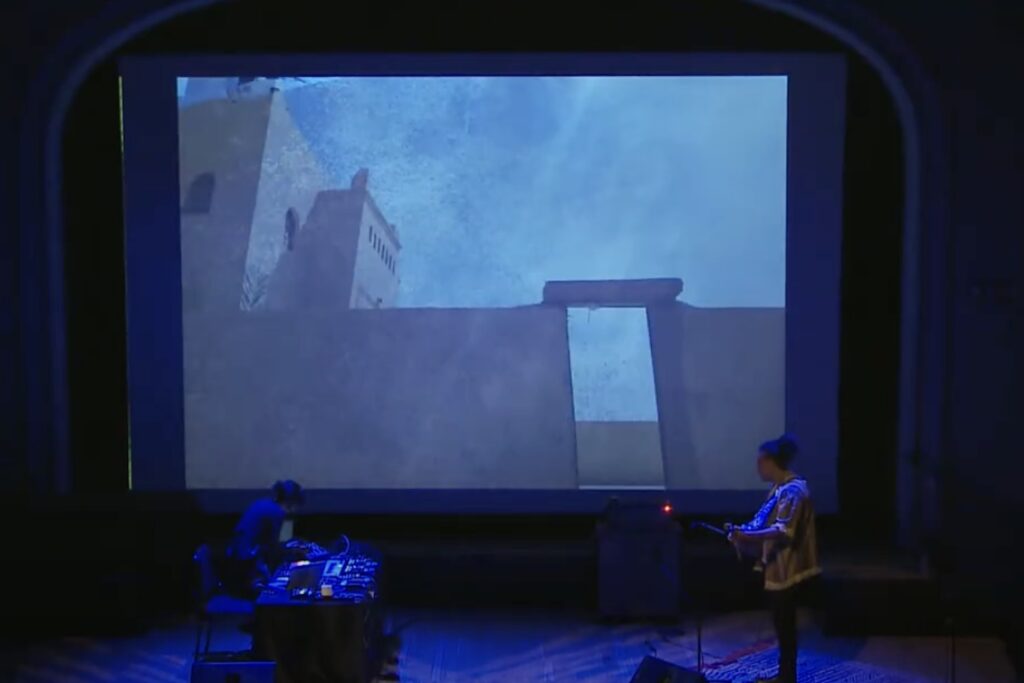
Projections were paired with the performance. From the passenger seat of a car, Abd filmed the landscape of a southeastern village near Errachidia, Morocco, a place where the sun shines constantly throughout the year — and where Abd’s great-grandfather’s shrine rests. The manipulated projections were so immersive that when we caught a brief glimpse of Abd’s phone in the rearview mirror, I was surprised to not see the audience reflected back.
The textured projections disrupted our sense of whether we were sitting in the present, the past, or a parallel dimension somewhere in-between. With mountains in the background, rammed earth buildings in the middle ground, and rays of sunlight in the foreground glaring overhead like stagelights, the three layers of the film shifted independently and created a timelapse of a timelapse. Architecture cascaded into rubble and melted into the decaying landscape while still staying intact, like a ripple through water. It read as a commentary on Amazigh language and traditions surviving amid colonial incursion, morphing and changing without losing its essence.
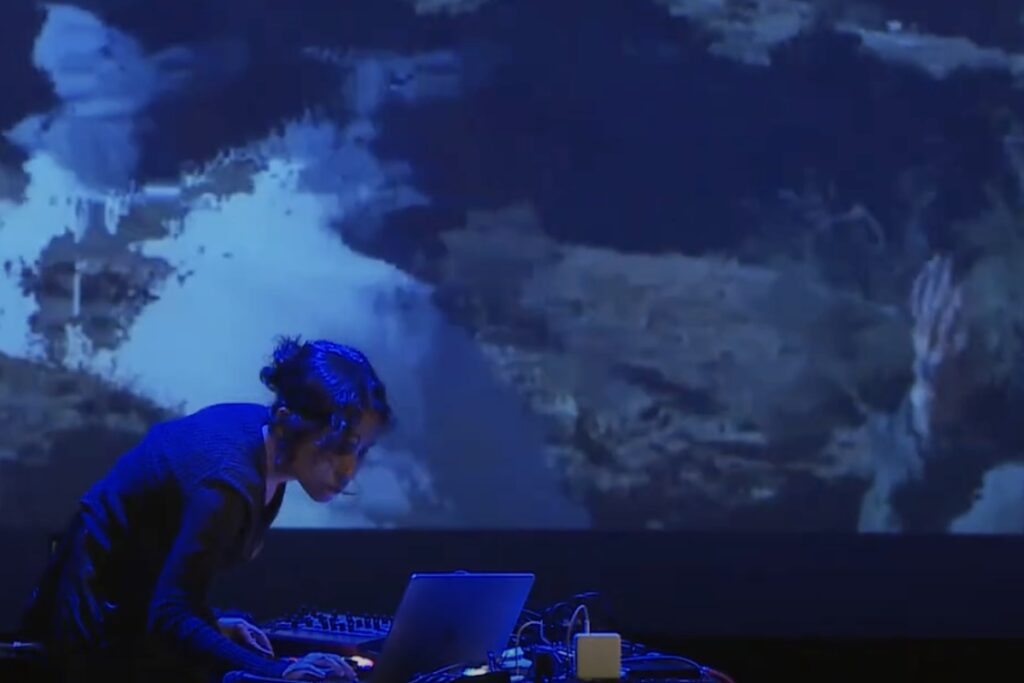
The live soundtrack employed a mix of musique concrete, Bergsonist’s own voice, ambient sounds, speech, and electronics. Much of the sound was saturated with reverb, giving the effect of being underwater, everything swallowed. Sounds that broke free had a sonar-like quality, still drowned but pushing through the water pressure. Voices were layered, split into multiple tracks, slowed down or sped up into varied intonations, and then re-stacked into speech collages. There was a rawness to the audio, like the crackle and pop of opening a can of soda. And yet, the music was distinctly orchestrated, just like the film.
Projects that combine projections, instrumentalists, electronics, and live processing can often suffer from a lack of cohesion, but Bergsonist’s work managed to feel free-ranging while still maintaining a sense of careful control. Neither the sound nor the images seemed to “run away” from their place in time.
As stated on her website, “ASL: صل ⴰⵙⵍ” is only the beginning of Abd’s “building [of] a visual and sonic archive that she now seeks to expand into new contexts.” This performance was an intentional, real-time processing of the material, with Abd building and interacting with her documentation to produce this time-based performance. The intentionality of every aspect — from the foods to the excavation of the material to the meticulous orchestration of multiple mediums — makes this ongoing project both educational and enlightening, disorienting and clarifying, all while remaining wholly intriguing.
I CARE IF YOU LISTEN is an editorially-independent program of the American Composers Forum, and is made possible thanks to generous donor and institutional support. Opinions expressed are solely those of the author and may not represent the views of ICIYL or ACF.
You can support the work of ICIYL with a tax-deductible gift to ACF. For more on ACF, visit composersforum.org.