Amidst the many impressive accolades cited in composer Natacha Diels’ bio, one line stands out to me with special potency: “[Diels’ work employs] cynical play to create worlds of curiosity and unease.” Her latest release, Somewhere Beautiful, expresses the very essence of this phrase. Currently available on Bandcamp, the entire album is built from structured, generative methods that stress the potential impossibility of drawing conclusions or meaning from the material. It is simultaneously deeply personal and open-ended, or as Diels explains in the liner notes, “at once familiar and unknown, comforting and unsettling.”
The first three tracks make up Act One of the album (and are in fact a single, continuous piece broken apart by track markers). “Universal Love™” combines live performance on glockenspiel and triangle with a snowstorm of electronic playback and processing. Despite the austere quality of the metal instruments and the clinical nature of the electronics, the piece holds a striking and pervasive melancholy that effectively sets the stage for what Diels describes as “the inevitable beauty and sadness of a personal journey.”
“This is a Bridge” expands Diels’ sonic world into a spacious environment with the notable inclusion of her own voice. Her narrations describe a kind of abandoned or post-apocalyptic semi-urban space inhabited by overgrown plants, broken down cars, gentle wildlife, and a “friendly troll” that lives under a bridge. The silvery quality of the ongoing electronic and metal sonorities creates the sensation of walking through a mysterious moon garden filled with strange, poisonous flowers illuminated by twilight.
An elegant fragility in Diels’ vocalizations suggests childlike wonder encapsulated by a specter of adult awareness, like a grownup attempting to reclaim the open perspective of their own childhood. This sense of longing resolves into the final chapter of Act One, “Somewhere Beautiful,” in which the discovery of an empty house may also represent the end of the traveler’s life. The work concludes with the haunted phrase: “When the sun sets the small plants make tall shadows that look like monsters, or maybe trolls…this place is somewhere beautiful.”
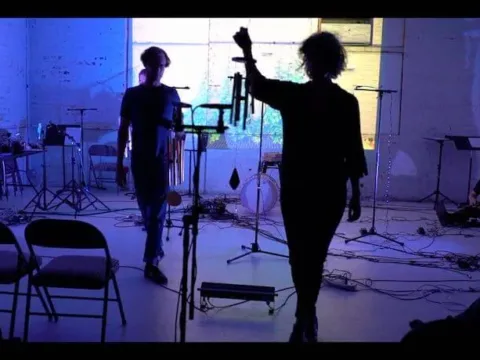
Standing alone as Act Two, “Untitled Art Piece” utilizes a custom-built MIDI controller to harness the process of creating complex, fixed geometries drawn using geared mechanisms (80s kids will vividly recall hours of tracing wandering circles with a Spirograph). In live performances of the work, Diels can be seen turning a cog that activates a series of wheels and levers to which an array of twinkling and buzzing electronics responds in sound.
Clicks like droplets of water echo in the distance as layers of tones begin to overlap and amass like footsteps treading over the same path until they become indistinct and worn into the ground. A few minutes in, a somber, lilting gesture descends like a rapidly melting candle as the layers seem to collapse under their own weight. Spread over nine minutes, the music passes by quickly, opening with distinct elements that become mottled by an immovable process and resulting in a curiously anti-geometric expression of sound.
In Act Three, “The God-Fearing Woodsman, Parts 1 & 2” follows its eponymous hero along a seemingly directionless path. He is encouraged to seek meaning in his journey by hollow points of inspiration generated by an online AI tool called Inspirobot. Diels explains that these fragments of advice “bear no real relevance to the moment, hinting at an omnipresent societal disconnect,” and that the piece is “both a commentary on our tendency to find meaning in repetition, and a search for meaning itself.”
This piece opens with a metronomic gesture enveloped by heavy, industrial textures and deeply resonant tones. The sense of wandering into a dark and thorny woods is immediate. This foreboding quality is abated by the phrase, “the most precious of stones,” which is spoken again and again with identical cadence and tonality and interspersed throughout the nonsensical narrative. Part 2 of “The God-Fearing Woodsman” is only a brief coda that concludes with the phrase, “I do most everything wrong,” sung over a descending scale that is left seemingly unresolved on the weak end of a final cadence.
As a final offering, Diels performs a dreamlike cover of Tom Waits’ 2011 single, Tell Me, which she describes as a song that “explains nothing and holds everything.” Consistent with Diels’ search for meaning, there is a hopefulness in Waits’ lyrics as they consistently ask why, and conclude rather groundedly that there always must be a good reason. With the inclusion of this song, and as the title promises, Diels’ album succeeds in creating a beautiful space in which the unease of not knowing becomes a fulfillingly enlightening journey.
I CARE IF YOU LISTEN is an editorially-independent program of the American Composers Forum, and is made possible thanks to generous donor and institutional support. Opinions expressed are solely those of the author and may not represent the views of ICIYL or ACF.
You can support the work of ICIYL with a tax-deductible gift to ACF. For more on ACF, visit composersforum.org.