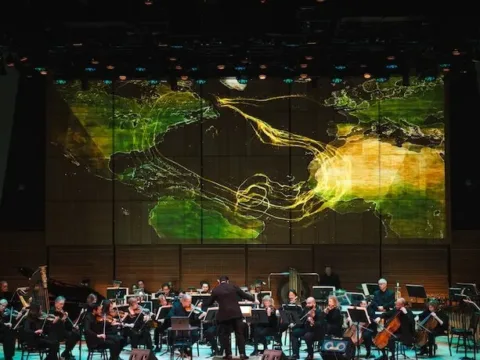
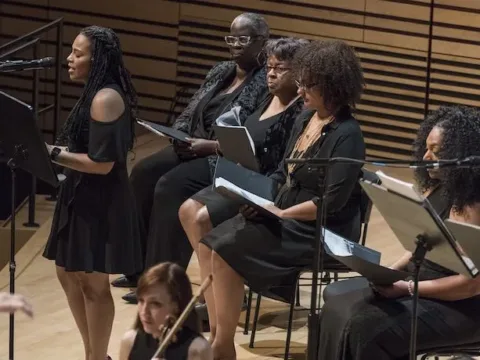
A stalwart in the creation and support of new classical music for the last half century, American Composers Orchestra is firmly in its next era thanks to new leadership and increasingly topical programming. And because the music programmed is often only a few years old, each concert is by nature a potent artistic mirror of current events, a grand display of multiple composers’ psyches exploring that alchemical magic between painful human experience and the balms we create from them.
The New Virtuoso: For Art’s Sake was the title of ACO’s Oct.29 concert at Carnegie Hall, and each work featured a technically fascinating, incredibly intricate sonic message. Aaron Israel Levin told the audience that Lear in the storm was an exploration of “the absurdity of power and how that impacts the mind.” Rich in orchestration and manic in its visceral extremes, the work was an intriguing take on a storied experience of madness.
Dovetailed mute-bearing brass were punctuated by an ever-evolving organism of percussion hits. A sustained drone in the low strings signified a soft, sweet, comforting nadir of the work. Electronic organ, lugubrious and mellow, was accented by first string stand outbursts. The groovy ending came complete with police whistle, big cross rhythms, and an ending so abrupt it felt like crashing into a brick wall. Mélisse Brunet’s graceful, adroit conducting shone in an extended long flurry of woodwinds circling down like falling leaves; she was malleating the sound in midair, bringing the leaf fall to the ground with a magician’s finesse, and weaving energy in four dimensions.
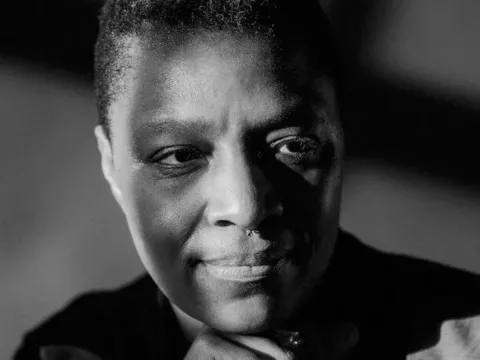
Mazz Swift lights up all rooms they enter, and Memory FIVE: Freedom Initiate for Conductrix and Orchestra lovingly illuminated the room with sound AND sight. Swift introduced the work, written in memory of culture critic and musician Greg Tate, as “training wheels for non-improvising orchestra to learn how to improvise together.” Their graphic score was projected onto the back wall during the performance: it was hand drawn and divided like a Cartesian coordinate system, with simple geometric shapes on the end of each axis. Standing on the podium, Swift held up cards with these shapes for the orchestra, plying textures together and apart.
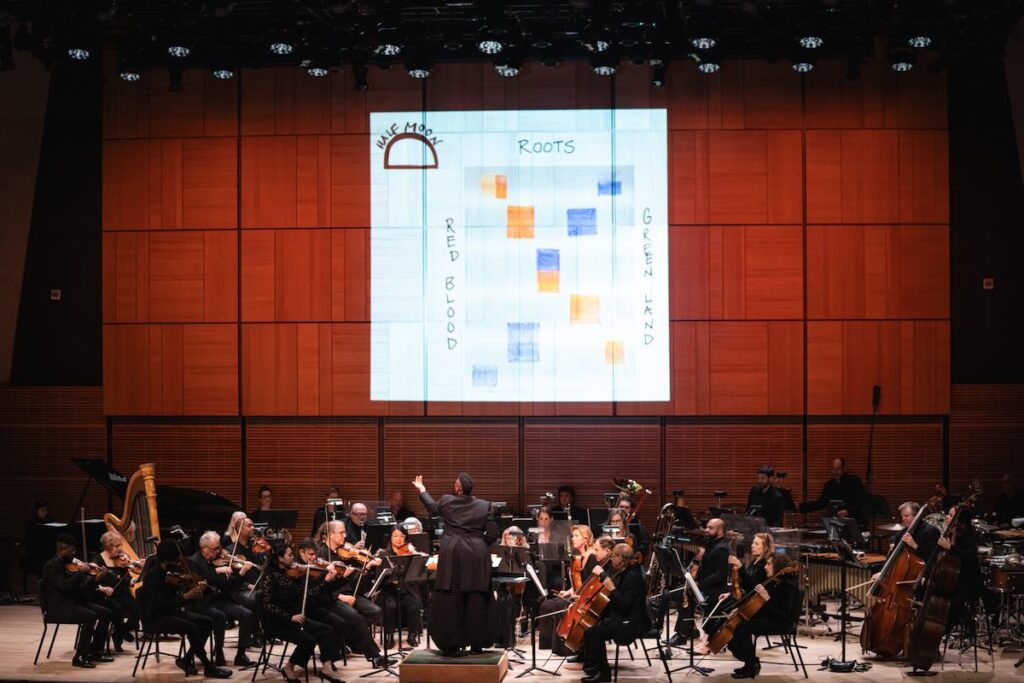
The music began with whimsical piano twinkles from Erika Dohi, playful timpani glissando from Jonathan Haas, and lovely, lonesome melody fragments emerging from the tuba. Particularly intriguing moments included striking pairings like bombastic pedal tones in the low brass underneath a trembling gossamer in strings that sounded like a balloon losing its air. An impassioned concertmaster solo by Christina Bouey set off an emotional ending to this in memoriam work: engulfed in a translucent cloud of violins, we were reminded that the existence of chaos ultimately points to the existence of harmony and order.
Raven Chacon’s music prompts self-examination, using pitches or textures as their own motivic microbe and keeping our minds in conscious thought as we listen and connect. Inscription, his first work for orchestra, began with a long sentence of klangfarbenmelodie in bass clarinet and low brass, slowly meandering its way around until it reached low flute. The pulse gradually quickened, summoning other hovering clouds of being-ness from the ensemble. The work featured Chacon’s research in extended techniques, creating subtle divisions of color in the bleak swaths of sonic landscape: cello/bass bowing from underneath the strings, harps scraping strings with credit cards, long drones creating binaural beating, and slow, sheer, multi-octave glossing in the strings.
Elijah Daniel Smith’s The Fall of Ideals, written as a “fanfare for a clown,” was a direct translation of the last several decades of political leadership, embodying a “superficial civility and…a feigned reverence for the Founding Fathers and the Constitution.” The work felt almost like a Bill and Ted’s excellent adventure for politically-conscious classical music audiences. With 20 different quotes from Haydn, Mozart, and Beethoven, the work is mainly built around the structure of arias from Handel’s Rodelinda, and maintains a constant cycle of “quoting then destroying,” as Smith explained. It was alternate-reality baroque, disembodied passacaglia, time stretched and rented, and Ivesian brake-drum enhanced brass band, with remnants of the original repertoire briefly peaking in through the swarms of sounds.
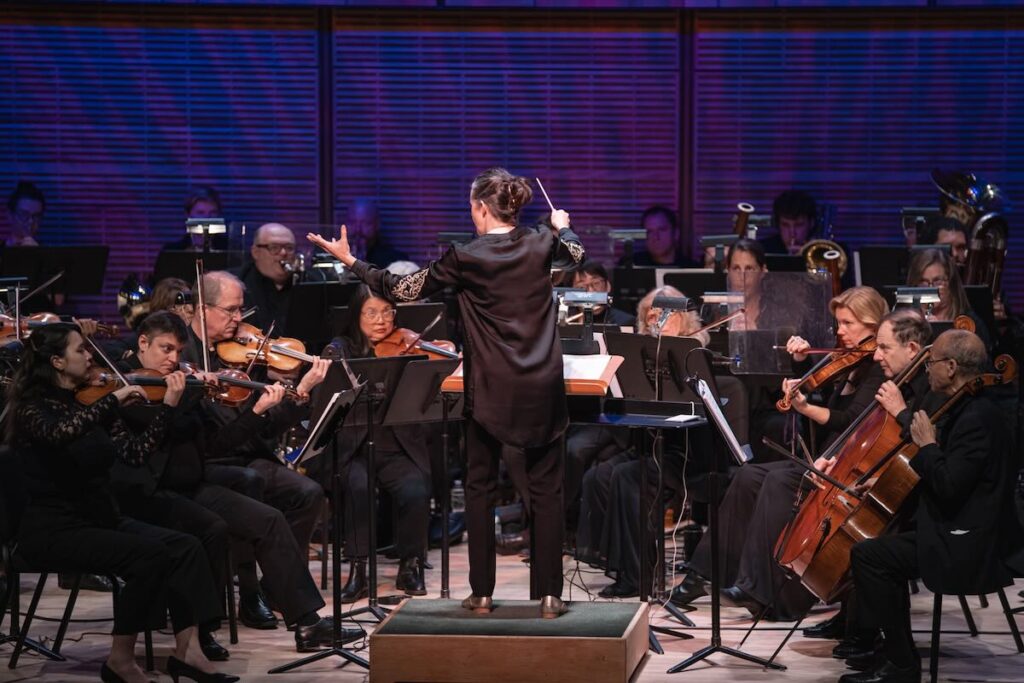
With direction and text by Daniel Kramer, Tamar Muskal’s Square Off featured a different kind of soloist: a kinetic sculpture wall by Daniel Rozin. A striking example of elegance in simplicity, it consisted of many lines of wooden tiles that could tilt back and forth, making sound and creating images through the tiles’ many possible shades of shadow. Soprano Lucy Fitz Gibbon starred as our nameless heroine confronting an aging body, dramatically looking into the sculpture wall as if it were a mirror and furiously naming the aspects of her reflection she was unhappy with like her “titanium hips and fogged memories” and “fatass lips and nicotine lines.”
The orchestra wonderfully assisted in this, helping create alternating golden and darkened moments of controlled and uncontrolled introspection. At first the wall merely reflected Lucy’s figure, then stunned as it recreated her pre-recorded face within its tiles. It began singing back to her, saying cruel things as the space between loving and loathing was explored. Fitz Gibbon was haunting in this performance, and Muskal’s clever use of Kramer’s sculpture as both duet partner and percussion instrument was delightful.
With constant and ever-fluctuating turmoil both out in the world and deep within ourselves, artists make true magic, using the filter of their unique creative language to turn darkness into light over and over again. American Composers Orchestra has helped so much light leak into the darkest parts of recent history, and together with the capable and attuned ensemble, Brunet brought each piece to a beautifully full expression of its parts, making for an evening that will spark thought and reaction long after its vibrations have left the hall.
I CARE IF YOU LISTEN is an editorially-independent program of the American Composers Forum, and is made possible thanks to generous donor and institutional support. Opinions expressed are solely those of the author and may not represent the views of ICIYL or ACF.
You can support the work of ICIYL with a tax-deductible gift to ACF. For more on ACF, visit composersforum.org.