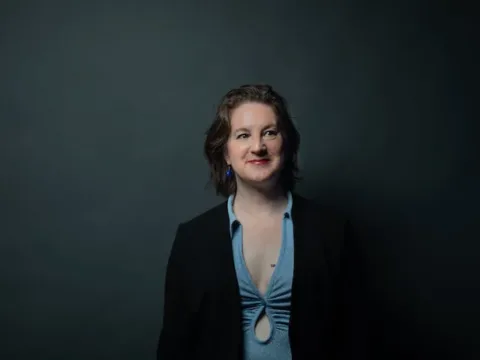
An omnipresent dialogue between Lisa Bielawa the composer and Lisa Bielawa the singer was on enticing display during her Composer Portrait at Miller Theatre on Feb. 26. Bielawa exudes a bright, eclectic genius both on and off the stage, and the three pieces on the program — works completed over the last 16 years — provided a pithy subset of her output. The evening also invited the audience to keenly peer into her values as an artist: both in what she decides to put into her music and what she wants audiences to experience — because in her world, these are not the same thing.
In Incessabili Voce for soprano and chamber ensemble (2013), Bielawa created a sacred space, cantillating lines from “Te Deum Laudamus” before Josh Henderson gently joined; his offstage violin playing was so ethereal that at first, it seemed like Bielawa was surrounded by a soft haze of electronics. The work built up almost subliminally; since Bielawa’s stage presence is so commanding, the members of Contemporaneous who had gradually taken their seats seemed to spontaneously appear.
The work stretched, expanded, and incorporated texts from Xenophon’s Anabasis and Heinrich Heine’s The North Sea, which were embodied with engagingly realistic physicality by Bielawa. And the work became an epic itself, voice and the ensemble acrobatically vaulting from emotion to emotion. Bielawa screamed “eeee!”, having fun as the instruments echoed her and creating a bright peanut gallery brigade. Next, she slipped into singing in overtones, then sang into the piano to summon even more overtones.
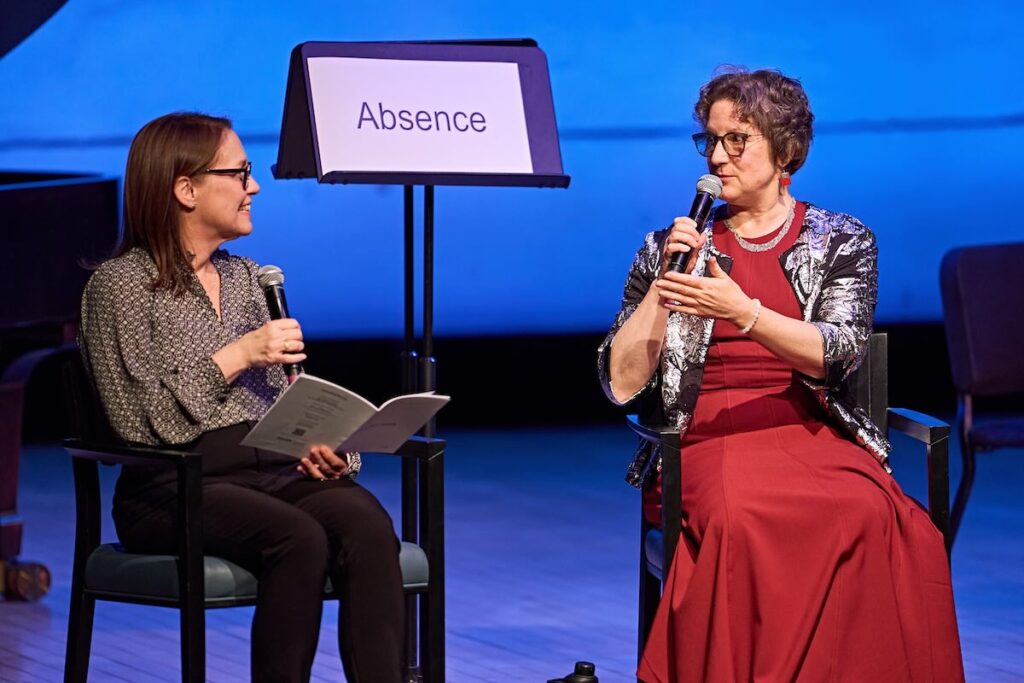
During the intermission talk-back, Bielawa discussed how her voice has matured and morphed since she originally wrote this piece, giving her an exciting and new experience as a performer. “Menopause is changing me in ways that make me more interesting to myself”, she said with fervor. As the work’s flow came to a final ebb, there was a magical, fleeting space of bass clarinet (Gleb Kanasevich), saxophone (Daniel Kochersberger) and voice chasing each other around in lovely glimmers of glissandi.
You know a piece is going to be exciting when one of the violinists gets ready by slinging an electric guitar over their shoulder and ensures that a power drill is safely under their chair for easy access. Balloon Variations (2026), a Miller Theatre Commission and world premiere, was a high-voltage tableau of folk absurdism. The work’s nine movements are a soundworld study for an opera Bielawa is writing with librettist Claire Solomon about the first woman to fly in a balloon: Her name was Elisabeth Tible, she was an opera singer in Lyon, France, and the year was 1784, the temporal night before the French Revolution. “That’s an opera!” Bielawa said during the intermission talkback.
The work was a timbral delight, with sudden bursts of strumming guitars, pointillistic, melancholy singing of “ballooo–”, and the satisfying tonal merge of violin tremolo with a powerdrill’s “zhhhh.” Beneath the raucous levity, Bielawa’s writing balanced its subject’s undertones: nimbly hopping between a triumphant strutting and a dark foreboding. She beautifully invited the audience deeper into the experience as we were all asked to sing “balloo–” along with the ensemble, creating a minute of time that felt incredibly buoyant. Fittingly, the work closed with an understated glissando up into the stratosphere, ending in the high twinklings of toy piano, delicately played by Paul Kerekes.
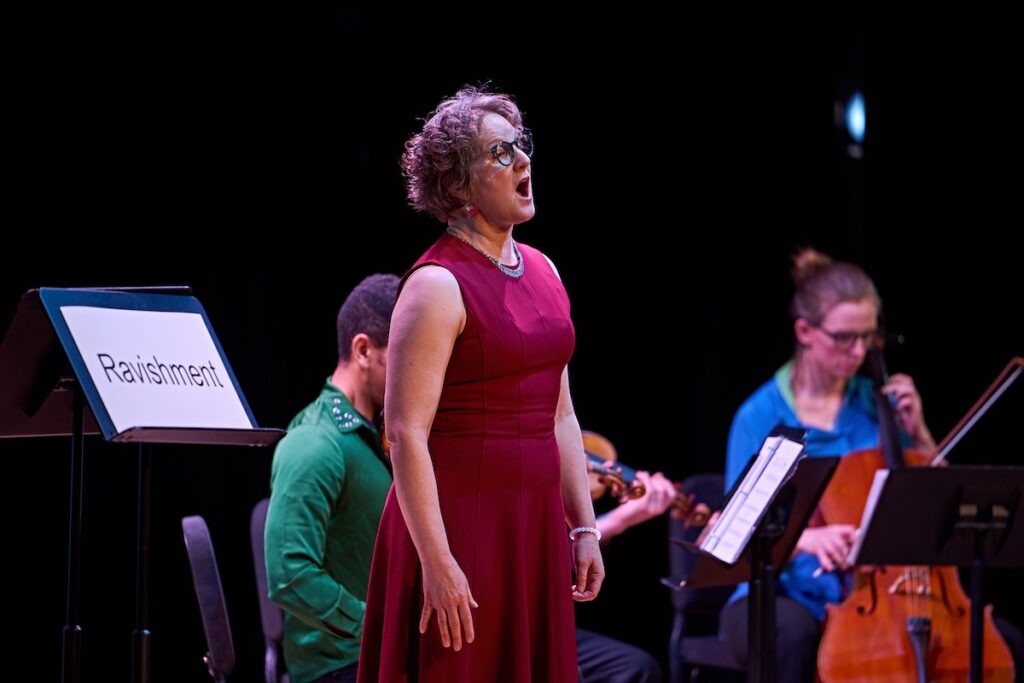
Graffiti dell’amante (“graffiti of the lover”) was written for Brooklyn Rider and composed during Bielawa’s year at the American Academy in Rome in 2010. Written for soprano and string quartet in six movements, this work is an early example of how Bielawa synergistically breaks the fourth wall, accomplished here by involving the audience in deciding the order of movements in a choose-your-own-adventure of melodic proportions. The five minutes of laughter and group-building as we chose movement order was a clever emotional cantilever to help us feel instantly more connected while embracing those six powerful meditations on the human experience.
Featuring text from Peter Campion’s “Letter from Ohio,” “Desire” opened the work in a flurry of affable exuberance. “Absence” involved huge leaps in the voice painted on a lush gardenbed of trills, tenderly executed by the string quartet. With text from W. W. Story’s “Cleopatra” in Graffiti d’Italia, Bielawa gave her acting skills plenty of room: Her “shriek!” was followed by shrieking harmonics in the viola and cello. And as the quartet’s thick trills became fast, narrow undulations of growing anger and agitation, Bielawa looked around furtively and we could feel the physical pain of those emotions.
“Absence” was followed by a moving cello solo played by Meaghan Burke, with long and lonesome lines that began heavy, deep, and gravity-filled but ended feather-light and transparent. A soft viola solo full of harmonics, elegantly played by Chelsea Wimmer, opened into Remembering, the final movement of this performance. Long, tenderly-held dark chords gave a feeling of patina’d grandeur, with silence occasionally breaking through them like light through a spot of fabric worn threadbare.
The evening was a sumptuous feast of sonic textures and human emotions, things a composer can write down before the performance. But it was also an experience in “the vividness of the exchange” between performer and audience, as Bielawa describes it. Accompanied with a telepathic grace by conductor David Bloom and Contemporaneous, Bielawa and her works held up mirrors to humanity. And as our own memories and experiences bubbled up to the surface, we experienced a new facet of ourselves. “I don’t want you to hear my music and go away thinking that you know more about me,” Bielawa said, “I want you to go away feeling like you know more about you.”
I CARE IF YOU LISTEN is an editorially-independent program of the American Composers Forum, and is made possible thanks to generous donor and institutional support. You can support the work of ICIYL with a tax-deductible gift to ACF. For more on ACF, visit composersforum.org.