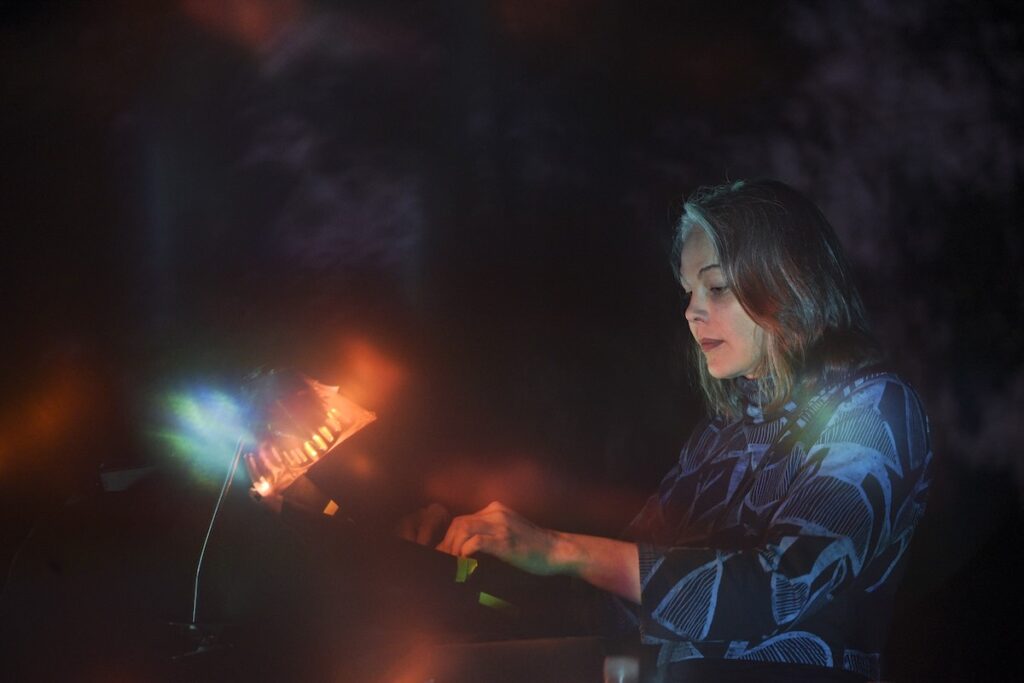
Olivia Block is pictured on her website before a glistening Steinway piano, illuminated from behind on a moody, darkened stage swirling with fog, her attention turned to a cart with an array of small, solid-state electronics. She wears a meditative expression on her face that harmonizes with the introspective nature of her work. In her artist statement, Block remarks, “Performing music acts as a kind of alternative non-political diplomacy, connecting cultures, cultivating peace, and opening up dialogue.”
For nearly 30 years, the Chicago-based media artist and composer has been cultivating a unique expertise in live experimental music and sound design. Ranging from chamber ensemble and orchestral works to electronics, piano, organ, and what she describes as “amplified objects,” her work is experiential, spatially-oriented, and engrossing — at once subtle in its minimal construction and massive in its depth and dimensionality. The intersections she explores between audio artifacts and musical ideation also take on physical forms in sculptural installations that guide visitors through alien landscapes with ever-changing sonic characteristics.
Block has released recordings on a wide array of highly regarded labels such as NNA Tapes, Black Truffle, Another Timbre, and GRM Portraits. She was recently named the third ever recipient of the Alvin Lucier Award for Music, joining an increasingly diverse cohort of prize laureates who have been annually chosen since 2024. Awarded by the Foundation for Contemporary Arts, the nomination and selection are conducted in secret and granted to composers, performers, or sound engineers who have made significant contributions to the field of experimental music.
Congratulations on receiving the Alvin Lucier Award! How might this incredible achievement shape what is yet to come in your practice?
Thank you so much! The award came at the perfect time. For the past few years, I had been doubting whether or not I should continue as a full-time artist. It feels like such a tenuous time in the arts right now. It’s so difficult to get any kind of support, and I never know from year to year how much work I will have moving into the future. Additionally I just felt like I wasn’t having the impact I had always hoped for. I have always been kind of under the radar because I haven’t been very active on social media even though I have been consistently producing music over time. So, in addition to the financial support, the Foundation for Contemporary Arts award made me feel validated, as if all of the work I have done so far really has made an impact. So in response to your question, the first thing that comes to mind is simply that I will continue on this path making music and art.
It affirms the life that I have chosen and my commitment to this practice. The financial support gives me some breathing room to work in my studio and do some research going forward. Right now I am trying to finish a group of experimental songs, a commission for pipe organ, and a commission for a trombone trio and some collaborations as well. There are also more skills I would like to acquire. I am trying to learn carpentry (I am terrible at it but still trying!) and would like to take welding courses. I am very interested in continuing to expand my practice with physical materials. I am so grateful that I have been given some extra support to think about these projects. It feels really good. I have no idea who nominated me for that award but I wish I could say thank you to that person.
So much of your work uses sound to express a sense of motion through limitless space. Do you attempt to recreate your own personal experiences with sound for your audience?
In many cases, I do. Sometimes I experience an impression of sound in a moment or in a certain location. I recently recorded the sounds of an elk herd during the rut season. The bucks were making an otherworldly bugling sound in the distance. That otherworldiness is the type of impression I often try to translate into a composition. My approach can be literal by using field recordings of the actual events or spaces I experience, or I might attempt to create a similar impression through different sonic experiences. I often think of my multichannel work as groups of sounds moving through space like weather patterns. I love the sound of wind and notice it everywhere. I am interested in the way wind moves other objects and activates materials, giving me a sense of location.
Sometimes I feel like I am recreating the experience of wind or water moving around the audience in concerts. In the live mixing process, I am focusing more on spatial aspects rather than narrative ones, which might be associated with more conventional musical structures. The sonic textures move through the space and unfold in time due to their trajectories from speaker to speaker through the air. Right now I am thinking of what a thunderstorm sounds like. The distance of the thunder gives my ears a sense of huge objects colliding far away, then rushing toward me. I love creating moments like that in multichannel concerts. The foreground and background placements of sound are extremely important. I always consider the scale I am working in and how I might create a different sense of location within the concert hall or venue.
I’m compelled by the way you adjust or alter your compositions for different performance spaces. When a particular work travels, what kinds of musical or sonic considerations do you make to accommodate its presentation in a new venue?
The medium of sound, perhaps more than any other, is dependent upon the architecture and space it travels through. Given the fact that I am often focusing on the timbral aspects of music, adjusting the EQ differently for each space can make a huge difference in the listener’s experience. I like to make the room sing. I feel as if I am cultivating a relationship with the space as I am with the audience. All of the materials that make up a building, the configuration of speakers, and the size of the walls – all of these aspects come into play when I am sound-checking and adjusting the volume and frequency profile during soundcheck. Sometimes I am soundchecking in a space and the pacing of the composition sounds totally wrong for some reason. It’s funny. In those cases I might even adjust the length of the piece.
Your work draws connections between geographical locations and physical materials (e.g., recordings gathered from a natural limestone cave and played back in an urban corridor constructed from the same limestone in Indiana Karst, 2019). Is there an inherent ecological message underlying these connections, or is some other fascination at work here?
I am often drawn to the material aspects of art, including sound art. When I consider materials in a general sense, I often think about geology and deep time. If I consider walls that make acoustic echos, for instance, I am also considering the stone that constitutes those walls. How were those materials formed over time, and where were they sourced? These considerations are most relevant in my installation work. I love having some reference to physical materials related to a theme or the history of a location.
Sometimes I place speakers inside materials like stone or wood. I have placed speakers inside oyster habitats and positioned them on the floor. When I plan sound installations I always research the history of the location of the exhibition space, particularly if the work is site-specific. The history might be geological or it might be socio-political or both. I wouldn’t necessarily say there is a message in these repeated themes; rather, the work reflects my own sense of curiosity and a wish to connect to different scales of time or pieces of history. The research process is so much fun. It’s my favorite part of making an installation.
Is there a creative distinction between projects that use audio artifacts and field recordings and work that is inherently musical in nature? Does either approach feel any more or less like “music?”
Definitely. I like to think of my work as a continuum, with “sound art” on one end and “music” on the other. My work usually falls somewhere in between those two points and blends creative approaches. Recently, I have been writing songs for piano and voice. The lyrical themes are related to The Great Oxidation Event on Earth around 2.5 billion years ago. The compositional process is more musical in the initial stages, when I focus on melody and harmony in the song fragments. After that, I move outward into the more purely sonic aspects of the piece, representing the apocalyptic sounds of volcanic eruptions.
I think of the more “musical” approach as an engagement with human social history. While I sit at the piano and write, I am aware (often unconsciously) of songs throughout the ages, in so many different cultures, expressing so many emotions. That sense of history affects the compositional choices I make, whether I am engaging in a musical tradition or ignoring it. I am also working with sounds as objects in space, exploring their timbral and textural qualities. Often, the “song” part will shift into a “sound art” section and back. So my creative approaches shift during the formation of the music.
I CARE IF YOU LISTEN is an editorially-independent program of the American Composers Forum, and is made possible thanks to generous donor and institutional support. You can support the work of ICIYL with a tax-deductible gift to ACF. For more on ACF, visit composersforum.org.