Few children dream of being a pop star and actually achieve that goal — but that is what happened for Mai Khôi. The singer-turned-activist studied music with her father, joined his wedding band at age 12, and went on to win the Vietnam Television Award for song and album of the year in 2010. The celebrity life was sweet at first, but Khôi’s mainstream success came at a spiritual price. Under Vietnam’s censorship system, she had to submit her songs to the Ministry of Culture for approval and allow authorities to monitor her lyrics, movements, and attire. During one rehearsal, a government censor humiliated Khôi and threatened to ban her from singing in public forever if she didn’t comply with his demands.
Unwilling to accept restrictions on her artistic freedom, Khôi began speaking out — not only against censorship, but on other political causes that she was increasingly awakening to. The government responded with retaliation: her concerts were raided by police, she was placed under constant surveillance, and she was evicted from two homes. Vietnamese state media dubbed her the “Lady Gaga of Vietnam” as an insult, portraying her as indecent and at odds with the image of a traditional Vietnamese woman.
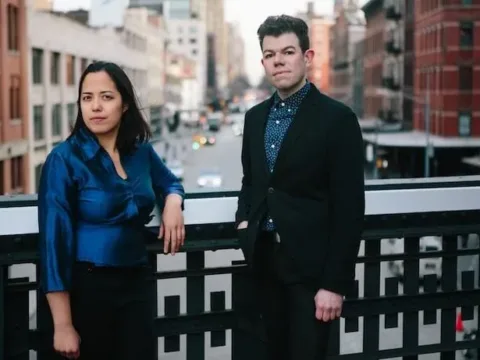
Facing escalating harassment from the Vietnamese government, Khôi fled to the U.S., where she has been living in exile since 2019. In 2021, she joined forces with pianist/composer Mark Micchelli, who became the musical director of her autobiographical stage show Bad Activist and helped revive the underground band that she had formed — and been forced to disband — during her final years in Vietnam. The new iteration of Mai Khôi & the Dissidents, now featuring Pittsburgh-based musicians, released their electrifying debut album Five Years in Exile this April, and it couldn’t sound more different from Khôi’s early pop work. Co-written by Khôi and Micchelli, the songs blend experimental jazz with elements of noise, punk, and art pop, showcasing Khôi’s powerful spectrum of vocals to enthralling results.
Your recent work feels much more experimental than the pop music you made at the height of your fame. How does working outside of traditional pop conventions change the way you communicate your ideas through music?
I was born and raised in a very conservative country with a very strict censorship system. I didn’t know anything about experimental music until 2016, when I started collaborating with composer Ngọc Đại and producer Nguyễn Nhất Lý to make songs about the political situation in Vietnam. At the time, I had just unsuccessfully run for Vietnam’s parliament as an independent candidate — a campaign that blacklisted me from Vietnamese public life and eventually forced me to flee to the U.S. out of fear of imprisonment. I realized I had to find a new musical language to express my frustration and rage about Vietnam’s treatment of activists like myself. I had no choice but to scream.
Experimentation also helped me express myself in the songs on Five Years in Exile. For example, the opener, “We Never Know,” is a tribute to a dear friend, Diego Chula, who suddenly died of a heart attack. I began the song with a phlegmy growl to invoke the angel of death who snatched away his soul. Following the line “bao người thân người thương đang khóc than vì anh” (“so many loved ones are crying out for you”), I overlaid 20 separate recordings of myself screaming to capture the sound of every human and animal in the world wailing in pain. All my new songs have moments like this — moments I could never have created back when I was a pop star. I’m very bored with pop music now. It doesn’t satisfy me any longer.
Your vocals on Five Years in Exile are extraordinary—full of fury, intensity, vulnerability, and absurdity. How did you train your voice to do some of the more experimental techniques we hear like death growls, screaming, throat-singing, super-fast gibberish, and singing while inhaling?
Soon after I arrived in my adopted hometown of Pittsburgh in late 2020, I took an improvisation class with composer and flutist Nicole Mitchell. She gave the students an assignment to make a “sound catalogue:” short descriptions of every noise we could ever possibly use in our improvisations. While I’ve since discovered wonderfully inventive singers like Diamanda Galas and Roomful of Teeth, I invented my first sound catalogue on my own. I sang nonstop around the house to uncover new techniques — in the shower, cooking food, laying in bed. I was very happy when the musicians in my band encouraged me to get weirder and weirder!
The topics of my songs also inspire me to develop new techniques. In “I Hear the River Calling,” I wanted to mimic the sound of an ever-flowing, shimmering, ethereal stream. So instead of breathing between phrases, I connected them using inhale singing, and then double-tracked it with a soft whisper. In “The Overwhelming Feeling We’re Already Dead,” I wanted to express the sound of total world annihilation — not a single person, animal, or plant left alive. The tortured sound that opens the song can sometimes be physically painful; when we perform it live, I have to take a short break afterwards to recover.
There is no gibberish on the album! Every sound that I make and every word that I sing has a meaning.
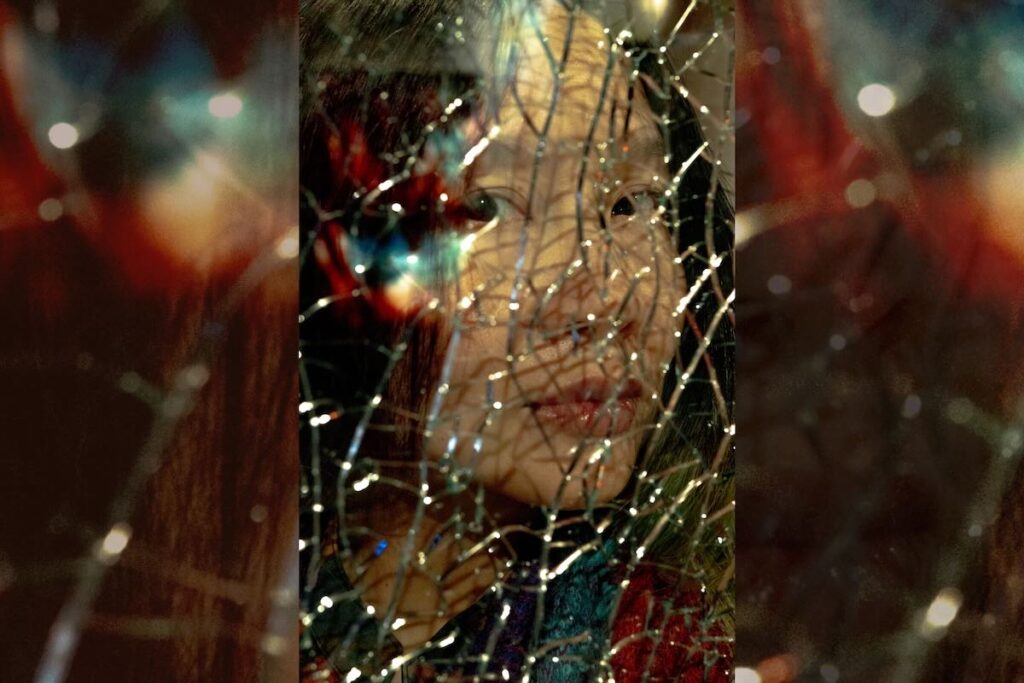
The music on this album manages to sound both spontaneous and very intentionally-crafted, especially the way that the vocals and instruments interact. How did you and Mark Micchelli conceive of and fine-tune these arrangements?
Mark and I started working together in 2020, when I hired him to be music director for my autobiographical theatrical performance “Bad Activist.” Mark was not a normal accompanist: I needed someone who could fight against me when I sang about censorship, not try to support me like a typical pianist. He is such a creative and inspiring collaborator, and over the years, he’s learned everything about my voice, my identity, and my deepest thoughts (we got married last year!).
When we write our songs, Mark usually comes up with musical ideas first, and then we work together to decide on a lyrical topic and vocal style. Sometimes I have to change Mark’s melodies because of what I want to say in Vietnamese: as a tonal language, different intervals can convey different meanings even if the sound of the words is otherwise identical.
Once we have the topic and the melody, Mark finishes the arrangement and presents it to the band. While the arrangements can be tightly prescribed, he always leaves room for improvisation and dialogue between me and my bandmates. Some of my favorite moments on this album are almost entirely improvised, like in “BURN” when I fixate on the line “không ai tin rằng tất cả chúng ta sẽ bị thiêu đốt cho đến chết” (“no one believes we will all be burned to death”), or the piano solo in “Dreamland,” when even the time signature is improvised moment to moment. The band contributes to our arrangements, too: even now, we make little adjustments to the songs even though they’ve already been recorded and released.
What has it been like to perform this album live, especially since you now have the freedom to perform without censorship?
It has been a very joyful tour. Our music can be hard to categorize, so we’ve performed everywhere from fancy jazz clubs and new music venues to punk-y dives and bars. I love spending time with everyone in my band — Mark on keys, Jeff Siegfried on sax, Eli Namay on bass, and PJ Roduta on drums — and we’ve found lots of ways to play around with the arrangements and find new inspiration in this music.
And while it’s true that I still perform without censorship, immigrants like myself are finding it less and less safe to speak our minds. Five years ago, I would say that I felt free here. Today, I’m horrified at how quickly America has started to resemble the authoritarian dictatorship I thought I left behind.
What issues are you currently trying to raise more awareness for?
Too many. The genocide in Gaza. The never-ending flood of fascist propaganda. Armed thugs kidnapping immigrants, throwing them in detention camps, and separating children from their families. The destruction of our planet throughout it all.
One issue that’s very personal to me is the plight of Lê Văn Mạnh, Nguyễn Văn Chưởng, and Hồ Duy Hải: three Vietnamese men on death row (Vietnam executes more of its citizens than almost any other country). While in prison, they crafted miniature deer figurines out of plastic bags, containing the letters O + A + N (“oan” is Vietnamese for “innocent”). Despite advocacy from international human rights organizations, Lê Văn Mạnh was executed in 2023, and Nguyễn Văn Chưởng and Hồ Duy Hải remain in danger.
I wrote a song about these prisoners called “Innocent Deer,” and fellow activist and artist Thịnh Nguyễn put together a heart-wrenching music video featuring their families. Early in April, I posted link to Thịnh’s video on Facebook, and it got 1.7 million views, which brought out the professional troll farms. I was accused of “lệch lạc tư tưởng” (“ideological deviation”) and being a Californian anti-communist agent; Facebook comments tagged Hanoi’s police department and the head of Vietnam’s anti-terrorism department. This sort of trolling doesn’t bother me — I dealt with it all the time back in Vietnam — but it perfectly encapsulates the way the Vietnamese government silences dissent and confuses its citizens into inaction.
I have joined calls for Vietnam’s new president to pardon Nguyễn Văn Chưởng and Hồ Duy Hải. I also continue to advocate for the 200 political prisoners held in Vietnam today, many of whom are my friends and collaborators. I also want to spread awareness about organizations like the 88 Project that are working tirelessly to fight against human rights abuses in Vietnam. Americans know so little about Vietnam, which remains a one-party state that doesn’t allow any opposition or freedom of expression. So while I continue to get involved in activism in my new country, I will never stop thinking about my old one. I still hold out a little hope that one day I might be able to return safely and freely.
I CARE IF YOU LISTEN is an editorially-independent program of the American Composers Forum, and is made possible thanks to generous donor and institutional support. You can support the work of ICIYL with a tax-deductible gift to ACF. For more on ACF, visit composersforum.org.