It’s end-of-term showtime at the London conservatoires, and recently I’ve seen some exciting new short operas by young composers. In June, I went to the Guildhall’s Opera Makers showcase, where the standout work was Elara Catching Sky by Yotham Ben Yami and Ariella Stoian, an immensely touching piece about an astronomer’s young daughter making friends with an extraterrestrial being. Ben Yami’s spectral-infused language created a bridge between the earthly and alien characters, all of whom were sharply drawn and emotionally real.
On 3 July, the RCM collaborated with adventurous opera company Tête-à-Tête, a biennial event that is a valuable opportunity for composers to work in a theatrical environment. This year’s theme was ‘Fantasy and Fairytales’: five short operas were directed by Bill Bankes-Jones, conducted by Michael Rosewell and the spectacular sets and costumes designed by Sarah Jane Booth. The college’s Britten Theatre, a miniature traditional-style opera house, is perfect for emerging singers. Let’s say immediately how lucky all the students were to work with such skilled and imaginative collaborators, and there wasn’t a weak link in the student singers and instrumentalists.
All the operas aimed to appeal to a wide audience, including children; some drew on fairytales and others created stories with a distinctly contemporary edge. Deniz Dortok’s The Boy Who Went to Find Fear opened the show. It started with two elaborately costumed female narrators asking the audience what their fears are: thank you to the person who said ‘Audience participation.’ A young boy went on an allegorical journey to confront and overcome fear; he emerged as a hero but discovered he is actually afraid of the responsibility that goes with a heroic role. The score was eclectic – Stravinsky/Britten/musical theatre/electronics – and made effective use of surround sound to evoke dread, though there was rather too much narration, giving the music little opportunity to tell the story creatively.
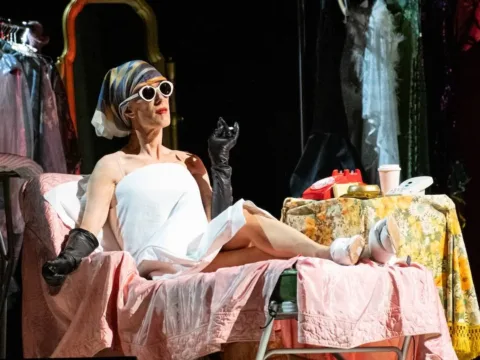
An audience favourite was Asher Joyce’s Three Lives, a tale of a moody teenager, Iphigenia, retreating into video games to escape her mother who is obsessed with a new partner. The broadly drawn characters were matched with cartoonish, wind-and-brass dominated music and splendidly imaginative costumes for the teenager’s game characters. When Iphigenia lost her final life in the game, she was sucked into a huge mouth-like machine with a sparkly purple curtain, filled with pink plush cushions and the bass-baritone Alex Hardy. Ruvin Meda was the youngest of the composers on the programme at only 19, and he chose to set Oscar Wilde’s story The Nightingale and the Rose in a version by Luz Wollocombe. His highly accomplished score was pastiche romanticism that showed some dramatic flair: I look forward to him developing an individual voice.
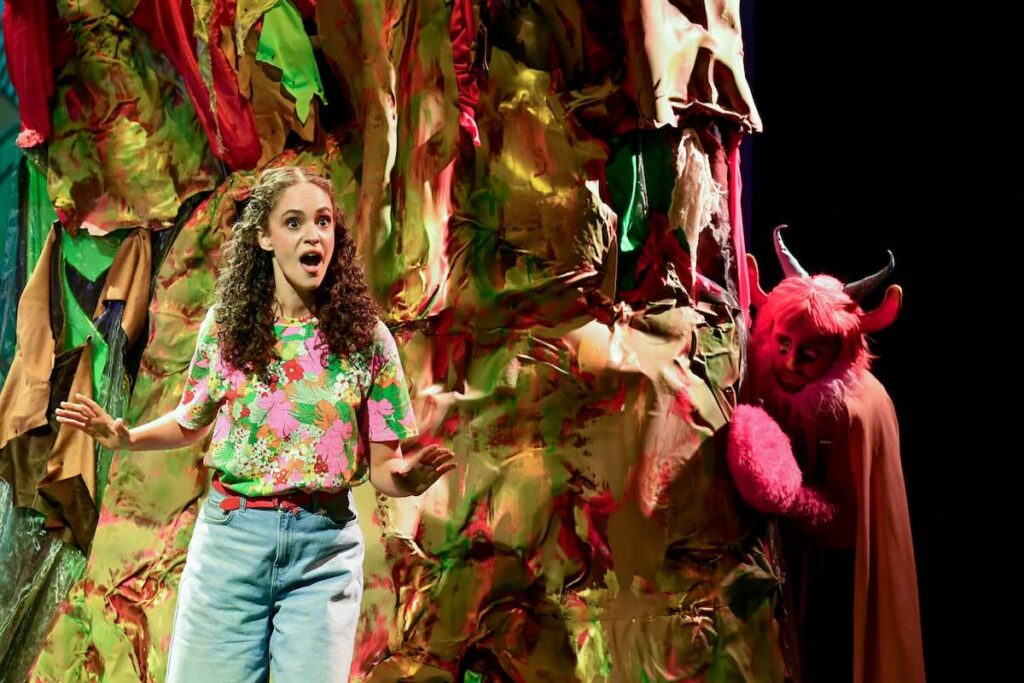
Daniel Musashi’s Ogga Loggas, with a libretto by Jacques Allen, was a fluent and engaging work featuring two siblings (soprano Eden Shifroni and mezzo Anastasia Koorn, both excellent) playing in a forest who encounter three Ogga Loggas, who tempt the children to defile nature. Koorn’s character Sean is easily led by the multicoloured glam-rock-meets-cartoon creatures (where’s the soft toy line?) who make horns and tails sprout from his body. Shifroni’s character Polly, on the other hand, cleans up rubbish and ultimately banishes the Ogga Loggas, who disappear accompanied by what sounds like a broken-down music box echoing nursery rhymes. Good to hear an environment-themed work that was witty and fun rather than preachy.
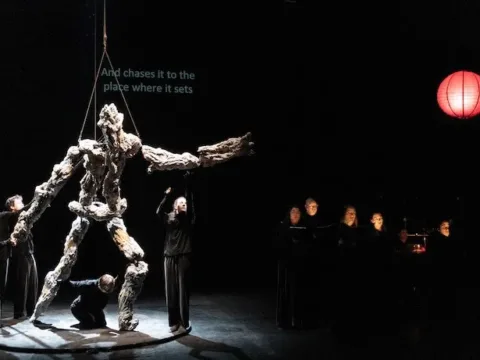
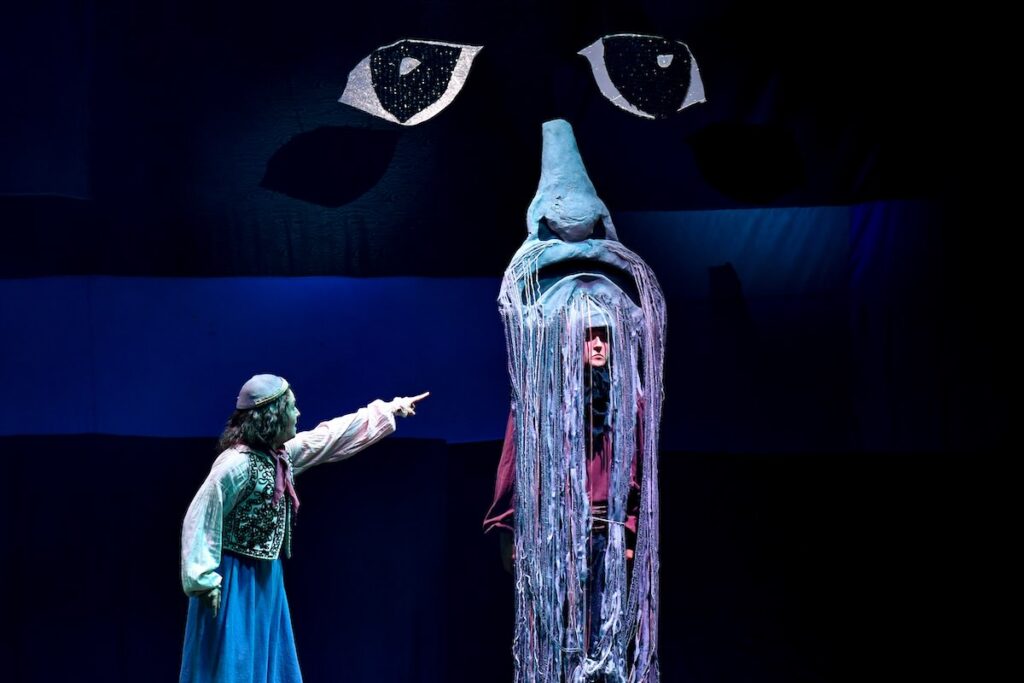
The Georgian composer Lasha Kharkhelauri turned to his country’s folk heritage with a story, Ramona, by Sandro Tsikoridze, set in a puppet theatre. Underpinned by a shifting chromatic score reminiscent of Saariaho, the work contrasted two pairs: an irritated theatre director and a puppet master desperate to return from exile to see his sick wife; and two puppet locomotives in love, Ermon and Ramona. Skilfully portraying undercurrents of erotic tension and stylised evocative sounds of train whistles, Kharkhelauri’s score was the strongest of the night.
This was a long evening: there were lengthy scene changes between each opera, and it would have been good to engage the audience during these breaks, perhaps through discussions with the creative teams. But the overriding impression was of a huge amount of talent in the room. Some standout performers were the sopranos Bella Marslen and Charlotte Jane Kennedy (surely destined for stellar careers), tenors Tom Law and Taining Zhao (both outstanding in comic and more serious roles), the bass-baritone Alex Hardy, and the bass David Fraser, already an excellent character singer/actor.
In the UK, the value of opera is currently contested and public funding has been sharply reduced. But the indefatigable Tête-à-Tête and the marvellous RCM students show that opera is alive, kicking and able to appeal to a broad contemporary audience. In the hands of these creative artists, I feel confident that the genre will find a way to survive and indeed thrive.
I CARE IF YOU LISTEN is an editorially-independent program of the American Composers Forum, and is made possible thanks to generous donor and institutional support. You can support the work of ICIYL with a tax-deductible gift to ACF. For more on ACF, visit composersforum.org.