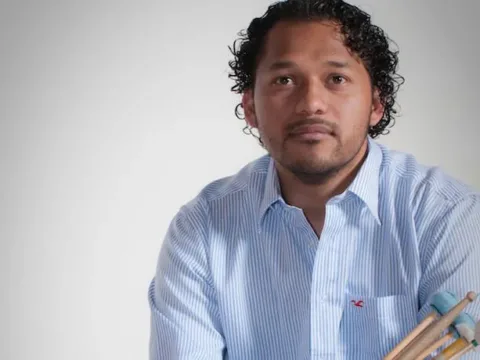
José Martínez has charted numerous routes through tradition and storytelling by leaning into abstraction, technology, and interdisciplinary performance. Bridging Colombian and Afro-Latin traditions with electronic and experimental music, his work takes many forms to craft sound worlds from personal and intercultural experiences.
As a performer, Martínez’s deep knowledge of Latin percussion traditions propels grooves in salsa bands like Hecho A Mano and is woven into polystylistic interactive electronic pieces like Elastic Skin (2018). As a composer, his solo and electronic works often find a self-reflective tenor through language and form. His “Monologue” series for percussion meditates on experiences of bilingualism and interculturalism, and improvised live electronic pieces like Self-Portrait (2019) create a framework for performers to improvise with self-selected sound samples.
Martínez’s multi-faceted work takes full form in interdisciplinary collaborations that range from intimate to expansive. Close family ties flourish in Atavism(o), where his playful experimentation with Colombian traditional music is brought home through dance by his niece, Laura Moreno, and abstracted through video work by his sister Sara Martínez. In theatrical multimedia collaborations, Martínez similarly weaves voice recordings, rich electronics, videos, and dance to tell poignant stories, including community-engaged reinterpretations of Colombian folklore (Orika and the Hippos) and contemporary stories of undocumented immigration (39 Inside).
In his first portrait album, Short Stories (New Focus Recordings, 2026), Martínez curates recent work where tradition and technology are synthesized through storytelling. Martínez’s seamless integration of percussion and saxophone timbres with live electronics on Monologue V and Do I Regret? provocatively extends earlier experiments with reflexive narrative forms and interactive sound worlds. Boundaries between disciplines and cultural traditions are elided in the cinematic textures of Sinsentido del Absurdo and playfully reimagined in Calescencia.
We caught up with José Martínez to talk about his recent album and to reflect on his wide-ranging musical practice.
In the liner notes for Short Stories, you state, “As much as a composer, I am a storyteller.” Could you talk a bit about how literary influences, your collaborators, and others shape this orientation to music, language, and poetry?
When curating the pieces for Short Stories, a striking common denominator emerged as almost every work was tethered to a narrative. What began as an organic discovery soon became the album’s defining framework. Each piece approaches the narrative through different lenses, sometimes through explicit text, sometimes through musical form, and other times with the use of an interactive performance systems. With this thread in mind, I chose a title to honor the cuento corto (short story), one of my favorite literary genres, in which Latin American writers were highly prolific.
In Do I Regret?, the narrative emerges from confronting the past. The performer engages in brief improvisations and thanks to the piece’s performance system, these fleeting short stories are captured and transformed into the ever-present background of the rest of narrative. It becomes a story within a story. Instructions for Playing draws directly from the whimsical prose of Julio Cortázar’s Manual de Instrucciones. The music attempts to translate Cortázar’s surreal, mundane directives, of instructions on how to cry, how to sing, how to run, into specific sonic reflections of my own.
Monologue V moves into a highly personal space and it was born from conversations with my collaborator, percussionist Jordan Walsh, regarding the emotional baggage we carry internally. For the piece, I wrote a bilingual poem in Spanglish about the common immigrant dilemma, the duality of the “here” and the “there.” The poem is woven stealthily into the music as a sort of timid confession. In the writing of both the bass drum and the electronics, I mirror this too, allowing hidden elements to slowly pierce through dense, noisy textures, as truth that comes through a veil.
Commissioned by L.A. based Hocket duo, Sinsentido del Absurdo responds to the explicit narrative of Man Ray’s surrealist silent film L’Étoile de Mer. My objective was to leverage my personal sonic resources to reframe and enrich the film’s historical, abstract love triangle. It was both challenging and fulfilling inserting my own Latin American identity and my personal taste into a century-old piece of European avant-garde cinema.
Finally, Coalesencia flips the paradigm completely by allowing the music to dictate the text. I collaborated with the poet May Romero Quiñonez, who used my experimental blend of folk traditions and electronics to craft a narrative centered on a modern, secular spiritual trance.
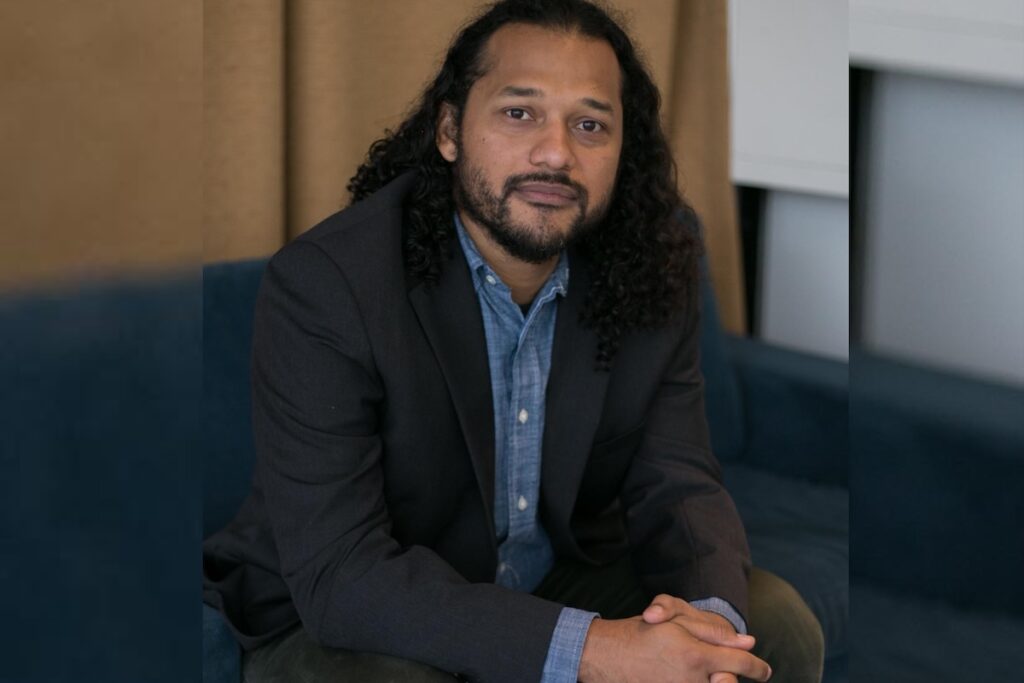
In your technological practice, you have described computers as a “meta-cultural instrument” that creates bridges between tradition and abstraction. How does this idea inform your approach as a composer and developer of interactive electronic music systems (e.g., PPIEL and Garabato)?
This perspective is rooted in my sampling practice, where the sounds of disparate cultures, time periods, and regions can coexist within a single soundscape. While this methodology demands a keen ethical awareness and reflection regarding cultural appropriation, it simultaneously opens opportunities for cultural preservation, cross-pollination, and bringing refreshing sounds into contemporary music.
This idea directly dictates how I build my software systems. When performing with PPIEL (Percussion Performance with Interactive Electronics), the computer acts as an improvisation tool that enables me to introduce specific cultural references and sonic environments that the other performers cannot do. It also guides me on finding out what musical role the computer will have as it has the potential to bring sonic symbols that help situate the piece in a specific cultural space. The system is in constant development as it responds to my artistic inquires and needs.
I am really intrigued by the way you use collaboration in your recent multimedia projects, Orika Y Los Hipopótamos and The Cuban Project: Mi Historia, Tu Historia, y Nuestra Historia. Could you describe your process of working with interdisciplinary artists and community stakeholders to compose and stage these works?
Both Orika y los Hipopótamos and The Cuban Project are rooted in the preservation of historical memory, specifically focusing on the resilience of marginalized communities. To step into these narratives as a composer is both a privilege and a profound responsibility.
Orika y los Hipopótamos re-examines the legacy of Benkos Biohó—the emancipated leader who established San Basilio de Palenque, the mythical first free town in the Americas. This is told through the lens of a small Afro-Colombian community who is looking for self-governance and through Benkos’ daughter Orika, who married a Spanish military officer agains her father’s will.
It was a treat for me to collaborate with Colombian prominent theater educators and directors, Alejandro González Puche and Ma Zhenghong. They cast young Afro-Colombian students and professionals primarily from Buenaventura, a stronghold of Black Colombian culture. We intended to use this work as a platform so that the story is told by those to whom it belongs.
Tasked with scoring this 120-minute work in five episodes, I anchored the sound in currulao music, the living, ancestral tradition of the Colombian Pacific coast. By intersecting these traditional rhythms with contemporary music, experimental sampling, and electronics, I tried to establish a sound to hold and enrich the historical and expressive narrative of each episode.
The Cuban Project, developed alongside choreographer Leymis Bolaños, Director of Sarasota Contemporary Dance, addresses Operación Pedro Pan—the historical exodus of over 14,000 unaccompanied Cuban minors fleeing communist indoctrination. This project was intimate for Leymis as her parents are themselves Pedro Pan children. The score integrates first-hand spoken word accounts with an experimentation of traditional Cuban music like son, bolero, and rumba.
Both of these projects put me in a space where I was the sole musician in rooms filled with dancers, actors, stage directors, and lighting designers. It was interesting once again to see that music occupied an entirely different psychological space for them than it did for me. To me, music is a highly malleable, structural architecture, an incredible playground; to a choreographer or actor, it could be that but also an atmosphere, a medium in which they can suspend their movement and let their performances soar. The trick is knowing exactly when the music needed to step in to drive the narrative, and when it needed to recede into a supportive role.
In earlier interviews, you’ve described the process of revisiting Colombian roots, Latin-American popular music, and folk traditions as foundational to your work. How have you noticed that process shifting over your career?
Early in my career, engaging with my Afro-Colombian heritage felt like a timid act of self-discovery, it was part of the puzzle of m identity reinitiated after I moved to the US several years ago. Over time, that relationship has matured significantly. It has become a fundamental, permanent tool within my vocabulary that pops up whenever a project can be enriched by it.
As an artists, I always seek at having as many expressive options as possible when I create. Developing fluency in these ancestral traditions keeps me artistically honest, curious and challenged. Integrating these elements is a fundamental part of my work and it actively challenges my classical training, forces me to refresh my compositional systems, and ultimately sharpens the distinctiveness of my creative voice. I am working on a couple of projects where I am experimenting more on this, I want to go into deeper places within the Afro-diasporic music. For example, I am exploring the intricacy and spirituality of Afro-Cuban batá drumming and how this can be implemented in other genres and instruments.
As you look ahead to future projects, what else are you hoping to explore in your many roles as a performer, composer, collaborator, and educator?
My recent release on Bogotana Records, titled /home/usuarios/share/intuición, signaled a definitive shift back toward live performance. In the album I treat the computer as a reactive and improvisational space, and it has reignited my desire to be back on stage.
I am working on a project/album Atavism(o), designed as a solo performance. In these tracks I use electronics blended with traditional acoustic folk instruments from the Colombian pacific. I am looking to establish an immersive “one-man show” that explores the conceptual intersections of ancestral currulao music and Afrofuturism.
Concurrently, I am conceptualizing my next full-length album, which looks toward systemic global issues. The project is shaping to be a song cycle built entirely around first-hand text, letters, and legal documents detailing individual experiences within global immigration machinery. Musically, I’d like to work on this album as a laboratory where I intend to dissolve genre boundaries entirely, blending diverse styles to amplify these deeply human narratives of migration, time will tell.
I CARE IF YOU LISTEN is an editorially-independent program of the American Composers Forum, and is made possible thanks to generous donor and institutional support. You can support the work of ICIYL with a tax-deductible gift to ACF. For more on ACF, visit composersforum.org.