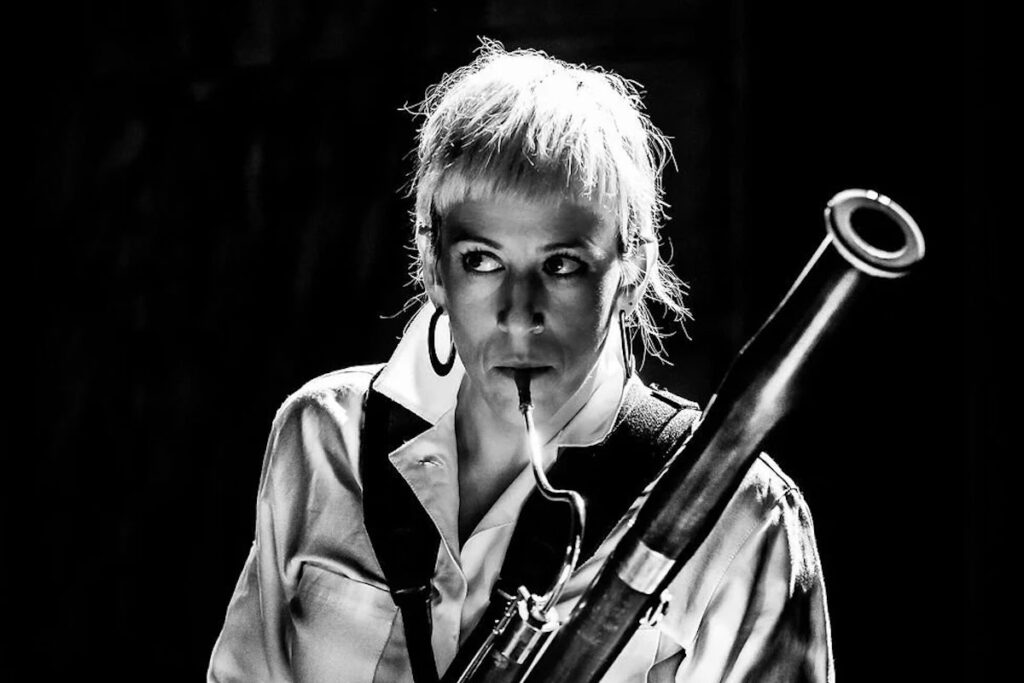
Rebekah Heller is on a mission to smash every tired stereotype or bad orchestra joke about the bassoon. On her new album Righteous Rage (Cantaloupe Music, July 31), arrangements of Julius Eastman and Steve Reich meet newly commissioned works by Jessie Cox, Fay Victor, and Brittany J. Green in a project that left me wondering why it took so long for the world to hear how cool bassoons are.
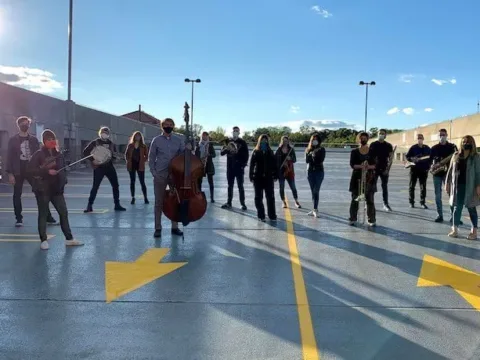
Heller’s love of the bassoon in ensemble is a revelation. The works she’s chosen are rich and layered, keeping all the clarity of solo bassoon while gaining the locked-in harmonies and blend that only similar instruments can achieve. For early premieres and workshops of some of the pieces, she thanks the Rebekah Heller Bassoon Ensemble — acknowledging that the pieces can also be performed by live groups. But Heller has multi-tracked herself on the album, putting her bassoon chops in the spotlight and adding technological flair to her production. This approach demands fluency in all the parts and accuracy down to the meanest variation. Fortunately, her staggering precision and attention to detail make the work sound effortless and leave the listener free to enjoy the interplay of parts and musical ideas.
Cellist and composer Clarice Jensen first transcribed Julius Eastman’s The Holy Presence of Joan d’Arc from a recording of the 1981 premiere at The Kitchen in NYC, and Heller’s arrangement of this transcription recasts the ten cellos of the original work as ten bassoons. While The Holy Presence doesn’t take Joan of Arc’s life as a program, the minimalist work evokes an emotional evolution from youthful certainty to a wiser resolve.
Heller’s version maintains the spirit of what Eastman called “organic music,” moving through sections of rhythmic vitality and longer intense tones that slowly change the harmony as they progress. Bassoons alter the texture of Eastman’s original by blending differently than cellos; listeners can hear more individual parts and timbres come through the ensemble much clearer.
Long before Righteous Rage came to be, strangers Rebekah Heller and Steve Reich moved into the same apartment building on the Lower East Side of NYC in the 2010s. After a chance meeting that led to friendship, she became determined to produce a version of his Cello Counterpoint for a solo bassoonist and recorded bassoons (tape).
Together they created Grand Street Counterpoint — a version of Cello Counterpoint named for their shared Manhattan address and co-produced for Righteous Rage. The piece retains its classic Reich-isms of floating lyrical phrases over rhythmic pulses cross-cut with hockets that weave the tape and live performers together. What changes is the articulation: the relative crispness of bassoon staccato introduces space into the texture and brings a new lightness and nimbleness to repeated notes.
Jessie Cox’s Sonic Cartographies is the first of the three commissions and immediately departs from the intricate rhythms and lyric melodies of Eastman and Reich. This is expressionism as only the bassoon could conceive it: long low dissonances at loud volumes, rattling key-clicks, and plenty of feedback from the wood of the bassoon. This feedback in particular creates a timbre unlike the instrument’s usual orchestral fare. Such tone color really shows Heller’s control over her blending and tuning — even through challenging harmonies, every note is placed exactly where she wants it and sounds cohesive.
Fay Victor’s Nurture (for Ingram) shows the bassoon at its most experimental. The piece is a tribute to her friend Ingram Washington, inspired by his “combined peace, fun, an easy prosperity and a no-bullshit way to be in the world.” It begins with long, layered tones that reach an organ-like resonance, which is later interspersed with more technically active sections and playful hocketing. Not content with the conventional palette of bassoon sounds, Victor expands it to include rhythmic reed crows, key clicks, and direct, forceful breaths through the instrument. The contrast between the sections is emotional as well as technical; the piece really shines as it changes between serious long tones and mischievous experimental techniques to evoke one complex human being.
The final piece, Brittany J. Green’s Righteous Rage, inherits the spirit of Eastman’s Joan d’Arc. Its driving rhythms and repetitive riffs nod to classic minimalism, while angry, wasp-like trills flesh out the title more candidly. Though it uses fewer extended techniques than the other works on the album, Green’s bassoon writing has a leanness that keeps it feeling current. It doesn’t indulge in expansive Romantic forms or heady flourishes, but builds momentum though a constant groove. Heller’s playing is as consistent as ever, but there is an added feeling of arrival in this piece — a synthesis of the old and new. As Heller writes in her liner notes, “This album is my love letter to the bassoon, and to bassoonists.” As far as love letters go, this one is timeless.
I CARE IF YOU LISTEN is an editorially-independent program of the American Composers Forum, and is made possible thanks to generous donor and institutional support. You can support the work of ICIYL with a tax-deductible gift to ACF. For more on ACF, visit composersforum.org.