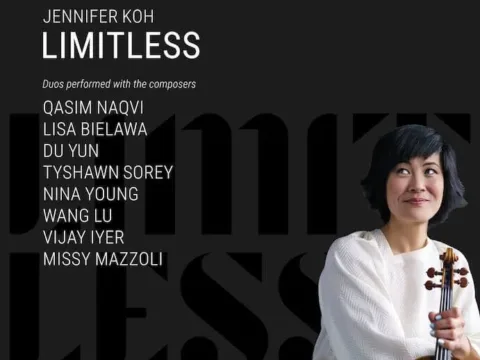
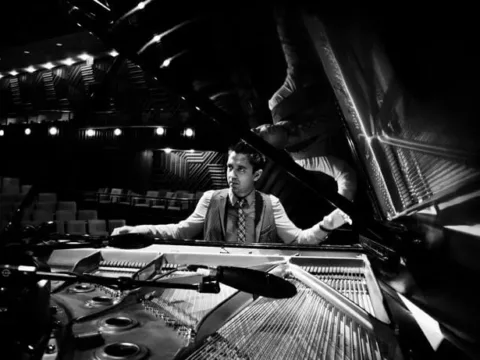
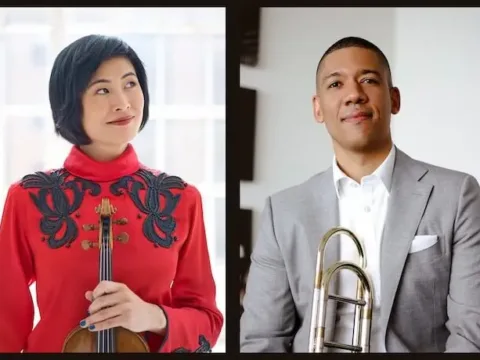
On The American Concerto, Volume One (Aug. 14, Cedille Records), the Grammy Award-winning violinist Jennifer Koh connects the concerto form to contemporary society. The album is the first volume of Koh’s commissioning project of the same name, which blossomed amid the recent resurgence of art that depicts and interrogates American identity — particularly as we mark our nation’s 250th anniversary this year. Joined by the Oberlin Contemporary Music Ensemble and conductor Timothy Weiss, Koh performs two newly commissioned violin concertos by renowned composers Vijay Iyer and Courtney Bryan.
Iyer’s Trouble takes inspiration from the famous words of U.S. Congressman John Lewis (“good trouble;” “necessary trouble”) and seeks to reframe the role of the soloist in this work for violin and chamber orchestra. Rather than positioning the violin as a leader with contrasting material, Trouble highlights the vulnerability of the soloist. Over the course of six movements, the ensemble brings feelings of tension and sorrow through an intimate give and take with Koh’s violin.
The opening leans into the insular sound of chamber music with hardly any demarcation between soloist and ensemble. Aptly titled “Prelude: Erasure,” the first movement features flute and piano taking center stage, joined by only a whisper of the solo violin. Later, the group moves away from this pared down texture and proves themselves more than capable of executing styles that require more body. The heft of brass fanfare, woodwind chorales, and sweeping string melodies sprinkled throughout the piece are a welcome variation.
The concerto also directly responds to the brutal 1982 murder of Vincent Chin, a Chinese-American man whose high-profile killing sparked conversations about hate crime legislation in the United States. The third movement is a somber dedication to Chin, rich with dissonance and delicate accompaniment. The piece settles into a tender and simplistic final cadenza that ever-so-subtly flirts with the idea of edginess through weighty bow strokes that creep in gradually, adding dimension. As the orchestra rejoins, this comes to a head with a gradual acceleration to a finishing flourish.
Bryan’s Syzygy is a work heavily influenced by the connective tissue of artistic lineage. Originally composed for Koh and the Chicago Sinfonietta, the title refers to “the nearly straight-line configuration of three celestial bodies in a gravitational system, such as the sun, moon, and earth during a solar or lunar eclipse,” says Bryan. The celestial bodies, in this case, are all artists who have inspired Bryan’s creative voice: Alma Thomas (“The Eclipse”), Frida Kahlo (“Tree of Hope, Keep Firm”), and Maya Lin (“Eclipsed Time”).
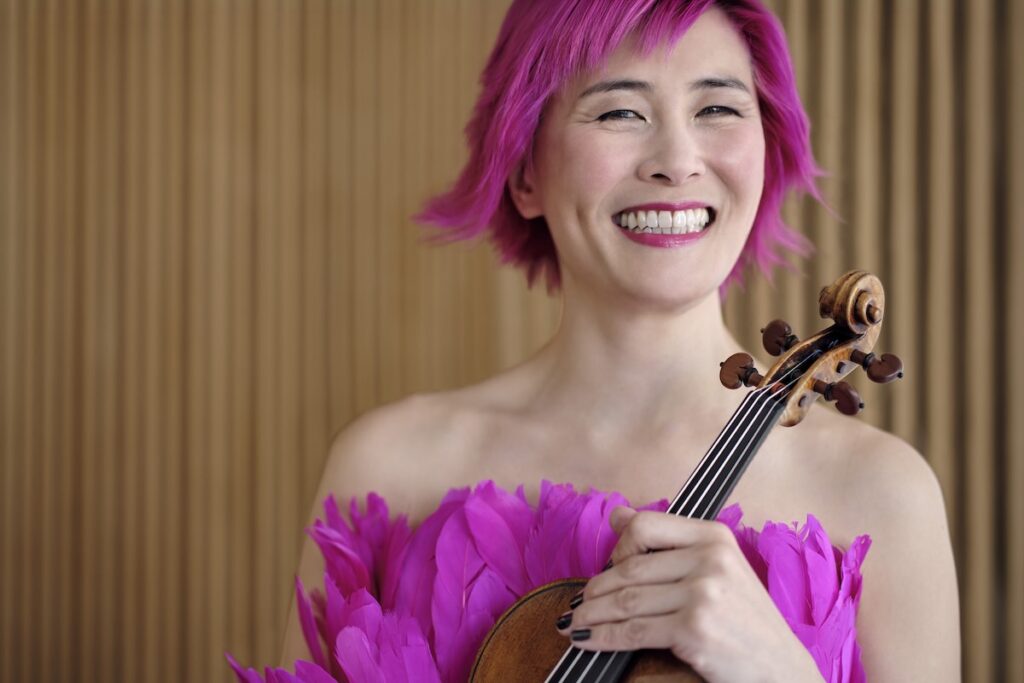
In the opening movement, fluttering flutes and twinkling chimes give life to the celestial theme, while the violin softly noodles up and down its range, trilling to a quiet finish. Kahlo’s tribute sports a Romantic air with light and gentle melodies in the solo violin. Koh’s phrasing is uplifting and charming, endearing the listener to every last note. Warmth radiates from the supporting passages in the clarinet and low strings, rounded with buoyant cadences. The final movement carries a tinge of darkness that lurks just underneath the surface of swelling strings and a soaring solo violin melody. Briefly picking up speed, sweeping chimes connect us back to the beginning of the piece, where the lineage of inspiration began.
In the past few years especially, audiences have been presented with artistic work that beckons them into larger conversations about identity, lineage, and belonging. While The American Concerto was built on a similar premise, it allows the featured artists to take these conversations down the paths that inspire them most. Despite being just the first volume of Koh’s “The American Concerto” project, it offers up an experience dense with emotion and brimming with talent from the musicians and composers alike.
I CARE IF YOU LISTEN is an editorially-independent program of the American Composers Forum, and is made possible thanks to generous donor and institutional support. You can support the work of ICIYL with a tax-deductible gift to ACF. For more on ACF, visit composersforum.org.