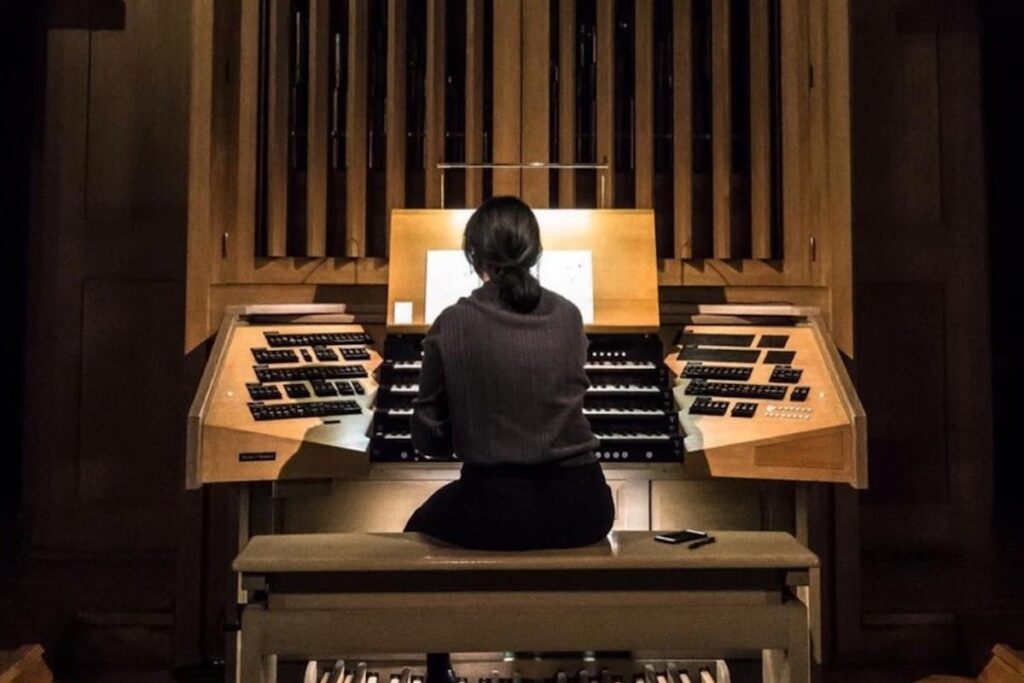
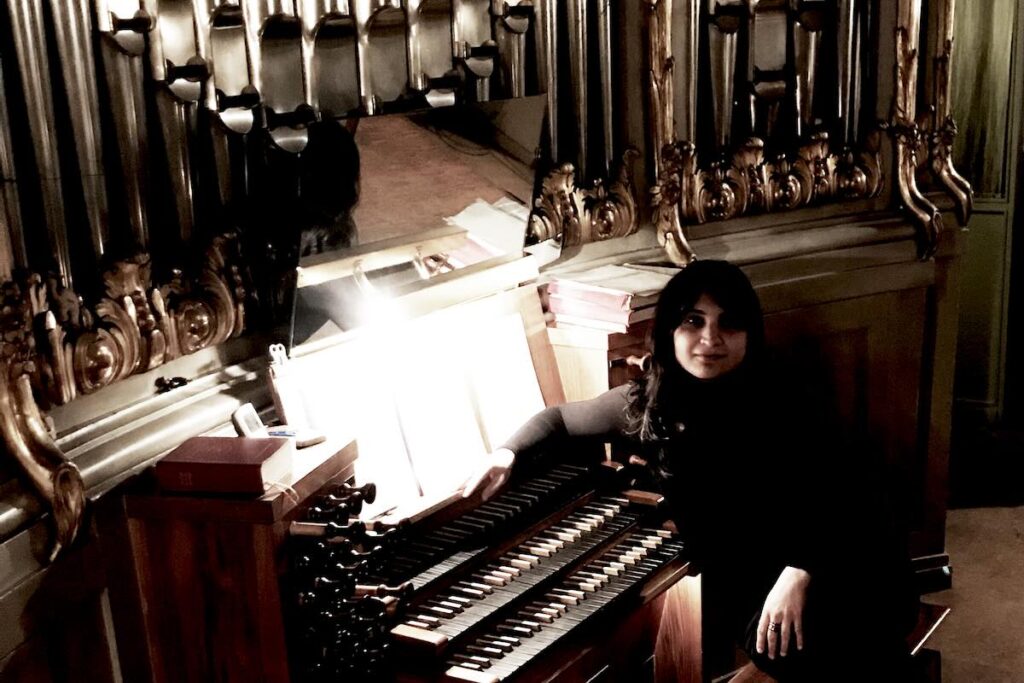
The organ at the Church of St. Luke & St. Matthew looms over Sarah Davachi as she takes a seat to perform at the May 2026 Long Play Festival in Brooklyn. The Canadian-born, Los-Angeles-based composer strikes a low, grumbling chord that harnesses the strength of the mahogany-toned wood and large metal pipes that line the altar. As this resonance simmers and rings, she meticulously adds more pitches, sculpting a melody that feels at once immediate and primordial, consonant and dissonant. And then, the organ lightens. Radiant tones soar from the instrument’s higher register and swirl around the room, landing on the walls, stained glass windows, and in our bodies.
During this performance, I sit in a pew with my eyes closed, soaking in the music as it evolves and feeling my muscles clench and slacken with every tension and release. This kind of close listening is a practice of concentration. Davachi’s music asks us to lean into the moment and emerge changed by, and with, the sound. “I think of myself as somebody who has constructed this space for you to go into,” she said over Zoom. “What actually happens within it is completely up to the listener and is determined by the listener. I want people to really take the time and just listen and see what happens.”
This philosophy is at the core of Davachi’s latest album, The Will of Tongues, out Aug. 28 on her label Late Music. The record foregrounds her patient approach to composition through solo compositions for pipe organ, choral pieces, works for strings, brass, and woodwind ensembles, and a piece for string trio, organ, and tape. It’s also a broad survey of her practice that highlights how she blends drone (in the vein of contemporary composers like Éliane Radigue and La Monte Young) with early music tonalities, writing music that is entirely present and born from an unreachable past.
Davachi’s interests in drone, historical instruments, and early music took shape while she was working at a musical instruments museum in her early 20s. At the time, she was beginning to reject the classical forms she learned through piano lessons, and the museum’s ancient instruments opened her eyes to new ways of experiencing music. “Appreciating those instruments in a firsthand way, and really hearing them, changed how I understand timbre and sound,” she said. “Compositionally, I really wanted people to hear details. Just a little change [can make] you hear music very differently.”
There, she also became familiar with alternate tunings like meantone temperament, which offered endless possibilities. “Once you hear it, you can’t unhear it,” Davachi said. In meantone temperament, major thirds are divided into two equal whole tones, but this means there are some notes that don’t quite fit. To accommodate this unevenness, there’s an imperfect “wolf” interval between A-flat and E-flat that clashes when played. Davachi is drawn to the unsteady wolf. “Nothing is as intense,” she said. “Most people tend to avoid the wolf. That’s the idea of it. But I like to use it when I can.”
Davachi’s music often involves electroacoustic methods, which she found to be intuitive while taking one of her first composition classes as an undergraduate. In school, she also became interested in phenomenology, and this study of experiences, senses, and interpretation led her to understand sound as a space for considered attention. These concepts began to inform her ever-shifting compositions, encouraging her to embrace the unpredictability of sound. “When you take something and you explore it…you arrive at different musical experiences. You can look at something from different angles, and they’re all different and they’re all interesting,” Davachi said.
The Will of Tongues explores these philosophical and compositional ideas, with a special focus on Davachi’s commitment to subtle changes of sound over time through the act of listening. As she wrote the pieces on the album, she spent a great deal of time immersing herself in the music she put to page. “Listening is half the way I work,” she said. “The cycle of beginning to end of experiencing music involves listening in some way.” She often writes music for several days, then takes a break for a couple of weeks and works on something else. But all the while, she’s still thinking about the previous piece, listening to it and taking notes. She also thinks about ways to move phrases around in the program Logic, placing melodies in the way that makes the most sense to her intuitively as she re-listens to her compositions.
For the album, Davachi recorded five organ pieces on instruments that hail from all over the world, including a couple housed in her favorite organ room: the Orgelpark in Amsterdam. She especially used Baroque organs with manual controls that adjust how air moves through their pipes. Each piece highlights the quirks and timbres of these organs, exploring their gradual, shifting textures as long-held tones unfold.
Other pieces showcase Davachi’s collaborative methods, in which she works with ensembles of other instrumentalists — in this case, vocalists, string players, woodwind players, and brass players — in a similarly iterative way as her solo practice. Two of the pieces, The Rose Dialogues and Interludes, were created during a fruitful residency at the Experimental Media and Performing Arts Center (EMPAC) in Troy, New York. Davachi brought sketches to this residency, then developed them through recording and rearranging with the artists in the room, returning to ideas over time to rework them.
Pressing play on The Will of Tongues, it’s impossible not to dive into each note and get lost in all its frayed edges, to succumb to each glacial melody as it melts. Wolf intervals fill the spaces between notes with archaic resonance, transporting us omnidirectionally through time with the sway of each tiny melodic or harmonic shift.
Davachi describes herself as an architect, someone who has constructed a space for us to enter and find our way within. Listening isn’t just entering the room, turning on the speakers, and letting the music seep into the background; we are invited to go inside of the music, no matter how desolate or beautiful or strange it sounds. “Listen to music in a way that maybe you’re not used to listening, or a way that maybe doesn’t always feel comfortable,” Davachi said. “Just give it a chance.”
I CARE IF YOU LISTEN is an editorially-independent program of the American Composers Forum, and is made possible thanks to generous donor and institutional support. You can support the work of ICIYL with a tax-deductible gift to ACF. For more on ACF, visit composersforum.org.