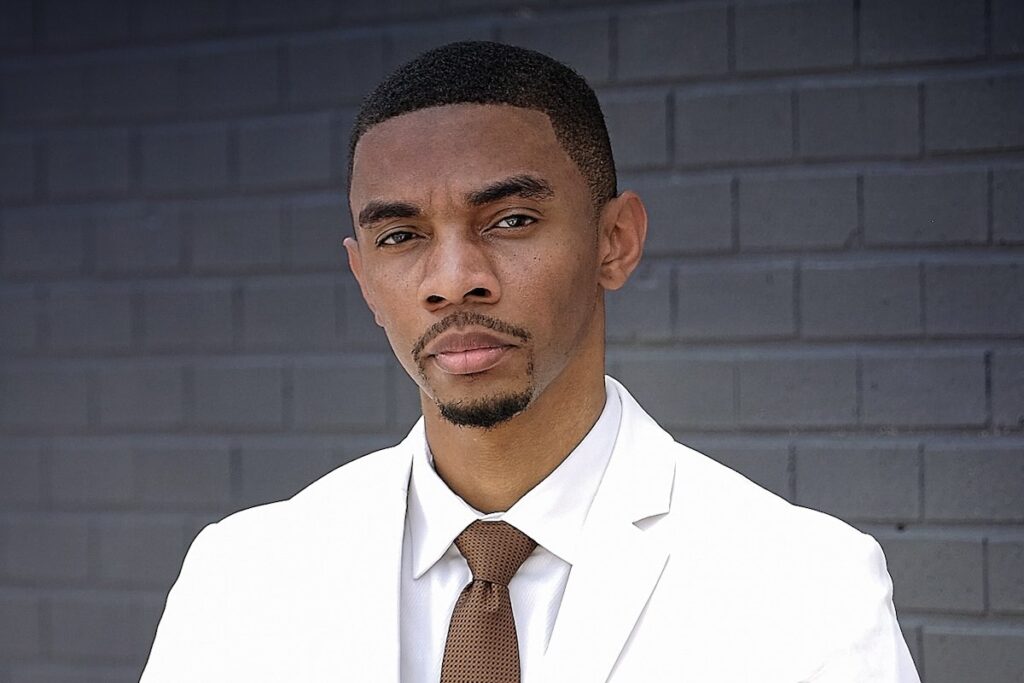
Composer and percussionist Christopher Thompson deftly demonstrates how overlooking the constraints of genre can yield artistic freedom. Blending the sounds of classical, jazz, gospel, rap, and more, Thompson’s unique style recently won over the members of the San Francisco Symphony’s jury, making him the sixth recipient of the Emerging Black Composers Project’s Michael Morgan Prize.
Thompson’s ability to masterfully blend styles is evident in the diversity of his resume. A proud alum of North Carolina A&T University, he marched for the Blue and Gold Marching Machine and was drum captain of the Cold Steel Drum Line. He holds advanced degrees in percussion performance and jazz studies from the University of North Carolina, Greensboro, and is currently pursuing a DMA in music composition from the Peabody Institute. Together, this multi-faceted background shines through in the versatile textures and execution of his art.
While committed to genre bending, Thompson remains true to the characteristics of the mediums he superimposes. In his 2024 piece Anomaly for string quartet and notated rap, for example, neither serves as lead or accompaniment. The string quartet sounds and operates like a traditional string quartet as Thompson raps in rhythmic unison with the group and skillfully weaves in and out of the instrumental texture. Thompson promises to continue introducing audiences to rap notation while simultaneously maintaining the distinct characteristics of the performing ensemble in his new commission for the San Francisco Symphony’s 2027-28 season. Following the announcement of his award, we asked him five questions about his musical influences, process, and how he is anticipating his experience in San Francisco.
Upon receiving the Michael Morgan Prize, you mentioned your gratitude to the San Francisco Symphony for seeing your vision. What unique struggles have you faced advocating for your vision in the past, and in what ways are you excited that your collaboration with the SF Symphony will help rectify them?
I feel there is a stigma pertaining to rap within the classical and academic community. There are many different styles of rap, and sometimes people miss the technical proficiency and lyricism that can go into the artform. In addition, when organizations or ensembles hear a collaboration with rap and classical music, it can be easy to assume that the “classical” identity, or idiom, will be lost. These preconceived notions can make advocating for my work difficult. It is usually not until someone experiences my work, like Shadows Uplifted with Alarm Will Sound, that they begin to see the concept of what I am trying to do.
In this new collaboration with the San Francisco Symphony, the musicians will not be in the background or reduced to just accompaniment. Instead, I will equally explore the dialogue between the rap and the orchestra. I am excited to delve into the possible creative combinations between the rhythm, intonation, and delivery of the lyrics, with the vast techniques and skill of the ensemble. This will involve merging lyrics with both tonal and atonal harmonies, various time-signatures, complex polyrhythms and syncopations, unique sound textures, and extended techniques. The piece will feel like classical music, while still feeling like rap, honoring both the legacy of hip-hop and the history of orchestral music. In doing so, I hope to encourage more classical and academic musicians to give notated rap a chance.
The simultaneous restriction and freedom of genre has been an important part of the musical zeitgeist in the past few years (the discourse about Beyonce’s Cowboy Carter album comes to mind, for example). How do you believe genre helps or impairs the way we view music?
Currently, music is too segregated by genre. To win a Grammy award, for example, you must be nominated in a specific category with few exceptions. In academic music, most majors, ensembles, and specialties are separated by style with little departmental integration or the inclusion of popular music genres. Though genre can be very beneficial in how we discover and study music, it cannot be a box in how we create and perform music. I believe there is so much creative potential, and a lot we can learn from each other and our various artforms, if we break down the walls between different genres.
Merging and combining genre in a genuine and authentic way is not easy, as it requires a deep respect, understanding, and reverence of the styles involved, but if done correctly, it can be a key to increase diversity and representation within classical music. These combinations can cultivate interest, inspiration, and exposure to new communities, encourage more youth to get involved with new musical styles and instruments, and bridge the gap between various audiences.
Who are your rap influences, and how do you think they would respond to your work?
Some of my biggest influences, in no particular order, are Lupe Fiasco, Busta Rhymes, Kanye West, Common, Jay-Z, and Tobe Nwigwe. Each have influenced me in different ways, whether Busta’s delivery, Lupe’s lyricism, Common’s fight for social justice, or Kanye’s creativity. Producers have also played a large part in influencing my music. Artists like Kanye, Timbaland, Pharrel, Swiss Beatz, and Mike Will Made-It, have been extremely pivotal to my creative process.
Truthfully, I have no idea how they would respond to my music. Some may like it and be excited about new collaborations and innovative directions. Others may not vibe with it, feel protective, or think that the traditionally classical styles and instruments don’t fit. In the same way, I am still learning how those in the classical sphere are responding. I do believe though that there is a consensus within the hip-hop community, that we need something new and different from a lot of the commercial options that we hear in popular music today. My focus now is to create the music that I believe in to the best of my ability and hope that it can bring different audiences together.
Can you share more about your compositional process? Does notated rap come first, does the instrumental music come first, or does it all happen at once?
I approach rap compositionally by its musical elements and phrases. At its root, rap is a rhythmic and vocal technique that can benefit from notation in the same manner as any other instrument or voice. We have seen many examples in contemporary art music where non-traditional vocal techniques and experiments are being considered. Yet, rap has been mostly neglected as a compositional endeavor. For me, I think of it as a percussion instrument. I’ll even take a snare pad and play the rhythms of the delivery.
Though my process has involved all three methods above, usually, I create the rhythm of the lyrics simultaneously with the instruments. As I write, I am always considering what is happening in the rap, even going as far as notating the rhythms into the score before I have words, and sometimes before I have anything else. I treat the rap like it is any other instrument and try to incorporate it as another member of the ensemble. Usually, the actual words are the last component that I fit into the puzzle, but I have also enjoyed writing lyrics or poetry, and setting them to music.
Your notated rap includes themes of Black love, community, and self-determination. Have you found the classical music community is “ready” when they experience your music?
Due to the stigma that I mentioned in the first question, “ready” is not quite the word I would use lol. But I will say that there are many within our community who are “open.” What I have found, is that several come into a concert not knowing what to expect, or already have preconceived notions of what I will say, or what the music will sound like, and are quite surprised by the combinations and the message.
I have had people of all ages come to me afterwards asking to send them the lyrics, or appreciative of the techniques found in the ensemble. The lyrics for me are personal, and while I hope they can be inspiring and encouraging, I also want to deliver a message that addresses the issues that I see in the world today. That means highlighting those who I personally look up to, many of whom are within Black history or my life, who have overcome some of the toughest obstacles to create change. I hope this is a message that can impact us all, and that each person can find something they can relate to within in the music, to address the problems that matter most to them.
I CARE IF YOU LISTEN is an editorially-independent program of the American Composers Forum, and is made possible thanks to generous donor and institutional support. You can support the work of ICIYL with a tax-deductible gift to ACF. For more on ACF, visit composersforum.org.