Camille Norment’s work embodies the best of experimental art: a space for curiosity and reflection; a conversation that is rooted in contemporary society, culture, and politics, yet not overly prescriptive; a strikingly embodied experience that you turn over in your mind in the days, weeks, or months that follow, parsing its personal resonance.
Though sound is an important throughline in her work, Norment doesn’t consider herself to be a “sound artist.” She describes her multimedia output as all “part of the same conceptual and formal fabric,” spanning installation, composition, sculpture, drawing, and performance. But her practice does not seek a middle ground between these disciplines — it’s a complex ecosystem of independent yet interrelated work.
This insistence on eschewing the fusion of artistic mediums pushes against our innate desire to categorize. “I find the persistence of genre curious,” she mused in our recent interview. “Even having gone through iteration after iteration of deconstructing genres, one still cannot be called a multimedia artist without listing all the forms that they work in.”
Norment has lived in Oslo since 2005, but she was born, raised, and educated in the United States. Her early training as a dancer left a deep somatic imprint, and her undergraduate studies as a comparative literature major kindled a lasting interest in parallel narratives. After earning degrees from the University of Michigan and New York University, she spent 12 years in New York before relocating to Norway, where she maintains a studio practice alongside her commissioned work.
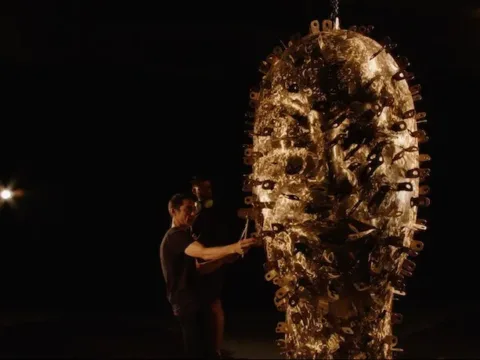
It’s not uncommon for Norment to present installations and compositions in tandem, as is the case with her upcoming work featured at Ultima, Oslo’s annual contemporary music festival. Every September, Ultima presents 10 days of boundary-pushing concerts, installations, theatre, opera, dance, and more. As part of the festival, Norment’s sound installation “Wonderful, Marvelous” will be on exhibit at Atelier Nord from Sept. 11-19, and her composition Wonderful Marvelous – fugue state will receive its world premiere on Sept. 13 at Sentralen.
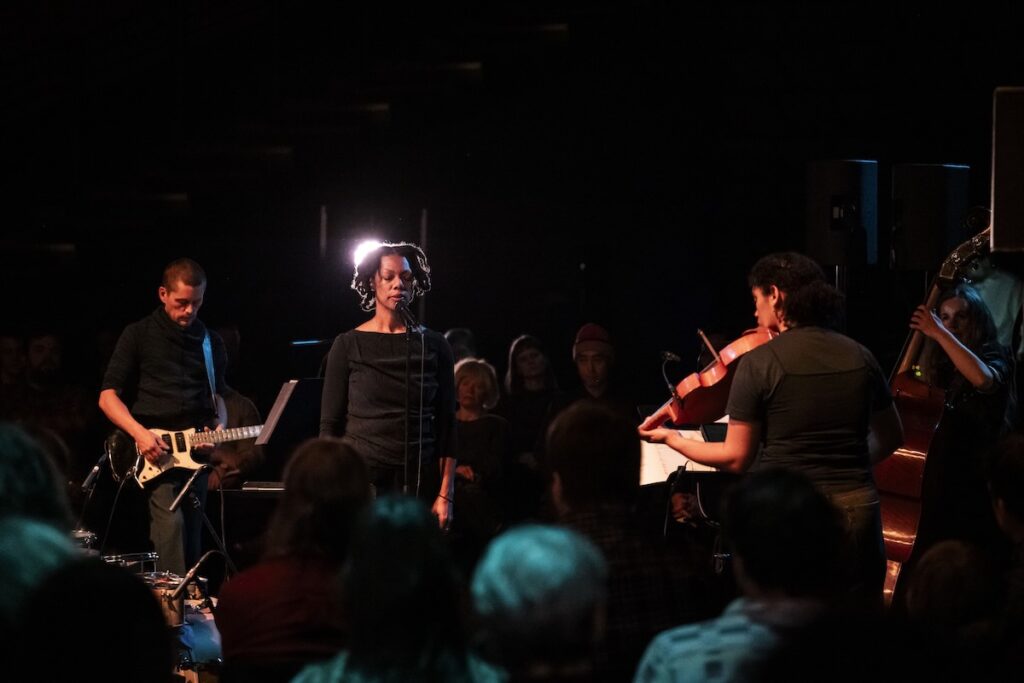
The installation “Wonderful, Marvelous” developed first; early seeds began germinating a couple years ago as Norment reflected on her perspective as an American living abroad.
“I was primarily inspired by songs speaking of love and blissful utopias that emerged along with the quote ‘Golden Age of American identity’ across the late ‘20s through the early ‘60s, specifically because of these very forceful waves — not only in the United States, but around the world — of this idea of returning to when things were ‘great,’ when they were actually mythically ‘wonderful.’”
The work originally stemmed from a personal love of jazz ballads from the ‘40s and ‘50s but grew to encompass a larger swath of The Great American Songbook. The installation features Norment’s recorded voice in fragmented, barely recognizable wisps of these songs that emanate from the speakers placed around the room. As microphones create a feedback loop with the speakers, her voice becomes increasingly obscured.
The installation and the composition share the same source material but offered Norment unique possibilities and vantage points for experimenting with these ideas.
“In a performance space, time is linear: you experience a work from start to finish, but with an installation, it’s more circular,” Norment shared. “The installation is driven by a generative composition that keeps it always active, and people can engage with it differently in terms of time and physical space.”
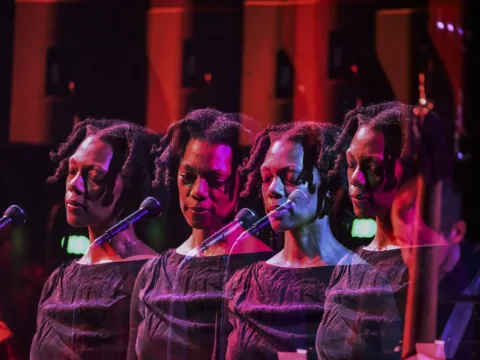
The composition Wonderful Marvelous – fugue state also utilizes voices and feedback in a performance that will feature the Norwegian Soloist’s Choir.
“In the live performance, the vocalists are performing as two instruments simultaneously: one is their voice, and second is their bodies as they solicit and negotiate feedback… Both works are composed with sparse density and a sense of distant dream or memory that blends the voices of humans with the voice of the environment as feedback.”
Across both works, Norment’s treatment of The Great American Songbook disproves the myth of “greatness.” Her use of feedback suggests how memories can fade and become abstracted through each retelling, exposing the dichotomy between the hopeful promise of these songs and the harsh realities of a post-war, Jim Crow America.
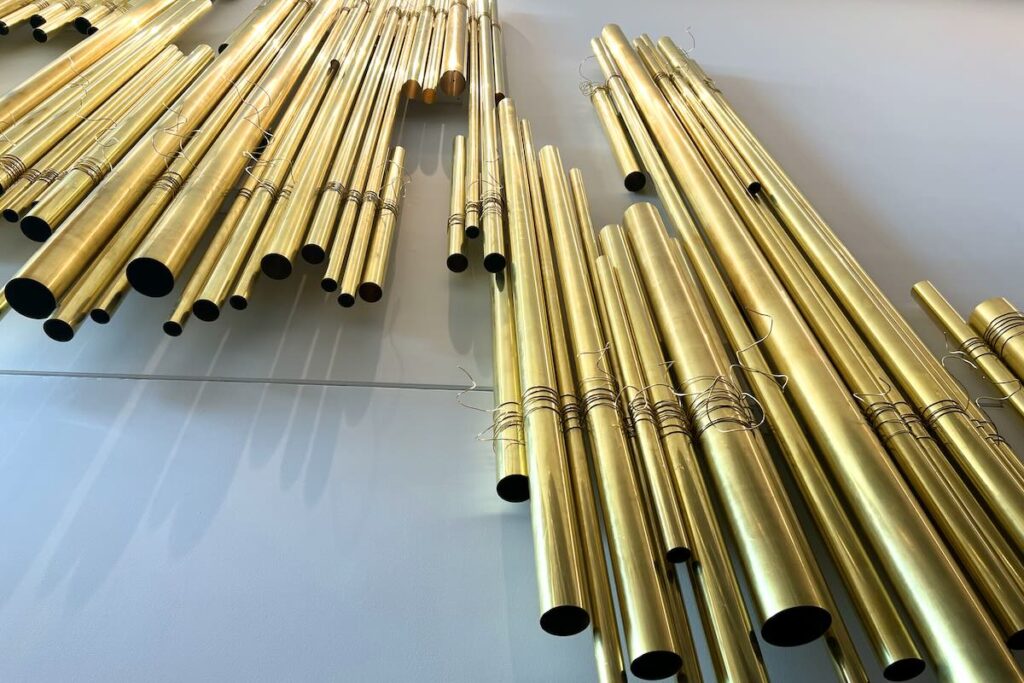
The physicality of feedback is a source of fascination in Norment’s practice more broadly. Though typically associated with the piercing, unwanted screech from a microphone-speaker loop, Norment sees feedback as a dynamic entity that can be shaped and surfed in order to place performers and audiences in direct conversation with their surrounding environment.
“It’s this kind of self-generating mechanism that instantly takes its sound and multiplies it upon itself. This instant growth — this blossom of sound — is just really beautiful as a concept, and as an idea of evolution,” she explained.
“In anthropology, there is a concept called evolutionary feedback loops: it’s how biological organisms evolve by reacting to the environment. I find this wonderful entanglement between this simple sonic phenomenon, the social human environment, and the larger biological environment of evolution, and it’s really an important spiral through a lot of my work.”
Norment maintains a highly conceptual practice driven by curiosity and experimentation, and there is often a clear social and cultural framing to her work. And yet, she is adamant about not suggesting any specific meaning to audiences. Instead, her goal is to create an experience that people can enter and explore through the lens of their own perspectives and histories.
“Art is its own form of knowledge, and yet, we are so wanting to distill semantic meaning from it: what does it mean in words?… I think the emergence of artistic research as a distinct discipline has lent itself to this assumption or need to divulge meaning in written form to show that it’s valid and important…. But I don’t want to talk about meaning. I really want meaning to just be in the experience of the work and in a space that is malleable in the relationship between the individual viewer, collective histories, and cultural memories — this wonderful thing that art can do that is so powerful because it is intangible and inexpressible in other means.”
As Norment fluidly moves through multiple artistic spaces performing, composing, and exhibiting, she doesn’t insist on having her practice labeled in a specific way, though she does acknowledge how the historical and cultural contexts of these categories inform our engagement and reception. Regardless of medium or how you position her work, she endeavors to create space for people to be proactive interpreters of their own experience.
“I don’t mind remaining an enigma, but maybe I’d like to be known as someone who creates engaging experiences that, regardless of form, raise questions by thinking through sonic means.”
The 2026 edition of Ultima runs Sept. 10-19 in Oslo, Norway. For more information, visit ultima.no/en/.
I CARE IF YOU LISTEN is an editorially-independent program of the American Composers Forum, and is made possible thanks to generous donor and institutional support. You can support the work of ICIYL with a tax-deductible gift to ACF. For more on ACF, visit composersforum.org.