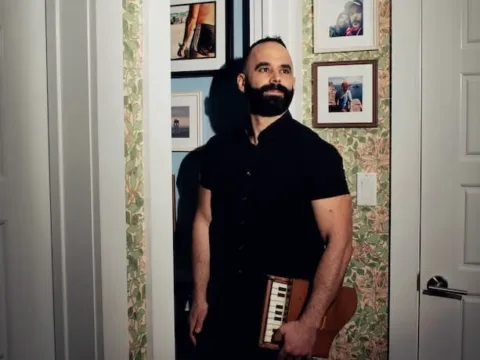
Christian Li is a pianist, composer, and arranger based in New York City whose work spans a wide range of aesthetics and styles. As a sought-after collaborator, he has worked with Unknown Mortal Orchestra, Sungazer, Childish Japes, and Kevin Sun, among others.
For his debut album Broken Neon Sign out on Sept. 4 (Endectomorph Music), Li deepens his exploration of music-making through a collection of work drawn from studio improvisations with prepared piano, guitar, and drums. Featuring everything from ambient drone textures to spooky alt-rock anthems, each of the 14 bite-sized tracks gives the listener a unique window into Li’s musical mind.
“Ambulance Chaser” is a total banger of a track, with pop-punk vocals and offbeat harmonies reminiscent of the English electronic band Portishead. Other tracks such as “Gallows” act more like palette cleansers, offering space to contemplate a more uniform musical texture, gesture, or idea. Some of the most interesting timbres are found in tracks like “Monks,” which showcases prepared piano textures that bring to mind the rhythmic drive and gamelan-inspired sounds of John Cage’s Sonatas and Interludes.
Every track carries different emotional and intellectual weight, but when listened to as a whole, the pieces meld together with the whimsical cohesion of a curio puzzle box. Another unifying factor is the mixing and sonic identity of the album. With its artful distortion and frequency filtering, the mix projects a welcome authenticity as heard through an analog patina.
Leading up to the release of Broken Neon Sign, we caught up with Li to chat about the album and his creative practice.
Since this is our first time featuring you on I CARE IF YOU LISTEN, can you start by telling us a bit about your practice as a pianist, composer, and arranger more broadly?
Thank you for having me! I came up playing jazz and classical music. I feel like a lot of my training was pretty hyper-focused on conventionally accepted ideas of virtuosity and pianism. My musical perspective was filtered through those values, and I started to lose touch with the personal, spiritual, and communal aspects of music making that got me hooked in the first place. Settling into life as a “professional musician” in New York warped my brain a bit more. The city moves fast, and so I felt like I had to hold myself to higher and higher standards in order for people to still want to work with me. Some of those standards were creative, but a lot of them came down to reliability and efficiency – the prosaic stuff.
So even though I still make a living as a musician, these days I actually feel like it’s healthier for me to keep at least part of my musical practice as a hobby – a way to carve meaning out of passing time and connect with people around me. It feels like music has more of a context in my life that way. Removing the professional from music gets me closer to the center of it, and everything else starts making sense around that. It becomes part of the daily ritual, and it can hold the mundane and the profound and everything in between. As a hobbyist, I can buy a bunch of old tape recorders off of eBay and spread them out in front of me on the floor and get really excited about how they all sound different from each other. As a professional, I’m concerned with showing up early to a rehearsal and whether the bandleader really meant to include that accidental in the score.
You have a wealth of experience as a collaborator. What was it like to create a project like this that is wholly your own?
I fell into being a perennial sideman because I don’t usually like to be the center of attention. There’s a certain satisfaction in sinking into the sideman role. I feel much more free to create in spaces that don’t revolve around me, and I don’t have to deal with a lot of the noise that comes with being out front. At the same time, I’m well aware there’s been some copping out going on. I’ve never released music before because the thought of doing so made me spiral into overlapping crises of self-confidence and shame. But I got to the point where the desire to have a body of work outweighed the attendant angst, because I was starting to feel really blurry around the edges. Maybe I could have kept going and been fine, or maybe I would have vanished. There’s no way to know for sure, because I’m putting out this album.
I’ve always felt more secure in what I stand for as a player than as a solo artist. I’ve had a lot of different experiences through which to explore my identity as a player, and I’ve been lucky to work for some really incredible musicians who have facilitated the hard work of questioning, grappling with, and growing into that identity. Making an album has required me to go through those same processes in my own music in ways that reflect directly back at me, and the process of actually releasing the album is allowing me to understand it from the outside in, as a thing that exists in the world, instead of just the inside out perspective I get when I’m lost in the creative sauce. It’s good medicine.
One thing that struck me when listening to Broken Neon Sign was the sheer range of each track. How do style and aesthetics play a role in your compositional practice?
The tracks came out of a day’s worth of prepared piano improvisations that I recorded with guitarist Asher Kurtz and drummer JP Bouvet. I had no style in mind for that session. Mostly I had an overwhelming desire to put random objects inside the piano to modify the sound of each note. I wanted to play an instrument that felt uncanny and alien. I had been feeling a bit stuck – my same ten fingers on the same black and white keyscape. Some pianists, like my former teacher Danilo Pérez, can transcend the physical fact of the piano. I didn’t feel capable of that. I needed to engineer it. Having a piano-like object that thwarts your expectations at every turn while operating with the same overall mechanics as a normal piano is an amazing cheat code for an improviser starved for surprise.
As I started playing around with the stems from that session, the improvisations began to hint at different styles and aesthetic choices. I tried to stay the course with each track even if it was heading somewhere uncomfortable or unfamiliar. I would often find myself in strange places where I wouldn’t fully know what I was looking at, and I’d have to find ways to create sense and meaning. It’s interesting the long-forgotten experiences and rabbit holes and arcana that can emerge when you’re gasping for coherence. My dear friend Michael Sachs, who produced the record, was a North Star for me throughout the process. He’s zany and unconventional and limpid and I trust him with my life. He pulled me out of an aesthetic mud pit at least once every other day. And one day, he pulled me out and we had an album.
What excites you most about the music on Broken Neon Sign, and how would you recommend listeners approach this album?
I fell in love with the prepared piano the very first time I heard John Cage’s Sonatas and Interludes as a teenager. I couldn’t believe I was listening to a piano. It sounded like a robot gamelan. It was like one of those culinary illusions where you have a hyperrealistic t-bone steak but it’s actually a cake. I heard myself in the sound immediately, but for a long time I didn’t pursue it because I’ve never owned a grand piano and I didn’t want to potentially destroy someone else’s. I was lucky to eventually meet the brilliant Eli Wallace, who taught me how to prepare a piano safely, and now everyone has to listen to this album. I’m really just thrilled to have had the chance to explore the prepared piano on my own terms and to have spent a year living inside the topsy-turvy semiotic world of its sound.
The shorter prepared piano pieces are, for me, the spirit of the album. My understanding of the feeling and persona of the album radiate from within those pieces. They’re a direct line to the improvisational tangle out of which the album took shape. I would encourage listeners to approach the album with those tracks as essential as opposed to interstitial. It’s really an instrumental record on a Rumspringa.
What is coming up on the horizon for you? Where can we keep up with you and your work as we look to the album release and beyond?
I spend a good chunk of each year on tour with the band Unknown Mortal Orchestra, which brings me great joy and creative fulfillment. When I’m not on the road, I’m trolling around NYC playing gigs and tinkering with new musical ideas. As I hinted above, this has been the summer of the janky cassette recorder. Props to Ruban Nielson of Unknown Mortal Orchestra for opening my ears to the beauty and inscrutability of old, hangdog equipment. He’s such a master of communicating through objects that most people would overlook.
I’m doing a couple low-key performances in some friends’ art studios upstate around this idea of recording and rerecording myself through chains of crackling cassette recorders until the tapes give up the ghost and become mostly just noise. I’m curious to see what that will feel like. I have a vague impulse to make an instrumental record that uses that procedure somehow, but I’m not sure where exactly that will lead.
My internet presence is pretty spotty, but I usually post about stuff on Instagram. In addition, Kevin Sun of Endectomorph Music, the label putting out this record, is great at getting the word out about his artists through the label’s Instagram and website. There are lots of wonderful musicians on the label to follow!
I CARE IF YOU LISTEN is an editorially-independent program of the American Composers Forum, and is made possible thanks to generous donor and institutional support. You can support the work of ICIYL with a tax-deductible gift to ACF. For more on ACF, visit composersforum.org.