For musicians seeking to collaborate outside of the neatly delineated roles of “composer” and “performer,” our institutions and their funding models — grants, tours, residencies — don’t always deliver the right kind of support. In Claire Chase’s estimation, our attachment to those systems can cause as many creative problems as they solve. “We are told to stay in the lane of the performer, the composer, the producer, the funder,” she shared on our recent Zoom call. “I have never believed that these aspects of our practice are separate — I have always believed that they are inseparable and interdependent.”
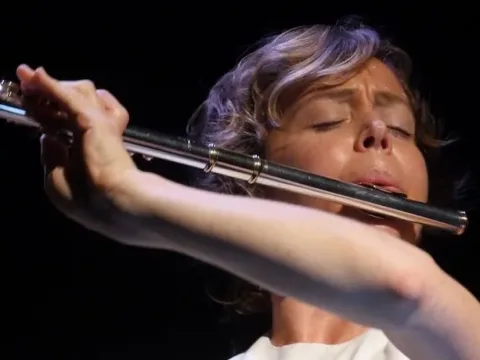
For the past 12 years, Chase’s efforts to expand the flute repertoire have also worked to reassess the relationships between performers, composers, and funders. This year marks the midpoint of “Density 2036,” a 24-year commissioning project that commenced in 2013. Named after Density 21.5, a solo flute work by 20th century composer Edgard Varèse, Chase’s project will culminate in 2036 on the 100th anniversary of its namesake. Each year, new works debut, building toward marathon performances every fifth year in which Chase performs the “Density” repertoire in its entirety. So far, the 2017 and 2023 marathons have inspired a flurry of adulatory press, covering Chase’s seemingly boundless capacity to play the flute in new and unexpected ways.
But “Density 2036” isn’t about Varèse. In an interview with Nate Wooley for Sound American, Chase wrote that its connection to the Varèse is more about “how far can we push this instrument — and the spirit that runs through it — into the future .” And although these new commissions are of such a magnitude that they deserve every bit of the press’ praise as “monumental,” her long-range vision for the project emphasizes the creative process as much as the body of work itself.
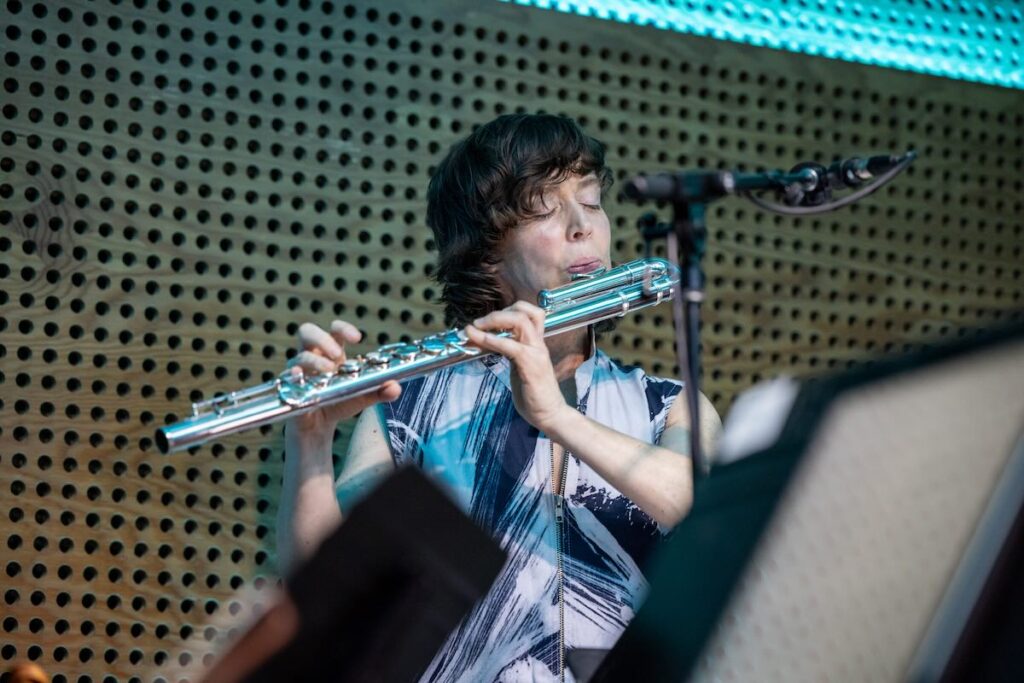
“I really wish for this body of work to be not just a contribution to the literature, but also a contribution to the way that we think about the whole ecosystem of bringing a new work into being: how it’s made, how it’s funded, how artists and other creative laborers are cared for in the process, how it reaches audiences, how it expands audiences — how, in the process, we rethink what a healthy ecosystem looks like not just for the creation of work, but the sustenance of that work.”
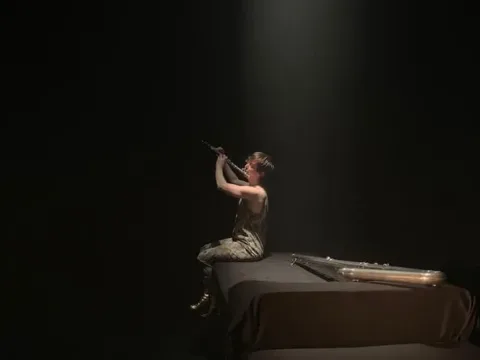
Consider Pan, Chase’s collaboration with Marcos Balter: it’s an evening-length musical drama depicting the flute-playing satyr Pan and his act of violence against the nymph Syrinx. Among what Chase calls the “many universes” of the “Density” commissions, Pan is one of the largest in scale for its mapping of the Greek myth’s narrative and visual elements to music.
Over eight movements, Pan’s slow discovery of music’s power over listeners is mirrored through the instrumentation’s progression through successively larger flutes, and Chase’s increasing absorption into the texture of live electronics. A proverbial Greek chorus (a different group of community members in each performance) offers a second lever for the dramatic interactions that illustrate Pan’s narrative arc. Beginning with simple, small-interval tweets on a wooden pan flute, Chase’s material develops through piccolo, C flute, bass flute, then contrabass flute to arrive at a mercurial series of live-processed vocalizations, at first into the flute, and climactically, Chase a cappella.
Pan challenged Chase to exercise skills well outside a “normal” performance regimen. In resolving the conflicting requirements of playing flute while simultaneously speaking and acting, Chase exceeded the typically distinct boundaries that separate “flutists” from “actors.” It is this philosophy of openness to letting the creative process guide performance practice that underpins all of the “Density” collaborations. For Chase, better works emerge from “production models that come from the creative work and artists themselves, rather than saying ‘Here’s a model, let’s fit the work into it.’”
In other large-scale works like The Holy Liftoff with the JACK Quartet and Terry Riley, Sex Magic with Liza Lim, and Elwha! with Annea Lockwood, the process has begun with an extended commitment to “living in the fog,” as Chase puts it. She refuses to fix ideas in place until after a substantial period of improvisation, conversation, play, and explicit discussion about how each person will be credited. In our interview, Chase shared that this extended incubation period without pressure of timing and deadlines creates a strong creative connection:
“Each work is like a deep dive for me into the dream world, the psyche, and the collaborative ethos of each one of these musicians…I look at each of them as a unique and very special, very particular relationship, and I really believe in tending to the uniqueness, the individuality, and the very human dimensions of each of those collaborations and those pieces.”
For Chase, that emphasis on relationships and lived experience translates directly to the resulting works. In some pieces like Bertha’s Lair by Tyshawn Sorey, she no longer uses the score or reference materials; it’s Chase’s knowledge and understanding of Sorey, the process of creating the piece, and her own artistic motivations that enables her performances.
“Density” is certainly about the creation of a new flute repertoire — the growing catalog is full of fascinating, deeply satisfying pieces eminently worthy of sinking one’s teeth into as a listener, a performer, a pedagogue, a scholar. Commissions from Matana Roberts, Anna Thorvaldsdottir, Dai Fujikura, Felipe Lara, and George Lewis catapult Chase (and her performer-collaborators Seth Parker Woods, Katinka Kleijn, Cory Smythe, Levy Lorenzo, and Susie Ibarra) into sonic worlds very distant from one another. But “Density” is equally about noticing and challenging the demarcated lanes that constrain our participation in new music: be an actor, a vocalist, an improviser, even if your job is playing flute.
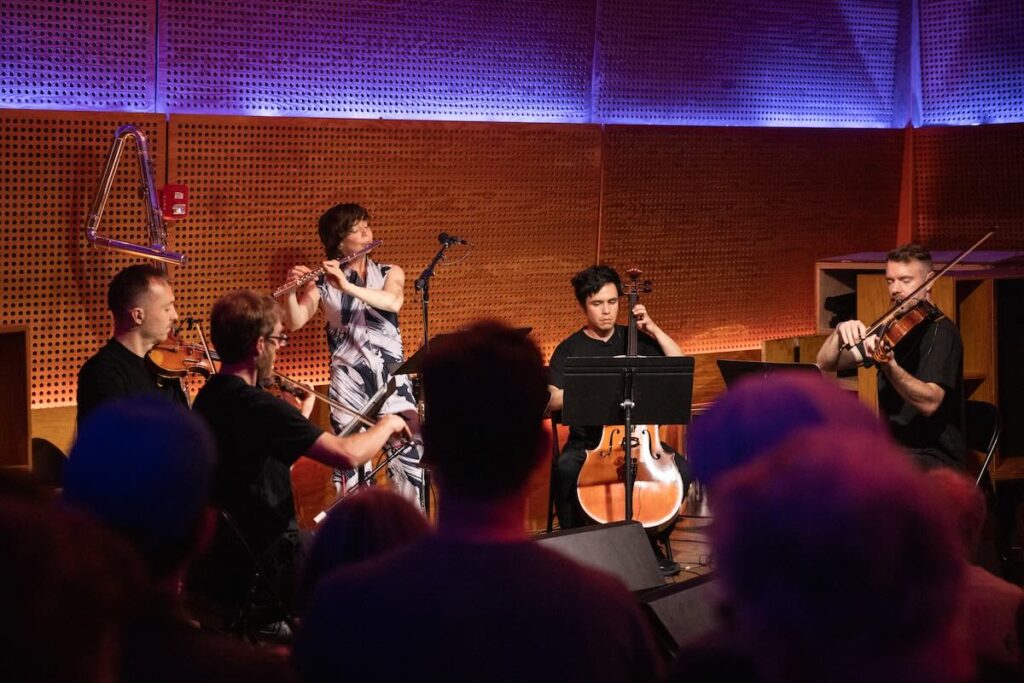
Another recent turn in the “Density” project is even more explicit in its attunement to these ideas. Chase’s Density Fellowships will soon begin its second cohort of flutist fellows, who choose pieces from the “Density” repertoire to interpret and make their own, all with career mentorship from Chase and her collaborators. Chase hopes that these flutists — and many many others — will take up the “Density” mantle:
“We’re now at the 12th year, right? We’re smack in the middle of it, going into the 13th year. Increasingly, the project is focusing on educational dimensions. It’s focusing on the fellowship program. It’s focusing on a new initiative I’m calling ‘Density Arts Studio,’ which is actually not specific to flute — and in the future, won’t even be specific to music — but a new kind of studio … that will, I hope, bring together performers, creators, and also artistic producers to talk about … everything around creating a healthy ecosystem for how work is made.”
Ultimately, “Density” doesn’t succeed or fail by delivering Chase’s lofty ideals for remaking the creative ecosystem. As Chase has herself noted, it is just “one small stream” of her commissions. Instead, it is bound together by its argument: people should keep asking how systems in new music are meeting our needs. And when we inevitably encounter friction, we should take Chase’s example in tackling it head on.
I CARE IF YOU LISTEN is an editorially-independent program of the American Composers Forum, and is made possible thanks to generous donor and institutional support. You can support the work of ICIYL with a tax-deductible gift to ACF. For more on ACF, visit composersforum.org.