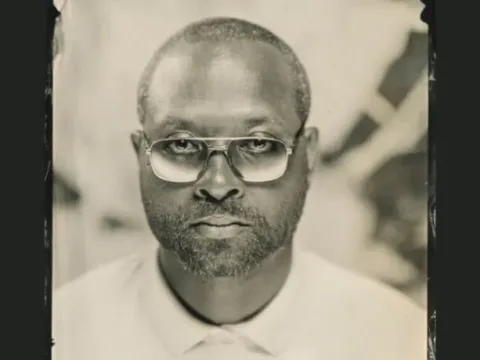
What happens when an iconoclast becomes an institution? That question continues to unfold with Julius Eastman. Composing in the heady New York scene of the 1970s and ’80s, Eastman wrote music years ahead of its time, all while placing his identity as a Black, openly gay man front and center. He died in obscurity in Buffalo, New York, in 1990.
Decades later, it has become Eastman’s time. Publishing titan G. Schirmer acquired the rights to Eastman’s music in 2018, the same year it purchased a swath of Florence Price’s music. Eastman’s Symphony No. II was widely performed and recorded by the Cleveland and BBC Symphony Orchestras. And three years ago, Stay On It (1973) even made its way to NPR’s Tiny Desk Concerts, via prolific Eastman advocates Wild Up.
The Eastman renaissance took root in Chicago on Aug. 23 with a free presentation of his The Holy Presence of Joan d’Arc (1981), produced by AfriClassical Futures. The local series has long sought a foothold outside of its host institution Elastic Arts, located in Logan Square, with future performances planned on the city’s South Side. This inaugural offsite performance at the Epiphany Center for the Arts — a church-turned-venue near the United Center — was a resounding success, drawing around five times the series’ average attendance. The concert had to be delayed by about 20 minutes to scrounge up extra seating for the capacity crowd.
The Holy Presence of Joan d’Arc is seldom performed due to its unusual instrumentation —10 cellos and solo voice — and steep performer demands. According to AfriClassical Futures co-curators Julian Otis and olula negre, and conductor–composer Ahmed Al Abaca, the concert required years of ideation, several grants, and ample rehearsal time. The performers were drawn from the trio’s network of Black, Latine, and queer cellists: Evé Sanchez, Lindsey Sharpe, Sajdah Muhammad, Alex Moore, Nick Reeves, King Sophia, Ómkara Gil, Luis González, Malik Johnson, and negre themselves.
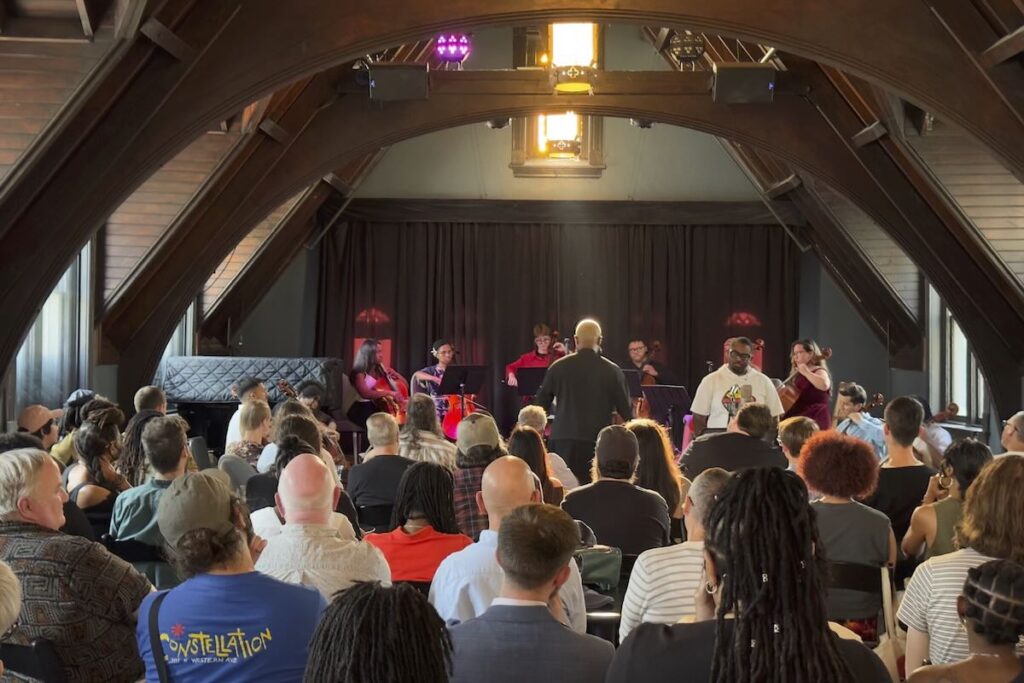
Though separated by generations, Otis and Eastman both came to wider renown as interpreters of the same work: Peter Maxwell Davies’ Eight Songs for a Mad King. Otis brought the same fiery command to the Prelude to the Holy Presence of Joan D’Arc; he stretched Eastman’s lines to the point of suspended timelessness, assuming the part of saint and oracle. Donning a white hoodie emblazoned with a Black Power fist that contained various terms for Black people — including the N-word — Otis was the embodiment of Eastman at his most provocative.
With its insistent sixteenth note ostinato and textural density, The Holy Presence is a work that lays its physicality bare. The focus and commitment from the Chicago ten-tet was hot to the touch. Dastardly technical moments — suddenly emerging simultaneities, linked lines across the ensemble — came off impressively.
As Al Abaca noted in the post-concert talkback, some of The Holy Presence’s “struggle” comes from the fact that it is often played sans conductor, requiring the players to trade off cuing at various points in the piece. Here, Al Abaca shepherded the performance, signposting fastidiously and shaping the contour of key lines with emotive, emphatic gestures.
In the same talkback, negre said the performance and rehearsals had been healing after dispiriting experiences in grad school. By the time they moved to Chicago in 2019, they seriously considered quitting the cello. “Bucket-list pieces like The Holy Presence, I wrote them off as something I never got to do,” negre said. They smiled. “But I did it today.”
Al Abaca also contributed two partner pieces to complement The Holy Presence: One More Angel, and Dawn, a premiere for 10 cellos and speaker which sets a poem by negre. Originally written for flute quartet, One More Angel was recently adapted by the composer for cello quartet; it was adapted yet again for 10 cellos for this concert.
The expanded version betrayed its past as a quartet, with members of the ensemble often paired in unison. But it also amplified Al Abaca’s many fine-spun details, with elaborate runs passed across the ensemble and solos shooting out like sprouts. After the opening theme is passed around the ensemble, the piece traverses blues arpeggios and brambly Stravinskian modernism before ending tranquilly, the final chord delicate as a sigh.
Dawn was just as engagingly scored. After an opening parade of solos, it settled into a sing-songy, bucolic theme, lofted by pillowy harmonies. Otis read negre’s verses aloud; an extended instrumental outro cycled on a motif, but ended, tantalizingly and ambiguously, just before its resolution. Overall, the performance took some time to hit its stride. In both Holy Presence and Al Abaca’s pieces, the cello ensemble’s intonation could be shaky, and the Eastman often wanted for more drive and off-the-string bounce from the motor voices to keep the intensity smoldering.
In recent years, the Eastman renaissance has yielded many well-preened yet plasticky accounts of his music, some of which has been put out on major labels. This Holy Presence, unfolding in a sweaty, crowded church loft, felt far closer to the single, surviving video of Eastman performing his own music, during a 1974 tour with SUNY Buffalo’s Creative Associates. In it, he delivers Stay On It with a falsetto, glam-rock shriek — hoarse, breaking, and more beautiful than any other rendition I know.
Was this a technically flawless Holy Presence? No — but that misses the point. It had guts, heart, and substance. I’d take it over a glitzier institutional performance any day of the week.
AfriClassical Futures continues with an installment as part of Elastic Arts’ Afrofuturist Weekend, October 4 at Blanc Gallery, 4445 S. Martin Luther King Dr.
I CARE IF YOU LISTEN is an editorially-independent program of the American Composers Forum, and is made possible thanks to generous donor and institutional support. You can support the work of ICIYL with a tax-deductible gift to ACF. For more on ACF, visit composersforum.org.