Ever heard of a wolpertinger? The mythical creature is said to inhabit the forests of southern Germany. It usually has wings, antlers, a tail, and fangs attached to the body of a rabbit. Like the Bavarian taxidermists who manufacture these animals as tourist souvenirs, composer Kristine Tjøgersen grotesquely stitched together myriad textures and timbres in her orchestral work Wolpertinger during the opening night of Ultima.
The 2026 edition of Norway’s largest contemporary music festival ran Sept. 10-19, and my itinerary for the first weekend took me to 19 different performances and installations in diverse venues across Oslo. With the resources to support everything from solo sets and individual compositions to large music-theater works, the festival offered consistently high production value across its eclectic programming.
In Tjøgersen’s hands, the Oslo Philharmonic was a wild, breathing ecosystem. The woodwinds squawked and chattered. Croaky wooden bird calls were accompanied by low, reedy sustains. Animalistic bass trombone pedal tones roared through the swelling ensemble. Tremolo crescendos powered down with sharp glissandi rather than blossoming. With the long history of the symphony orchestra and the oppressive weight of its canon, it’s a steep challenge to express new ideas in a confident contemporary voice — but Tjøgersen certainly managed this in the Norwegian premiere of her alluring and cohesive work.
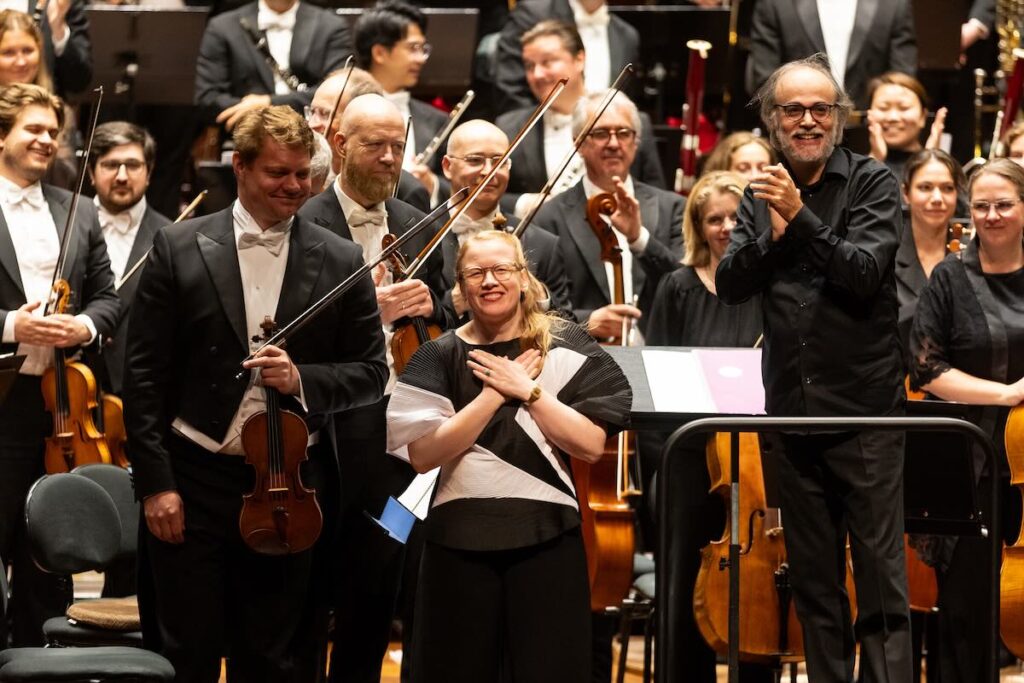
Øyvind Torvund’s Two Pieces for Orchestra and Electronics also received its Norwegian premiere on the same program, though the work was noticeably tamer than his usual fare. The stronger first movement was Wagner on LSD: the iconic solo trumpet crescendo from Rienzi Overture unzipped like the THX sound effect in reverse, and glitzy, sci-fi inflected electronics rocketed around the room in spatialized audio before the Romantic harmonies could become too saccharine.
Torvund’s capricious whimsy eventually materialized on Sunday afternoon at the Norwegian Academy of Music. Untitled School for two pianists, two percussionists, and electronics evoked the feeling of walking down a practice room hallway and absorbing the composite chaos. In this work originally written for the U.S.-based ensemble Yarn/Wire, Rousseau paintings, embroidery patterns, and medieval manuscripts flashed by on a projector screen as messy glissandi interrupted heavy-handed scales and crash cymbals overtook watery impressionism.
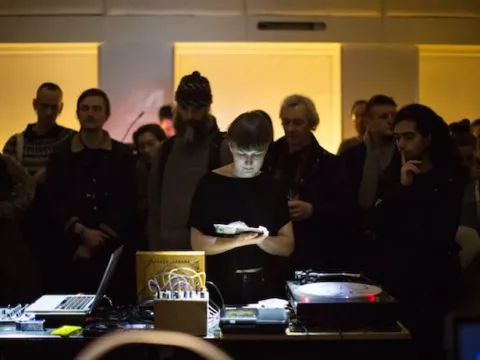
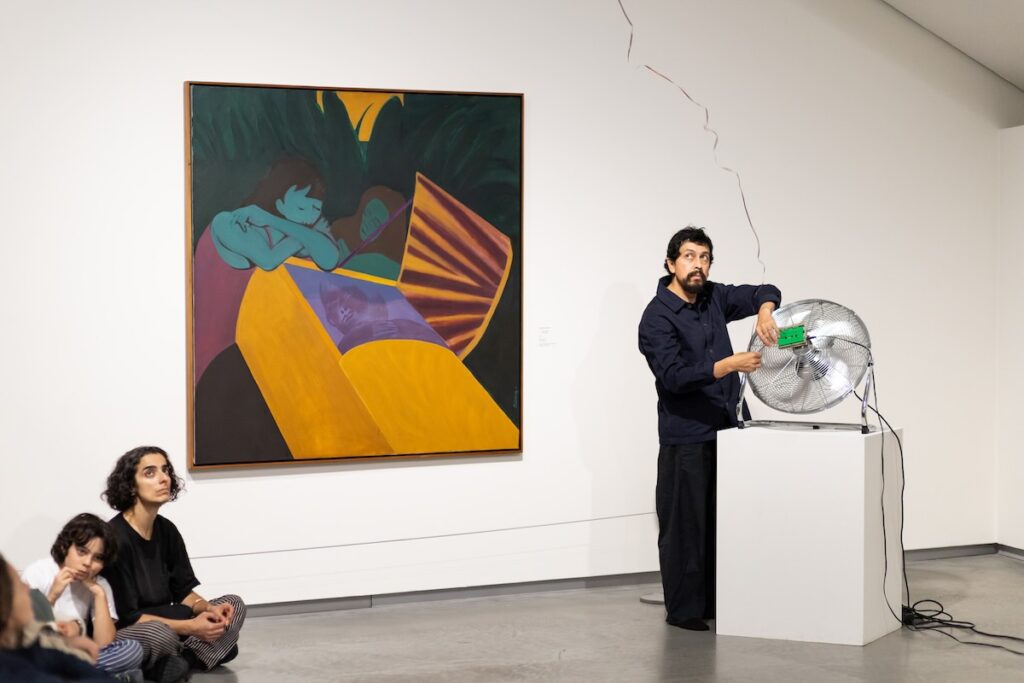
Ícaro Zorbar’s And they call it present was at the polar opposite end of the spectrum with its understated approach. The short gallery performance at the Astrup Fearnley Museum on Saturday began with a woman’s recorded voice: “There is always something before: a history, a background, a past. How do you begin something that has already started?” Zorbar moved through the space as a facilitator of analog machines: a Shruthi box pulsed with the friction of tight harmonies; a plant spun on a record player; a cluster of music box motors simultaneously twirled in a discordant dance. In a particularly mesmerizing moment, an unraveling cassette tape flew higher and higher as it fluttered in the breeze of a fan. It tested the bounds of its extension, as if trying to create a bridge to a recorded past, before inevitably reaching its apogee and tumbling back down to earth.
It’s difficult to establish universal criteria for what makes experimental music successful, but most standout works display a clear artistic identity, purposeful choices, and a quiet confidence. The performances that didn’t fully hit the mark over the weekend were noticeably missing some of these qualities. For example, Lichtbogen, co-created by the four musicians of the ensemble LEMUR, never found a cohesive aesthetic. The thrumming and gurgling work felt co-created as it moved through disconnected textural explorations.
Tine Surel Lange’s Let us all sense was intended to be a multisensory exploration of polar night and started off promising with reedy bass clarinet and accordion drones gently blooming as we sipped peppermint tea with deep blue light circling the room. But unfortunately, the music, lighting design, and distributed food, drinks, and sensory items ended up lacking a convincing connection to a unifying concept.
The anime opera crypt_ by composer Yuri Umemoto and librettist Gareth Mattey was an attempt at avant-garde provocation in an allegory about sacrifice and genius. But the result was a “Ghost of Christmas Past” Victorian man-child stripping down to his underwear after being stabbed and berated about his small dick while an anime girl avatar repeated her shrill, grating melodies ad nauseum.
Some clear highlights of the opening weekend came from artists who had the conviction to let their ideas develop slowly … sometimes very slowly, like Lasse Marhaug’s 24-hour noise performance Trash This Temple. I made it over to NRK Store Studio for hour 21 of this massive undertaking and found the room soaked in deep red lighting and throbbing with empathic, insistent bass — it was a soundworld that could hypnotically sweep you away for hours.
Sarah Davachi’s Feedback Studies for amplified pianos, tuned gongs, Almglocken, and tubular bells was a deliberately-paced outgrowth from the low register of the piano that built to a monastic ringing of the overtone series before folding back in on itself. In the cavernous Paulus Church, Jonas Lie Skaarud’s Transparent Fabric for string quartet and electronics metamorphosed from a volcanic ooze of searing microtonality to a fragile tundra of translucence. The Oslo String Quartet’s constant sustain steadily disintegrated; as the string texture wore thin and exposed holes in the fabric, the electronics finally revealed themselves and maintained the unbroken line of sound.
In RLLRLRLLRRLRLRLRLLRLRLR by Julian Sartorius, FRAMES Percussion performed the same 23-beat sequence of right- and left-hand strokes for the entire piece, yet this simple concept was astonishingly complex and engaging in execution. Starting on muffled toms and snare, a fifth performer gradually placed additional instruments and objects on the drumheads; the clattering of triangles, singing bowls, frying pans, and gongs created pitch-bent timbral accents that almost sounded like gamelan. Eventually, all of the objects laid littered on the stage as the drums were uncovered and booming in full force for a 5-4-3-2-1 countdown.
In general, the opening weekend of Ultima traversed an extreme dynamic spectrum that started with noise and ended with silence. Friday night had taken us to a repurposed bank building where two noise sets in the former vault offered an intentionally unfolding somatic experience.
Cellist Violeta García dragged us to the underworld and back in her visceral, cathartic performance IN / OUT. She struggled with and against her cello as rolling arpeggiations awash in reverb quickly intensified into creaking overpressure that made her entire body contract and lifted her feet from the ground. She ripped double stops out of the strings with her bow slicing through the air like a katana and began violently twisting her cello on the endpin as the bow continued battering the instrument. The only detraction was intense strobing lights that came with no flash warning — and this accessibility issue unfortunately extended to a significant number of performances across Friday and Saturday.
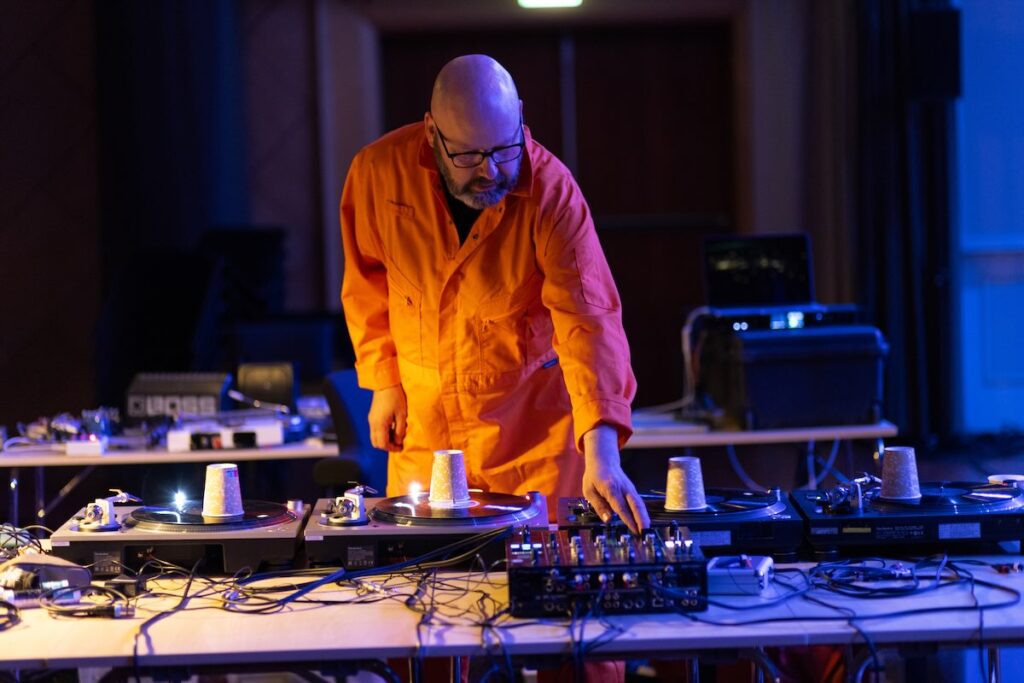
Yann Leguay’s Volta Feedback was similarly riveting; two audio jacks placed in close proximity created a visible, high-voltage filament that generated the sound material for his set. The volatile current rebelled as Leguay tried to shape and manipulate it, and its disobedience was visible in the mutating shape of the glowing arc. With the electrifying performance situated in the vault of a former financial institution, the piece felt like a commentary on how technology and capitalism are intertwined.
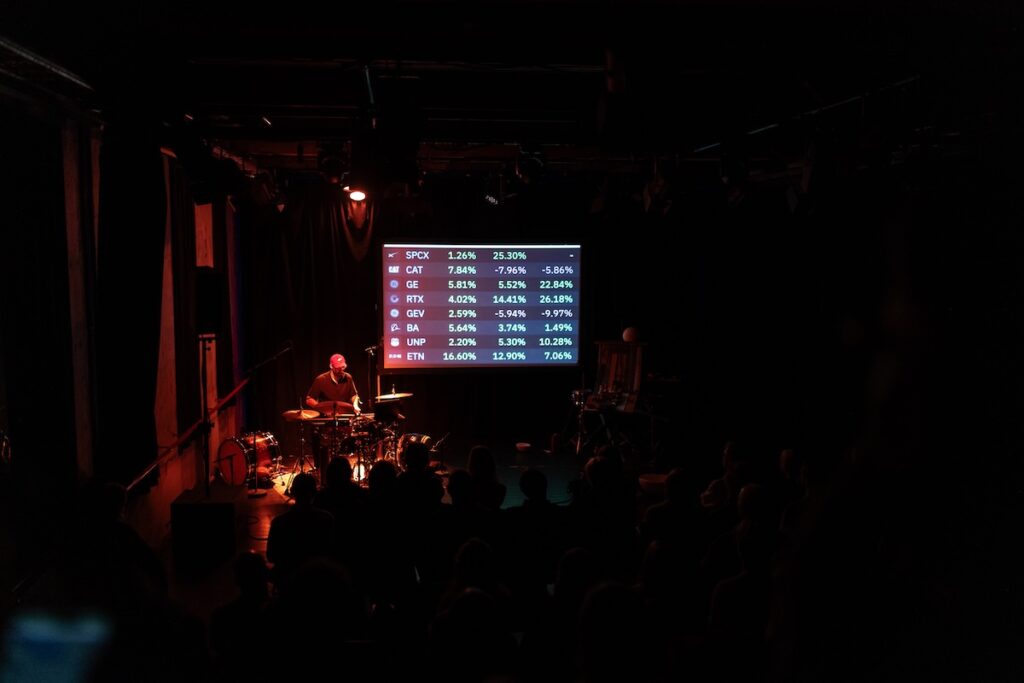
Later that evening, Alberto Bernal was much more explicit in his condemnation of capitalism in impossible translations #3c for percussion and video, performed by Miguel Ángel García Martín. The New York Stock Exchange “Big Board” appeared on the projector screen, its numbers ticking in sync with pounding, polyrhythmic toms. On irregular bass drum accents, the screen flashed to images of war zones, protests, the Black Power fist, and the definition of genocide. The din of cymbals and punctuated bass drum grew more insistent; each stock percentage change was increasingly like cannon fire.
United States politics are inextricably entangled with capitalism, and this has become impossible to ignore in our current American oligarchy. The U.S.-born, Norway-based artist Camille Norment has been watching the rise of MAGA from abroad, and her two works at Ultima challenged the “greatness” of the so-called Golden Age of American identity: a time that — were we to return to it — would mark a regressive stripping of civil rights.
My weekend ended at a concert titled “HUSH” that featured the world premiere of Norment’s choral work Wonderful Marvelous – fugue state. Live-generated feedback by members of the Norwegian Soloists’ Choir had a ghostly and ethereal quality activated by fluid, choreographic hand gestures in front of the speakers stationed around the room. Hazy excerpts from The Great American Songbook wafted through the air alongside manic Stepford Wives smiles, forced laughter, and a swinging rendition of “Keep on the Sunny Side.”
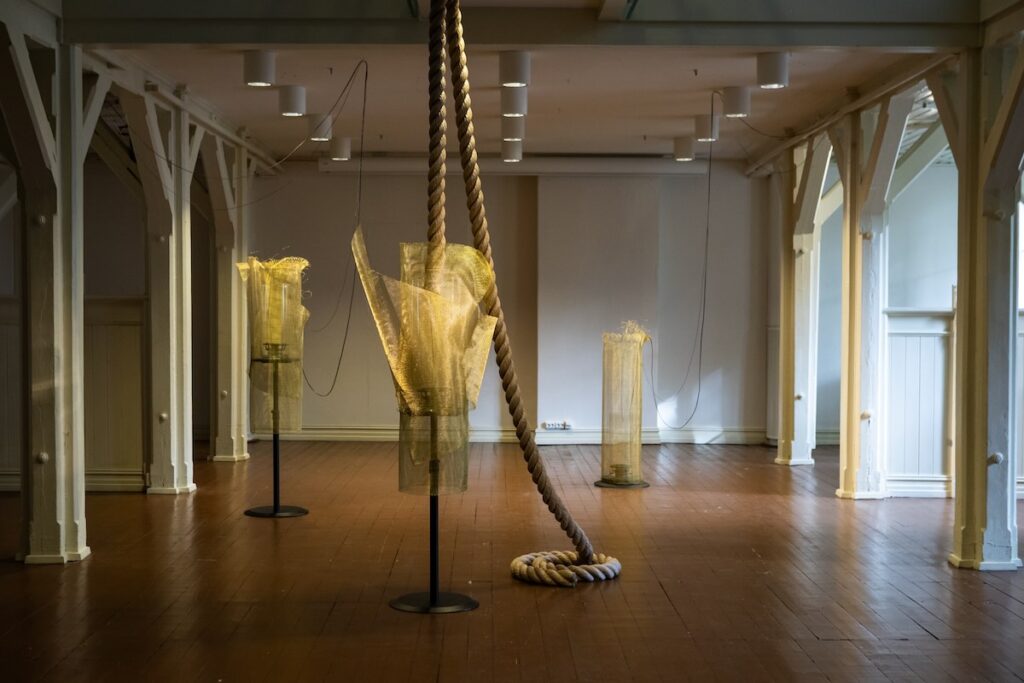
The composition was especially effective in combination with Norment’s transfixing sound installation, which I had visited earlier that day at Atelier Nord. Walking into the space, languid recorded excerpts of George Gershwin’s “S’ Wonderful” and “I Got Rhythm” were immediately recognizable. Individual round speakers sat encased in resonant glass cylinders — two propped up on black cocktail tables, and one on the floor. They were all dramatically wrapped in brass mesh, lending a strong art deco aesthetic. Like a siren song, Norment’s sensual voice beckoned us to return to this “wonderful” and “marvelous” time. The only thing snapping us out of her spell was the intermittent swell of feedback generated by small microphones dangling above each speaker.
But the longer I sat in the space, the line “who could ask for anything more” transformed — there was resignation and dejection in Norment’s voice. My eye was drawn to the way the brass mesh was fraying at the top; the illusion of happiness was coming apart at the seams. A large coiled rope hung from the ceiling — was it Norment’s escape route, or mine?
I CARE IF YOU LISTEN is an editorially-independent program of the American Composers Forum, and is made possible thanks to generous donor and institutional support. You can support the work of ICIYL with a tax-deductible gift to ACF. For more on ACF, visit composersforum.org.