The Ditch doesn’t exactly sound like the name of a classical music venue. Situated in a fashionable district of central London, the rough-and-ready town hall basement might not look like your typical classical music venue either. And yet it proved against expectation to be an excellent space for choral music on 26 Sept. at the launch of Vox Urbane’s début album.
The vocal group was founded to give opportunities to singers from all backgrounds, and they acknowledge there are social and economic barriers to professional music making. Many British choristers start singing as children in one of the cathedrals or large churches: traditionally this was open only to boys, but opportunities for girls have changed significantly during my lifetime. As a graduate student in the early 90s, I sang in a chamber choir alongside young men from cathedral and church backgrounds and realised that women were simply disadvantaged. The first cathedral to start a girls’ choir with equal status to the boys’ one was Salisbury, in 1991.
There are a lot of professional vocal groups in London, and it’s difficult for them to project a genuinely different identity, surely because the background of the singers tends to be homogenous. Many singers on the London choral scene studied at Oxford or Cambridge Universities and were members of one of the high-level college choirs; they represent a wonderful tradition of which the UK should be proud. But Vox Urbane founders, conductor Dan Ludford-Thomas and artistic director Helen Meyerhoff, are both from backgrounds that are historically atypical for UK choirs. I spoke to Ludford-Thomas, who is of mixed ethnic heritage and was educated in a state school, and he told me he always wondered where ‘people like me’ were in the choral scene. Vox Urbane was created to respond to this perceived need.
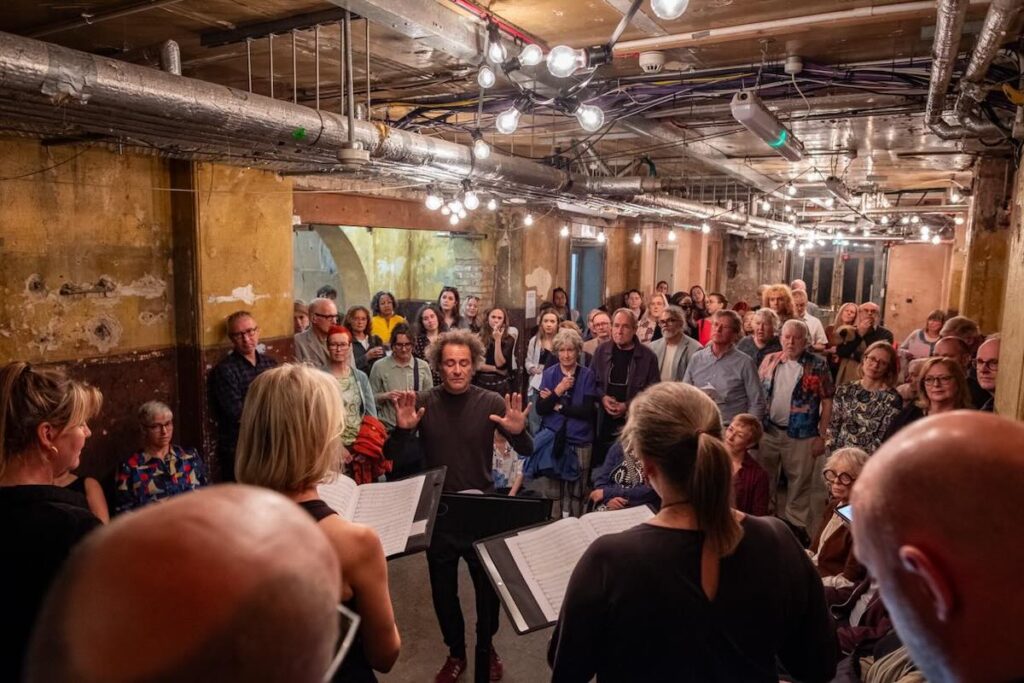
On the evening of 26 Sept., the group featured eight mature voices who achieve that choral music ideal: they blend very well and also have the freedom to express themselves. The sound is warm and generous, and the basement proved acoustically friendly, supporting the group’s resonance while allowing for clarity of diction.
Their album, London Calling, is a contemporary portrait of the city: all composers included apart from one are alive, and most are emerging artists. Seven pieces were heard at the launch, and a few of them stood out. Jago Thornton’s ‘From Telegraph Hill’ was inspired by the London area where Vox Urbane’s directors live: the text reflects the area’s modernity, and the warmly communicative piece tapped into the vivid richness of the vocal group. I loved Lillie Harris’s ‘Margaret,’ based on a church memorial to a medical practitioner who died in 1643. Her first name provided a refrain, and Harris’ simple setting was a touching tribute to someone none of us ever met. Emily Hazrati’s ‘The Time Has Come’ was notable for its lively wit and imaginative vocalisations. It incorporated the traditional London song ‘Oranges and Lemons,’ and the audience enjoyed the ding-donging bell accompaniment.
Of course, there was promotion for the album, but we also heard two short speeches about causes close to the group’s heart. The brother of Anthony Webb, the photographer of the striking album cover image, paid tribute to his talented sibling who sadly took his own life in 2019; his work lives on and his family continue to support the cause of homelessness that he cared about. The homelessness charity Crisis was represented by Paula Lonergan; she spoke movingly of the choir they run for their clients. It was refreshing that the event gave a voice to causes that demonstrate the group’s values.
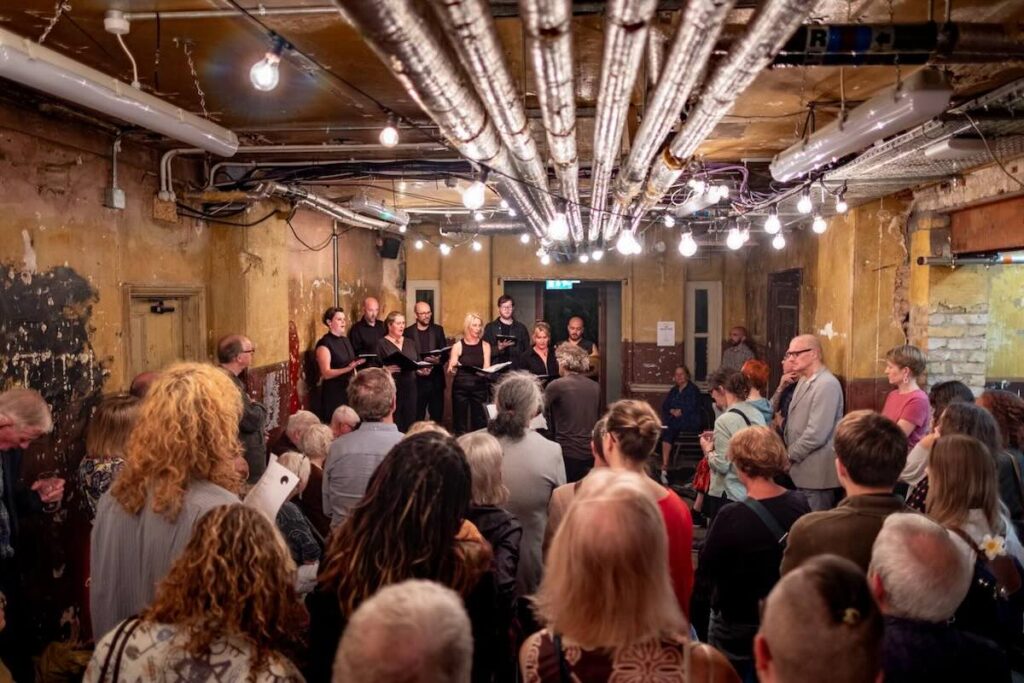
I enjoyed Barbara Dudek’s Odyssey-inspired ‘The Song of the Sirens,’ a showcase for the wonderful contralto Charlie Morris backed by the other voices in instrumental mode, shushing and whistling and ooh-ing. Tara Mack’s ‘Harlem Night Song’ and Kerensa Briggs’s close-harmony ‘Inner Light’ were both effectively written for the ensemble, and the final piece, ‘One’ by Ludford-Thomas, conveyed a strong message of unity that was an apt conclusion for the event.
The evening was friendly and welcoming in a way that is rare in the contemporary and choral music worlds (the vegetarian sushi and miniature chocolate tarts offered to everyone helped a lot). In the UK, we are finally starting to talk about the issue of social class and money being a barrier to the music profession: conductor Robert Ames’ recent article for The Guardian draws on his own experience of financial struggle as a young musician, and he believes things are getting worse, not better. Vox Urbane are a distinctive addition to the UK choral environment who, importantly, are both doing something to broaden the scene and displaying the highest musical and aesthetic standards.
I CARE IF YOU LISTEN is an editorially-independent program of the American Composers Forum, and is made possible thanks to generous donor and institutional support. You can support the work of ICIYL with a tax-deductible gift to ACF. For more on ACF, visit composersforum.org.