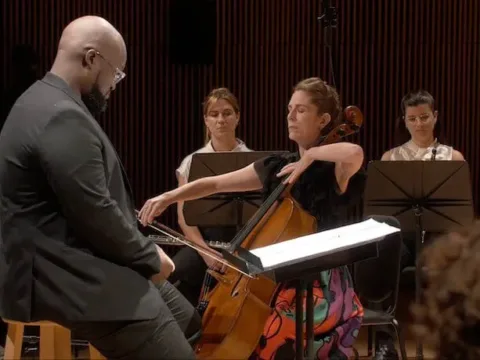
In the last minutes of Márton Illés’ Forajzok (2021), every member of the International Contemporary Ensemble was holding coins in their right hand, shaking them above their heads the same as conductor Rebekah Heller. The coins made a rustling and transitory sound, small but still loud enough to hear in the hall, before Heller began to slowly lower her arm. The ensemble followed by slowly lowering their arms, the contour of the coins shifting into a dense, low rattle. Then, in the quiet, it stopped. Real silence, then applause.
Across four premieres on Aug. 17 at The DiMenna Center for Classical Music, the International Contemporary Ensemble animated the works of four composers circling the same question: how does instrumental sound edge toward the human voice, and how does that voice edge toward silence? The coin-shaking ending of Forajzok closed Monday night of the TIME:SPANS festival and was just one way that these composers chose to explore the boundary between sound and its absence. But the evening didn’t just contain four pieces about sound-approaching-voice: it was carefully built, in order, to end there.
The night began with the U.S. premiere of Imsu Choi’s Pop (2023), an 11-minute piece built on a single electronic popping sound that guided this performance for small winds and percussion. Generated via a motion-sensor improvisation tool, the dry, clipped sound expands and changes throughout the composition, beginning as a brief pop that abruptly appears and freely floats around the ensemble. But the electronic sounds are not ancillary or separated from the acoustic instrumentation; rather, they interact. Tonal divebombs from clarinetist Emmalie Tello gave a wild, unruly dynamic that mimicked the pop, and prepared woodblocks gestured toward a percussive melody. Throughout, the electronics supplied the energy that the flute, clarinet, trombone, and woodblocks spent.
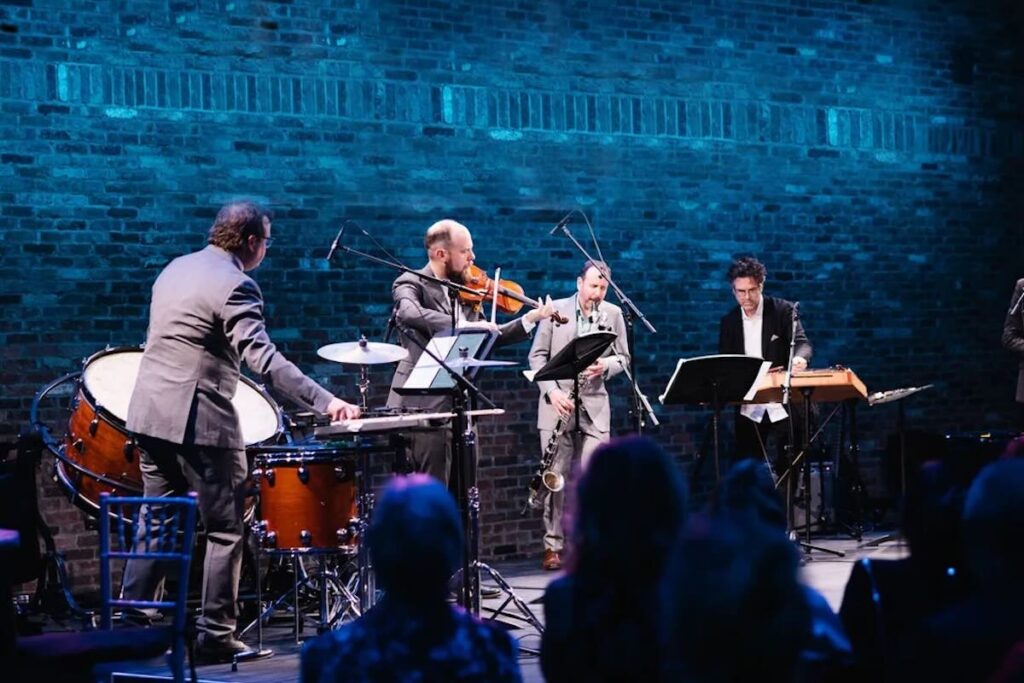
Njabulo Phungula’s ochre song (2024) features three self-described textures — grainy, fluid, earthy — mapped onto specific gestures across roughly 15 sections tied together by color association. The work does not settle on a formal signpost like melody, instead emphasizing the periodic accumulation of sound, occasional waves of tone and color, and rhythms that stayed dislocated across Randall Zigler’s bass and Wendy Richman’s viola. Percussion turned driven, the viola rattled, and Michael Lormand’s sudden, stark leaps on trombone cohered into coruscating, shifting multiphonics. But this roiling eventually receded and yielded to a harp slide, plucked dreamily and almost peacefully by Nuiko Wadden, ascending into tones beyond hearing.
Farzia Fallah composed I did not paint the war. I lived the war. — une Aubade (2025) after she encountered Picasso’s “L’Aubade” and Dora Maar’s “Guernica” photographs in Paris, alongside her own recent experience of war in the Middle East. Heller’s conducting gave the players leeway to take swells, glissandi, and sustained notes without reservation. The clarinet was the sound of a voice holding out against cataclysm, looking for resolution in the morning; Tello held long, high, airy notes gently but firmly against swirling string harmonies before piano tumbled through the ensemble, matching the rhythm of the tolling percussion.
Márton Illés has said his music is built on physical, almost bodily gestures, and his Forajzok showed the somatic core of his sound. The breath was preeminent here, often through extended techniques: ensemble members grunted, groaned, and whispered; woodwinds hissed and clicked; strings sighed in and out of earshot; and Zigler’s bass held under all of it, the one voice that never rose. These archaic, vocal-like textures called the listener back to the human instrument that has always been present at the root of all music. By the time the coins arrived, like departures on small wings, the appearance of silence was logical. It’s where the music had been leading.
An aubade — the genre referenced in the title of Fallah’s work — mourns a parting forced by daylight: lovers or a city pulled apart as morning arrives. The program seemingly occupied the hour before dawn, with the parting still ahead of us. Each sequential composition had been clearing room for the moment the ensemble would stop and the room would keep listening. That moment arrived on schedule, and for a few seconds, the hall went on listening to a piece that was still waiting for the light.
I CARE IF YOU LISTEN is an editorially-independent program of the American Composers Forum, and is made possible thanks to generous donor and institutional support. You can support the work of ICIYL with a tax-deductible gift to ACF. For more on ACF, visit composersforum.org.