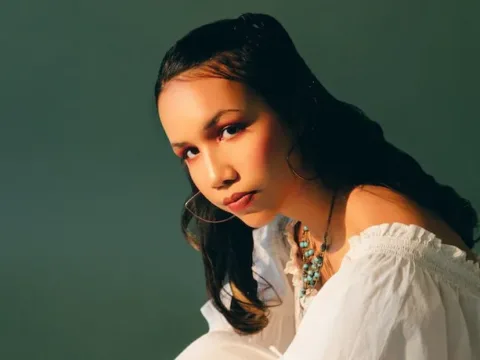
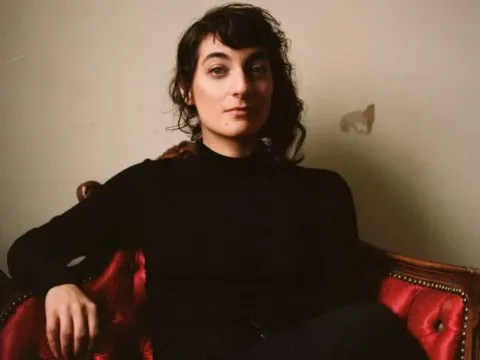
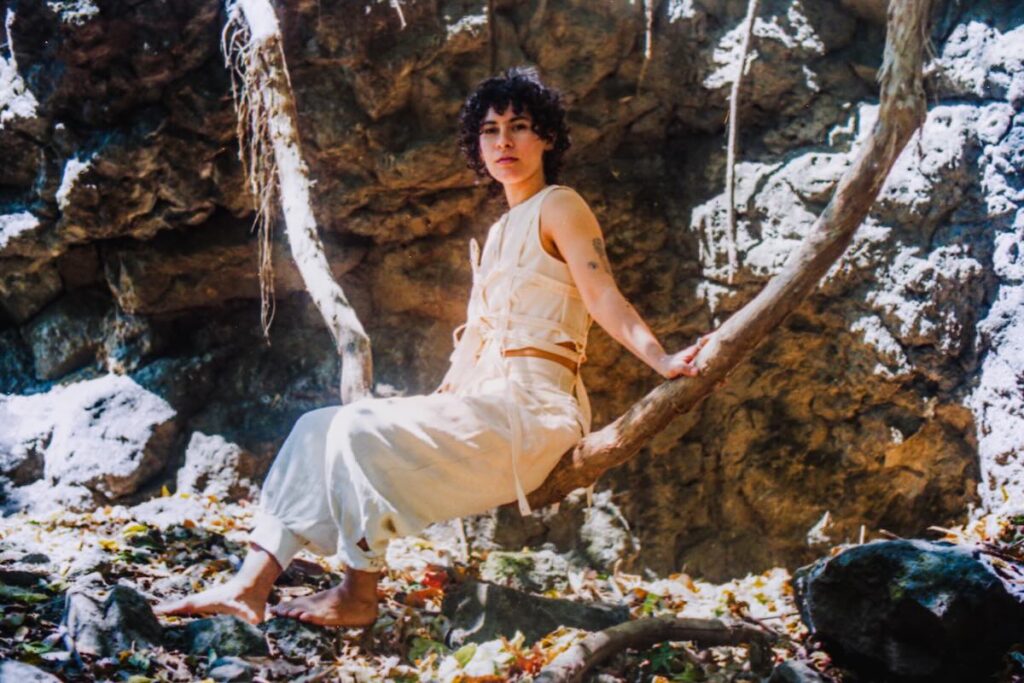
It would be futile to impose a narrative on isabel crespo pardo’s art and artmaking — the Brooklyn-based singer, composer, and interdisciplinary artist is more compelled to create emotional landscapes, memory portals, and “rituals of transformation” than linear tales. Using sound, text, performance, and visual art, crespo pardo adroitly navigates the space between structure and freedom, often starting with a loose framework and leveraging improvisation as a “bridge to the subconscious.”
The interaction between stability and flexibility is a throughline in their work, which frequently leans toward collaboration. In the past two years alone, they have released albums with three of their ensembles, including tilt (with Carmen Quill and Kalia Vandever), toso toso (with Kabir Adhiya-Kumar, Rahul Carlberg, and Celia Hill), and sinonó (with Lester St. Louis and Henry Fraser) — a group that also serves as the main performance vehicle for crespo pardo’s “poemsongs.”
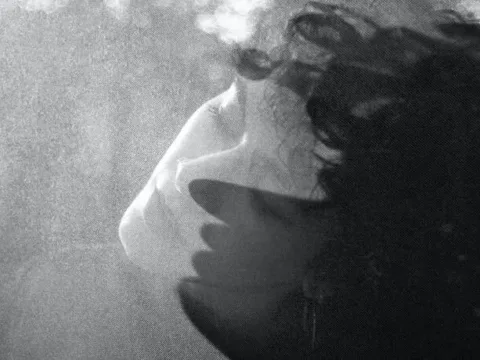
Now, crespo pardo is ready to release their debut solo album, tanto te he querido (so much i’ve loved you), under the new moniker iiisa. An electroacoustic blend of poemsongs, field recordings, and familial chatter from their home in Costa Rica, tanto te he querido incorporates fragments of past compositions and recordings collected over the past decade, resulting in a richly-layered, lived-in, and intimate body of work.
iiisa’s voice sparkles on this record, their agile, jazz-infused vocal technique augmented by deft prosody and bold electroacoustic production. In “tiendo a desaparacer” (“i tend to disappear”), they softly scream and hocket with choked delicacy over a relentless, thumping heartbeat. In the lead single “aún siento la sombra” (“i still feel the shadow”), their electronically-harmonized voice is pushed to buzzy overdrive before being eclipsed by distorted industrial noise and overtaken by frenzied drumming, crying, and shrieking from overlapping field recordings.
Enthralled by their album, we had a chance to catch up with crespo pardo before their Oct. 2 release on Leaving Records.
You’re an incredibly prolific artist with talents in multiple modalities, from singing, composing, and improvising to embroidery, poetry writing, and electronic production. How have you cultivated all these various artistic skills over the years?
My formal training is in improvisation, composition, and voice, but visual art and poetry have always been in orbit as well. I enjoy creating opportunities to explore the things I’m drawn to, and sometimes they become fodder for new works. So, although the core concerns of my practice are consistent, my output is flexible. I also love learning; it’s one of my primary interests and fundamental to my creative process. I’m often taking classes, and love seeing the logic that runs through different mediums or areas of study.
There’s often a set of hidden threads underneath what someone teaches you: why the practice is important to them, what their priorities are, who they imagine you to be as they interpret your questions. It’s all so fascinating, both in the way of learning something new, but also in the social ritual of passing on information. I’ve been studying metallurgy for the past year and a half, and working with metal in particular has taught me so much. There’s also so much to learn within music. I’ve been taking classes or enlisting friends to teach me about mixing, dj’ing, rhythm analytics, etc. I find my mind needs a lot to chew on, and so I’m on a constant search for inspiration.
Considering your rich history of collaboration, what is different about making and releasing your music as a truly solo project, iiisa?
As someone with a background in improvised music, I always knew the benefits of maintaining a solo practice, but it’s something I avoided for a long time. It was difficult to sit with myself, attend to my creative desires, and craft an expression of my inner world. Ultimately, what made it make sense for me was recognizing that there’s nothing we do alone. My solo practice became a way of tapping into the constellation of shifting presences that have surrounded me, which has been incredibly elucidating and healing.
It’s still so mysterious to me. I started working on this project four years ago, and yet every time I sit down to practice for a show, it feels like treading a new path. When I’m playing solo, I’m entering the cave of my mind and bringing the audience with me. So, it feels important to hold every part of the process with care.
The performance begins long before I arrive at the venue, the soundcheck must be peaceful, and gratitude stays at the center, otherwise it won’t work. Maintaining a solo practice has definitely been difficult – mostly because I’ve been trained (like so many others) to disregard myself – but it consistently centers me in ways I couldn’t have imagined.
Each track on your new album feels incredibly well-sculpted and complete. How much of the original structure and digital effects will translate to a live performance setting?
I crafted the album as a concise introduction to this collection of songs, but in performance, they are often more expansive, morphing and combining in different ways. It’s what keeps me engaged in the process. I call them “poemsongs” because even as they shift, they remain tied to a felt essence.
Sometimes a written composition can feel like a rubric, rather than an invitation. In performance, I keep a clear hierarchy: whatever present-me feels called to do always takes precedence over what past-me wrote. I compose in a way that accounts for the kind of freedom I know I will want in performance.
And even prior to performance, I love recomposing these pieces. “en voz alta” is actually the first piece I performed solo, and it used to be 20-minutes long. Since then, I’ve re-written it eight times! Each section of “aún siento la sombra” has been rewritten at various points to where it’s almost entirely a new piece but somehow still carries the essence of the original piece – real “Ship of Theseus” style. All this to say, the music is in motion, and no two performances will be the same.
I love the embroidered graphic score (desbordándome) that you created during your 2022 Van Lier Fellowship. How did you choose the materials and decide how to visually represent your ideas?
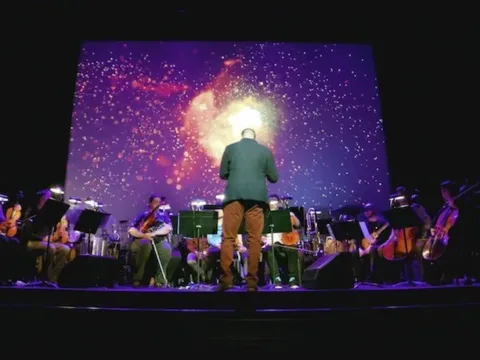
I wrote desbordándome for my cello, bass, and voice trio, sinonó. I had been writing open-form pieces and graphic scores for us, and after one particular performance, an audience member said they wished they could see the scores while we played. Their wish stuck with me for some reason, and in response, I created an enormous embroidered graphic score on tulle that floated between the trio and the audience, like a map for all to follow.
My choice of materials is usually quite intuitive, functional, and aligned with a particular concept at the core of a piece. Regardless of what mediums are involved, I’m interested in creating pieces in which every element feels necessary. I feel this way in musical ensembles, as well: I always want everyone involved to feel their role as fundamental to the piece. So although it took me countless hours to embroider the score – tulle is quite delicate – I felt committed to the concept behind it.
Your new album makes such creative use of electronic production, and I’ve seen videos of you performing in front of a laptop with an extensive live rig. Can you shed some light on how you use electronic tools (including hardware and software) in your creation process?
Learning electronics feels like learning an entirely new instrument(s), and although I’m still at the beginning of that process, it’s been exciting to catch glimpses of the sonic possibilities. Currently, my practice is primarily electroacoustic. I’m interested in how an acoustic sound is captured, the texture within a degraded sound, the energy behind it, and the context it brings with it. From there, I enjoy applying electronic processes to acoustic sounds as a way of putting them in conversation or abstracting them. And given that I’ve been working a lot with field recordings gathered at home in Costa Rica, this has meant layering and resignifying memories via electroacoustic practice.
In terms of my setup, the components shift around a bit, but I primarily use Ableton Live and the Push because I enjoy the flexibility they give me in performance. For the tanto te he querido tour, I’m excited to incorporate tape and multialgorithmic pedals, and I am increasingly curious about the kinds of distortion at play within the set.
I CARE IF YOU LISTEN is an editorially-independent program of the American Composers Forum, and is made possible thanks to generous donor and institutional support. You can support the work of ICIYL with a tax-deductible gift to ACF. For more on ACF, visit composersforum.org.