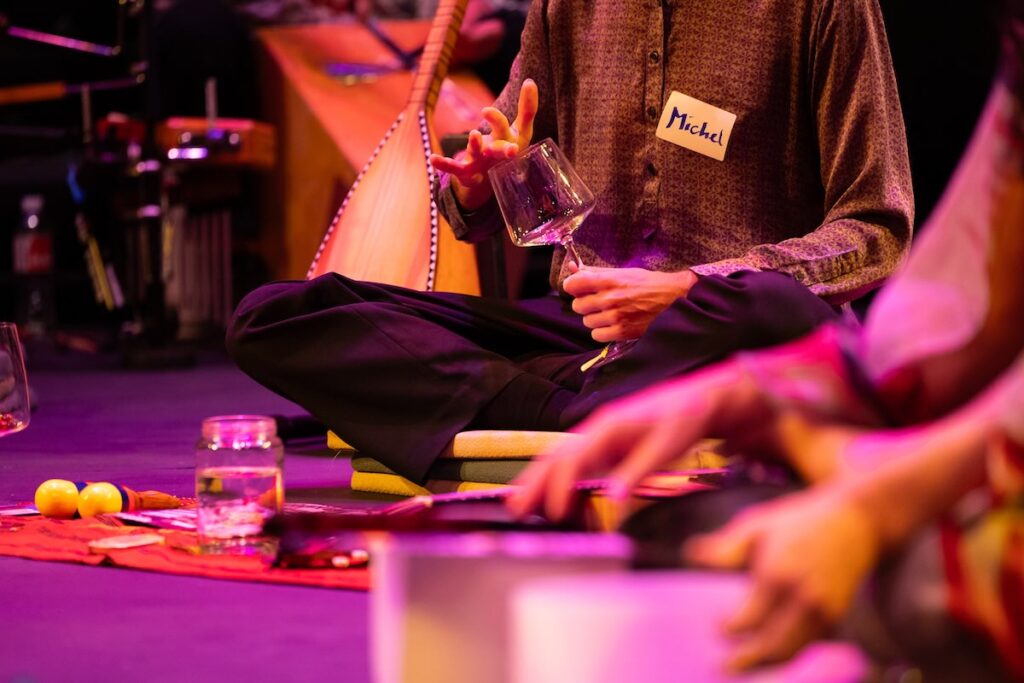
Within the sonically contained black box theater at REDCAT, a prismatic playroom of toys, knick-knacks, and household items were sprinkled amid instruments, cushions, and chairs. As the world premiere of Shelley Washington’s vibrant How We Hold Together unfolded, the stage became an immersive game of “I Spy,” both visually and aurally.
The improvisatory performance on Oct. 11 was presented on a program titled “The Room Begins to Rise” during the second weekend of “Democracy Sessions 2026” — a month-long festival of music and performance leading up to the U.S. midterms. Organized by the Los Angeles ensemble Wild Up, the series explores “how art can function as a democratic practice” through community events that highlight interdisciplinary artistry, including animated films, performance art, sculptural installations, among many premieres of new music.
Reflective of the chromatic set-up, the score for How We Hold Together was itself a colorful collage folded into a zine-like pamphlet: performance directions and music notation were unevenly cut and pasted on a moodboard of assorted seasonal images, and each season was assigned five bars of melodic and harmonic motifs. Arranged in a clockwise loop, the score’s layered visuals — from a sage green waterslide beside a barren desert to cold steel flowers by a warm cityscape — informed the performance as much as the words and music.
Washington’s instructions referred to the score as a “map and calendar,” the performers as “neighbors,” and the music as a “catalog sound poem” performed with any instrument, voice, or object. Though I wish audiences could have been given physical copies of the one-page score to follow the cycle through the seasons — something that could have strengthened the performance’s connection to collective participation in a democracy — the relationship between score and sound was clear even when reviewed in hindsight.
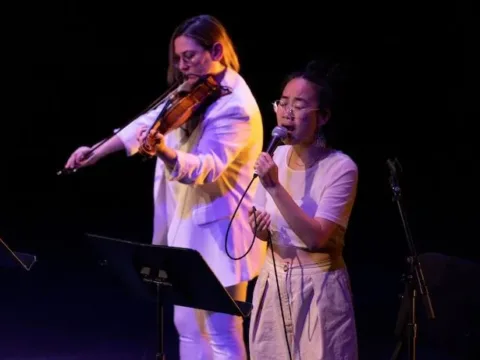
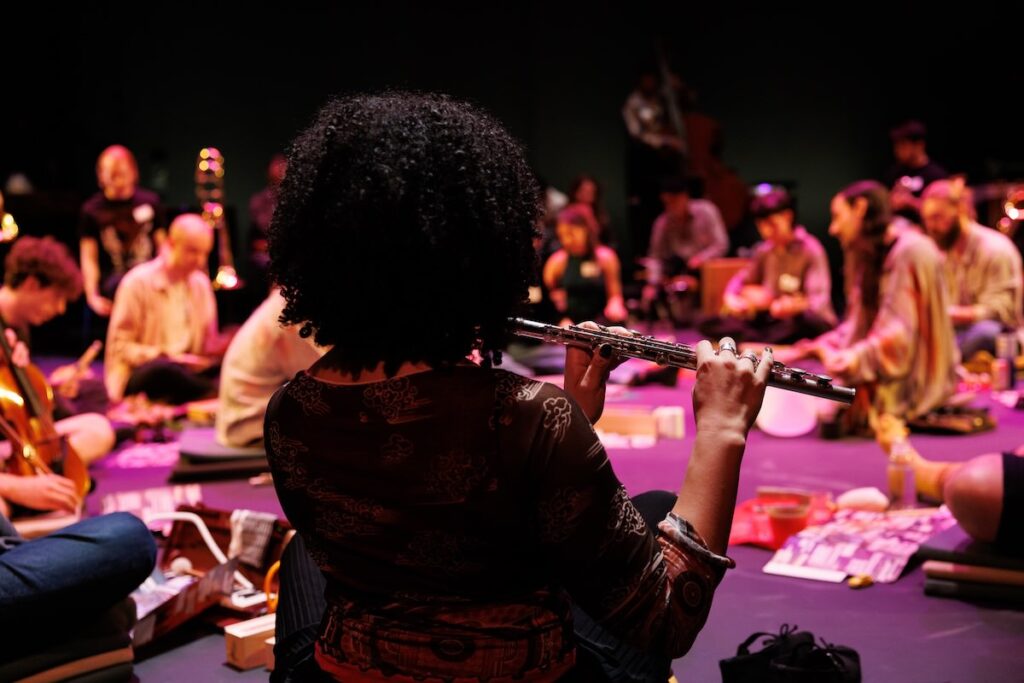
Over 40 performers comprising Wild Up musicians, CalArts students, and the Collective Orchestra filed onstage, took off their shoes, and ritualistically created name tags that would identify them throughout the performance. Among them: Washington, on a cushion front and center with dice, pebbles, keychains, and her flute; to her left, Artistic Director and conductor Christopher Rountree before a toy piano.
Like a lambent dawn, the music materialized with the faintest of rustling, rattling, and whistles that reflected the current autumnal season. My eyes and ears continually darted around the stage, where performers alternated between instruments, objects, and the body. Washington made warbling sounds with her pebbles while playing flute. A drummer crunched a pile of dried leaves and jingled plastic bottle caps attached to strings. A cellist paged through her journal between bows. A xylophonist made tea in a thermos and tapped the plastic lid with his mallet. Then came spoken words, poetic and meditative on top of steadily growing harmonies and uttered at each performer’s own pace: “With our palms up. With our hands out. With arms surrounding.”
Before long, the grating and shrill sound of metal against metal and artificial harmonics heralded a gelid winter cold. I watched Rountree conduct for the first time, cueing a series of lurching, heavy swells, as if fighting through a bitter storm. Performers seemed to pulse together in the way that teams in a tug-of-war synchronize their pulls. It was then that the program title “The Room Begins to Rise” made sense to me — only collective, diverse strength can make a room literally rise, and by extension, allow a democracy to flourish.
The thunderous tones dulled when Rountree made a butterfly gesture. The music transitioned to a fluttery, jaunty springtime soundscape — the most rhythmically cohesive season in that afternoon performance — and I found myself swaying to the kashaka’s rattly click-clack and the marimba’s buoyant chimes. Meanwhile, two performers took turns rolling a xylophone on a skateboard towards the other. The person who had made tea earlier handed out paper cups to his neighbors. Another performer swirled a skimmer in a metal bowl of water to create the tiny splashes visually depicted in the score.
Summer exploded into existence with a climactic wall of sound. Bows grinded into strings, voices bellowed, and brasses blared in what became the most fervid moment in the performance. Like the winter storm, Rountree again cued undulating dynamic progressions, this time emulating relentless Southern California heat waves. The sonic overwhelm eventually gave way to laughter and voices, with a question recalling the spoken words we first heard: “How do we hold on?” The music fell hushed with soft pitter-patters of taps and claps, just enough that I could make out the faint inklings of autumn returning. “With our palms up. With our hands out. With arms surrounding,” they answered once more in whispers, closing the hour-long journey through a year.
Through this experience, Washington allowed us to experience a type of unity that preserved individual differences in voice, pace, and interpretation without stringent timing or constant adherence to a conductor. In doing so, she offered an imagined possibility for discourse and nationhood: perhaps our eclectic and discordant perspectives, even amid entropic circumstances, can still yield a beautiful and playful togetherness.
I CARE IF YOU LISTEN is an editorially-independent program of the American Composers Forum, and is made possible thanks to generous donor and institutional support. You can support the work of ICIYL with a tax-deductible gift to ACF. For more on ACF, visit composersforum.org.