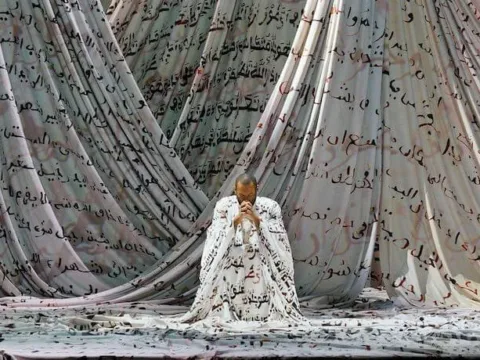
I heard the wind rushing as soon as I stepped into the Metropolitan Opera House on the evening of Oct. 19. The hall resonated with a crepuscular chorus of cicadas, frogs, and crickets as overture, and a dark hush was maintained by the audience as they took their seats. The curtain gave context to this swampy atmosphere: made of black lace, the audience’s perspective was that of a mourner looking through a funeral veil into the woody cemetery beyond. When lifted, it revealed a mossy forest of trees, exuding dampness and enchantment and stretching into the rafters.
Lincoln in the Bardo inhabits this liminal landscape of purgatory. With music by Missy Mazzoli and libretto by Royce Vavrek, the new opera is a dazzling wild rumpus based on the 2017 Man Booker prize-winning novel by George Saunders. “Bardo” is a Buddhist term describing various transitions of consciousness, and here it refers to the graveyard where Abraham Lincoln has just interred his young son Willie. Filled with spirits who are unable to let go of their respective traumas, Lincoln’s repeated visits to his son’s body prove to be a catalyst in helping the inhabitants finally allow themselves to “matterlightbloom,” detonating themselves into the ethereal beyond in a thunderous flare of light.
And yes, there is a five foot long, unnervingly realistic penis puppet (by Brenbri Properties and The Paragon Innovation Group), though the fact that Vavrek managed to condense the book’s profusion of male member references down to one is its own feat. But the moments of quirkiness and lewd levity helped to retain Saunders’ dark humor and mood-mining flavor while creating space to discuss death for nearly three hours.
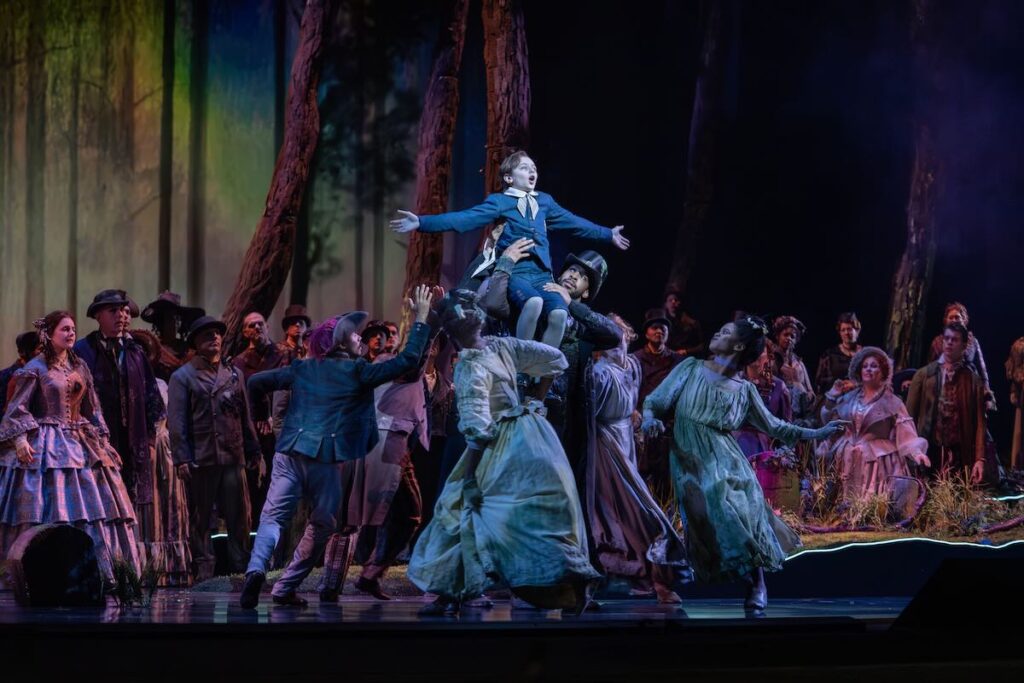
Mazzoli’s orchestration — though not as high-octane as I would have hoped given the subject matter and performing forces of the MET orchestra and chorus — is deeply layered in symbolism and lends both subtle and overt context to the character’s varied stories. The multitudinous chorus of spirits managed to be both eerie and effervescent; Mazzoli’s writing trended towards kazoos and upwards glissandi, including a wordless, gargantuan tutti gliss into the stratosphere that foreshadowed their eventual matterlightblooming. The chorus’ moldering garb from multiple periods, designed by Montana Levi Blanco, beautifully conveyed how elaborate they must have been pre-death.
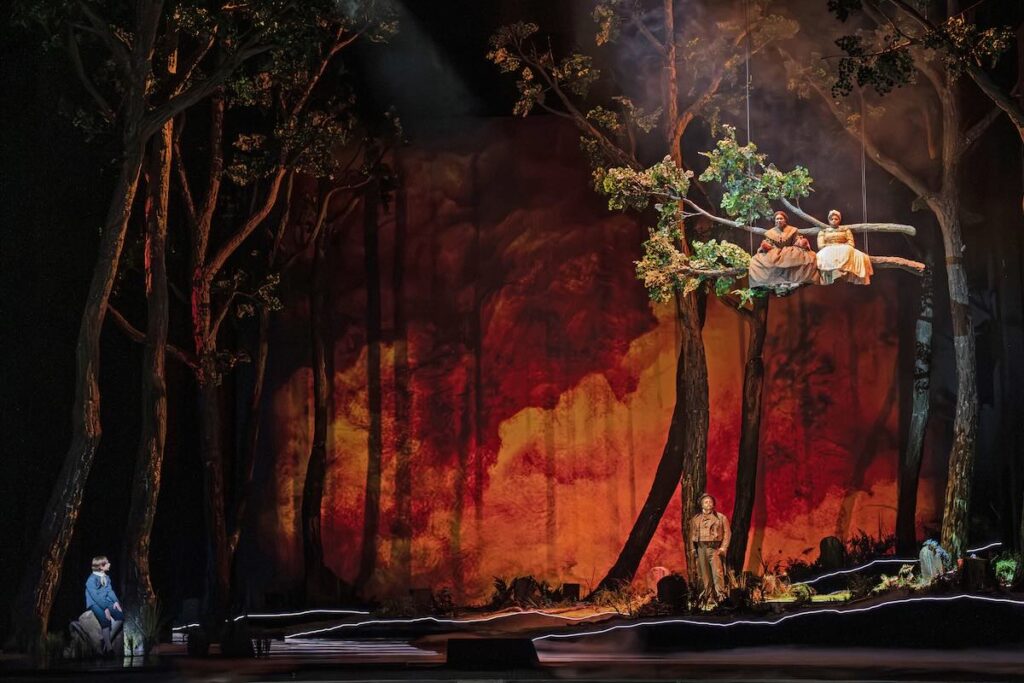
Adam Rigg’s set design (collaborating again with director Lileana Blain-Cruz after the success of John Adams’ El Niño) featured neon green striplights that traced the terraced contour of the terrain, portaling the sepulchral into the magnetic by marrying a dark dreamscape of magical realism with the vivid electricity of the 21st century. Frequent and quick changes in pacing occasionally proved distracting and flung my awareness off of the stage and back into the audience, though perhaps this is a necessary evil when creating from material constructed mainly from monologues.
Entering the stage to a rush of applause, Christine Goerke as the Reverend had some of the biggest musical moments of the evening while recalling the experience of being judged at the gates of heaven. In front of a backdrop that makes stunning use of negative space, Goerke’s dramatic soprano reigned over an orchestral palette filled with church and angel references, including momentary organ, the chorus’ sole instance of hymnlike counterpoint, and a low, buzzy harp melding with burring cello and murmuring woodwinds.
Singing solely in monologues, Peter Mattei’s Lincoln projected believable grief, from the subtle to the primal. One of the most poignant moments of the work: Mattei singing “Willie is dead” in a translucent, golden falsetto alongside Everett Sobers’ sensitive navigation of the incredibly demanding role of Willie.
Anthony Roth Costanzo’s portrayal of Miss Elise Traynor gave haunted Little Bo Peep thanks to a fabulously elongated brown wig and white gown complete with dirt-stained hem. Having died at age 14, she is unwilling to accept that she will never experience the sensual joys of marriage and motherhood. Costanzo was expressively dextrous, effortlessly conjuring the many nuances of this character’s personality and physicality as she shape shifts between an ominous tangle of vines, a gigantic clapping jaw, and a cloud of pigs in correspondence with her mood.
Ryan McKinny’s Vollman perfectly balanced comedic timing while endowing his lines with the rough-hewn, crestfallen energy of a man who died before ever making love with his wife. As the Flaubert-ian Bevins, Jonah Hoskins’ commanding spectrum of tone beautifully embodied this character who, just before death, became tuned in to the magic of the mundane. As Janai Brugger’s fierce Mrs. Francis Hodge descended from the ceiling with a defiant cry while sitting on a tree limb that looked like it was a watercolor drawing from a children’s book, I was struck with awe thinking about all the performing forces it took for this moment to happen. It was a veritable argument for why opera exists, is an inimitable art form, and should be treasured.
Joshua Blue gave a show-stealing portrayal of Thomas Havens, an enslaved person who cherished the infrequent moments of solitude in his life — and who steps into Lincoln’s consciousness by cuddling up under his arm, automatically heightening Lincoln’s awareness of the horrors of slavery. It is through this same gesture that Vollman and Bevins first share Lincoln’s consciousness, noting immediately that there was “a touch of the prairie about him.” By being able to glimpse into each other’s psyches, they are each able to glean new understandings about their own memories, and are able to immediately matterlightbloom. An astonishing piece of theater, Lincoln in the Bardo beautifully unearths the message that ultimate healing comes from willingly engaging in ultimate empathy.
I CARE IF YOU LISTEN is an editorially-independent program of the American Composers Forum, and is made possible thanks to generous donor and institutional support. You can support the work of ICIYL with a tax-deductible gift to ACF. For more on ACF, visit composersforum.org.