The sky can’t decide if it’s going to rain. Baby blue dots the gaps between hulking grey clouds over the Minneapolis skyline. The moody tone resonates with bassist and composer Liz Draper’s self-styled “classicaldoomfolkjazz.” But the scene also shares a looming sense of possibility with her Aug. 21 sound installation at Edna’s Park — a small rectangle of green space obscured behind a hot dog shop, The Wienery, in the Cedar-Riverside neighborhood.
“Sound installation” perhaps carries connotations of pre-recorded gallery work, but words around music can get frustratingly muddled. Terms like “new music” or “experimental” can mean almost nothing. Yet, there are grains of precision in “sound installation,” a phrase that accurately telegraphs an intentionality that expands beyond the aural experience.
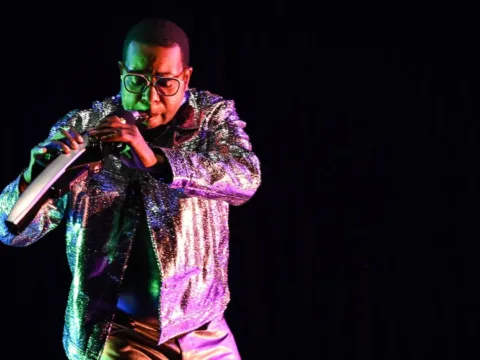
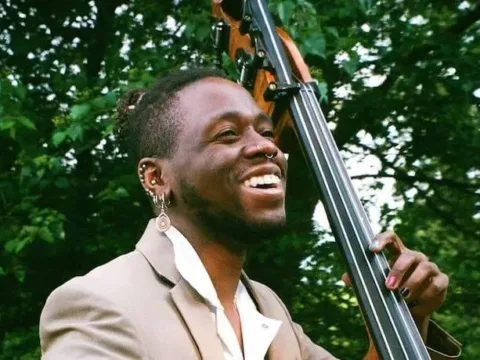
Draper’s quartet is assembled in a rough oval around the park. A drone surfaces as they begin a loosely composed, nearly 90-minute piece with improvisations. Violinist Alissa Ona Jacobsen stands on a small patch of concrete, Draper’s upright bass placed near a bed of flowers, Dameun Strange’s kamele ngoni, synth sax, and mbira on a square of flattened cardboard, and cellist Mikey Marget rounds out the assembly, sitting on a white sheet.
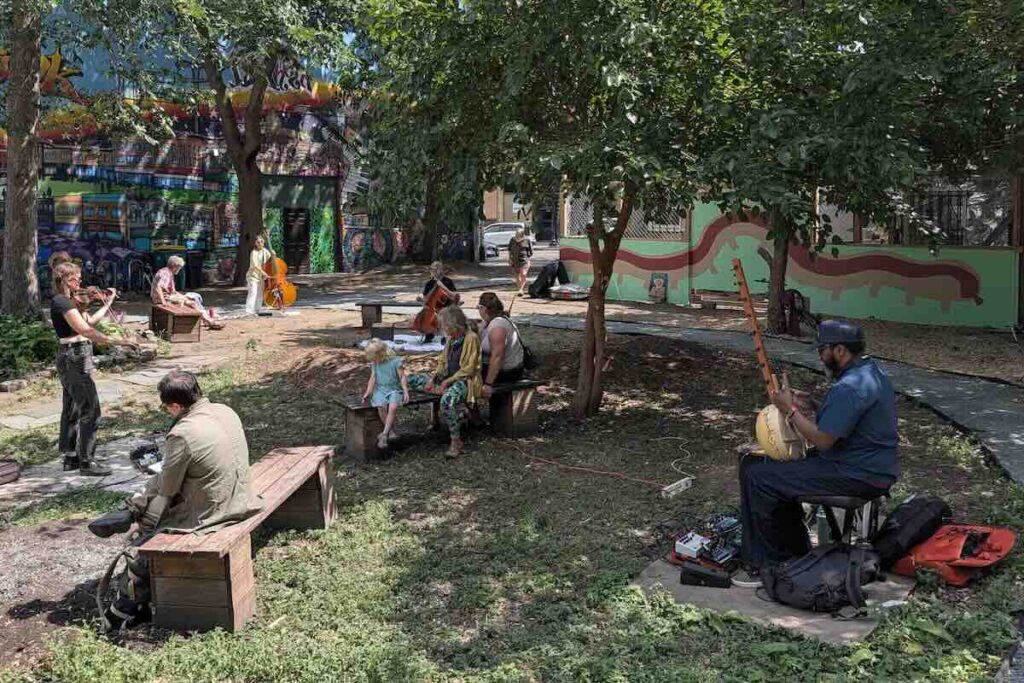
Each of the performers runs their instrument through pedals, processing the sounds before amplification. Reverb-laced discordance emerges from the drone, with ecstatic, if morose, violin flourishes and squeals calling above the substrate of the mounting tension from bowed bass. Marget’s cello forms a wash, a warm blanket thrown over Strange’s more heavily processed kamele ngoni. Jacobsen taps the body of the violin as Strange briefly moves to mbira, plucking a key that, run through his pedalboard, transforms into a synth-like flurry of notes. He switches back to the kamele ngoni, scratching its round body, a noise remodeled by reverb and delay into a ghostly moan. The result is harsh and darkly atmospheric.
The small crowd, knowingly or unknowingly, becomes part of the piece from its outset. It’s not just the setting, where wind sifting through the trees accents the cello’s delicate melody. The audience is asked, required even, to make choices about how to exist inside the composition. Sit or stand? Stay still or stroll? Open a soda and allow that aluminum crack to enter the conversation?
Sitting on a bench between the violin and kamele ngoni, the acoustic quality of each emerge quietly underneath the louder processed sound, a result of the performance’s intimacy. Yet, listeners on the far side of the park get the same from the bass, tones lost to me until I walk a loop and settle again on a bench near the raised flower bed.
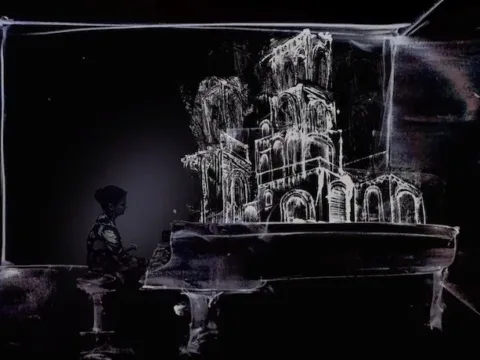
A literal and figurative cityscape rises and refuses to settle. At times the instruments greet one another; the cello and kamele ngoni offer a longing call-and-response, interrupted by the muted plucking of the bass between bridge and tailpiece, a discordant clarion answered by the violin’s reverb-washed pizzicato. In other moments, the voices are not necessarily at odds, but exist in their own lives simultaneously.
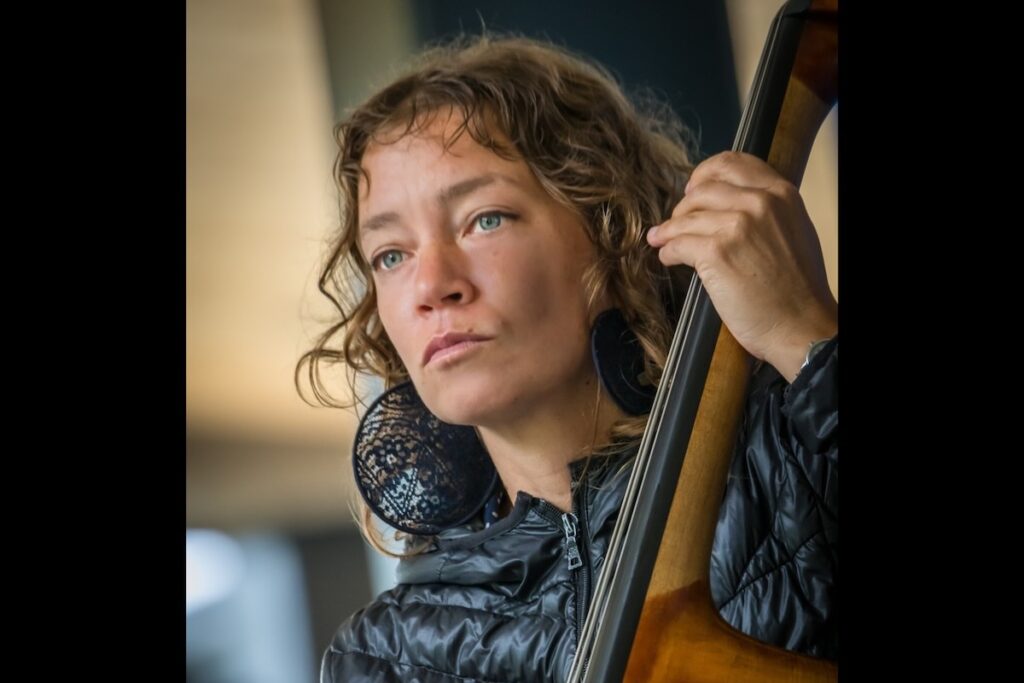
That sense of a community-in-dialogue is more strongly suggested because of the installation’s choices; the sounds of the surrounding city build a similar conversation parallel to the music. Car horns at the stoplight around the corner. Children talk and laugh along the sidewalk. A bang echoes off an apartment building as a delivery truck lowers its ramp. The cellist pauses to listen. The kamele ngoni issues a plucked call answered by the bass.
The result is uneven. For what the piece occasionally lacks in sonic cohesion, a segmented dialogue rises. That unsteady feeling isn’t chaotic fragments, but a novel in short stories. Its atmospheres are erratic, but its broader picture is clear.
There’s tension in the dissonance, but also in the growing entropy of its world. Just as the compositional structure invites a certain form of exploration from the audience, the musicians seem to test their instruments’ capacity for new sounds. Even at its most fervent — a frantically bowed cello that becomes an ambient texture against staccato melodies from the synth sax — the audience and instruments are being asked: how will you choose to live in the shared space at this moment?
Draper’s work forms a melancholy question mark over its own cityscape, delicately but assertively asked. Not why can’t things be a certain way, but simply “why not?” in broad strokes across public space, across how we listen, across the perceived utility of objects, or across the larger expanses around us, wherever we may be.
I CARE IF YOU LISTEN is an editorially-independent program of the American Composers Forum, and is made possible thanks to generous donor and institutional support. You can support the work of ICIYL with a tax-deductible gift to ACF. For more on ACF, visit composersforum.org.