The desire to bring the music of Hildegard von Bingen into the modern day is not an uncommon one. As the medieval composer, abbess, writer, and mystic has ascended to something of a household name, contemporary ensembles have gravitated toward the stillness and semi-improvisatory nature of her music. Such is the case with Nwando Ebizie’s Ecstasy of the Virtues, which holds this focal point of Hildegard’s work while introducing elements of contemporary classical and experimental performance ranging from electronics and minimalism to ceremonial musics from across the globe.
The new opera production, presented on 26 Sept. by Mahogany Opera, is inspired by Hildegard’s morality play Ordo Virtutum, the visions she experienced through her life, and the beauty of intimacy and ecstasy. Seeking to reframe Hildegard’s work through an Afrofuturist and neurodivergent perspective, Ebizie and her team gathered experts in mycelium, apothecary, rituals, and neuroscience to devise a multisensory opera with myriad influences. Ebizie also drew on her own experience with Visual Snow Syndrome, which altered her perception of reality to feel more translucent and aura-like.
The performance began well before we sat down; the Oracle, a tribe of wise council members wishing to provide prophecies to the virtues, immersed themselves amongst the audience. Each engaged in their own ritualistic behaviour: spraying rosewater, bowing, lightly massaging their hands, all while singing poised fragments that led to the first Incantation.
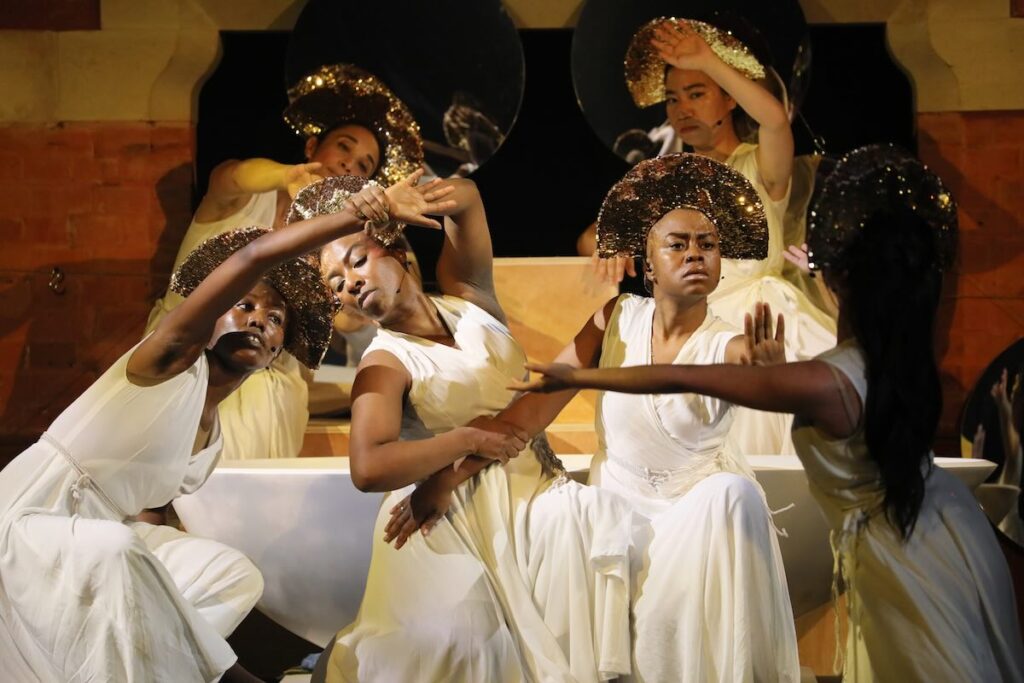
This idea of blurring carried through these incantations, breaking away from the operatic tradition of alternating recitatives and arias. The swaying and dreamlike environment saw each performer navigating their own internal, mythical melodies and spontaneous choreography, creating a feeling of continuous sonic and physical movement. In the opening, these overlapping vocalisations effectively created a sense of wonder within the ethereal space we were about to enter. Laura Bowler, who played the virtues of Love, Potential, Belief in Humanity, and Mercy, delicately shifted the vowels within her straight-toned line to infuse stunning texture into the glowing sea of voices. Later, hocketed rhythms developed through footsteps and percussive, syllabic vocals to evoke the desired feeling of glee.
Each incantation sought to balance the ritualistic nature of the Ordo Virtutum with Ebizie’s interdisciplinary vision. The experience was immersive at times, but many sections ultimately lacked cohesion and direction. With each subsequent incantation, the chaos of independent singing and movement grew stagnant rather than presenting a ritual seeking to be carried out.
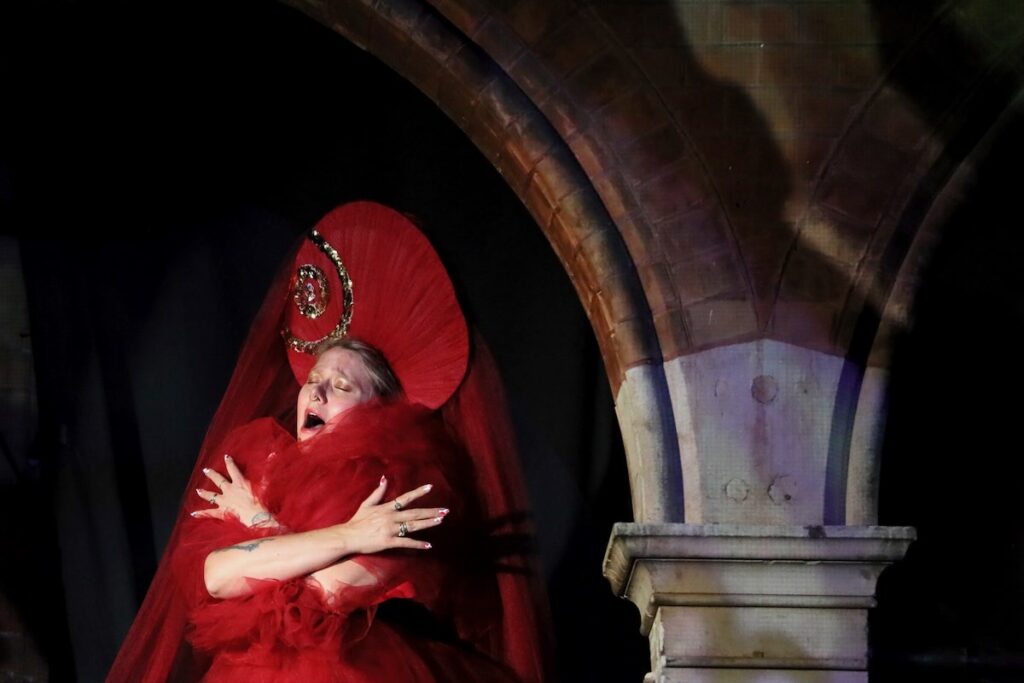
Some moments of clarity still managed to come through the murky texture. In the Tableaux of the Second Half, tingling melodic pulses emerged amongst the ensemble to contrast those coming from various synthesizers. These sections of the opera felt particularly strong and empowered; the ensemble joyously danced with the hocketing counterpoint of pulsating vocal rhythms and body percussion, embodying the titular feeling of ecstasy. Chisara Agor was a driving force in bringing the musical energy to unencumbered elation. In the interval, audience members chatted with singers from The Oracle as they broke bread (literally) while remaining within their mystical characters.
A stunning feature of this production was the joint performance of the virtue of Self Loathing by soprano Grace Nyandoro and Deaf performance artist, dancer, and choreographer Chisato Minamimura. In Incantation 6, the theatrics of Minamimura’s choreography paired with British Sign Language viscerally shaped each phrase with the rhythm of the music. With the production’s focus on reframing, this pairing of brilliant performers served as a reminder of how our industry should look: representative of the world around us, and challenging the idea of what opera — or any form tethered to the world of classical music — can be.
I CARE IF YOU LISTEN is an editorially-independent program of the American Composers Forum, and is made possible thanks to generous donor and institutional support. You can support the work of ICIYL with a tax-deductible gift to ACF. For more on ACF, visit composersforum.org.