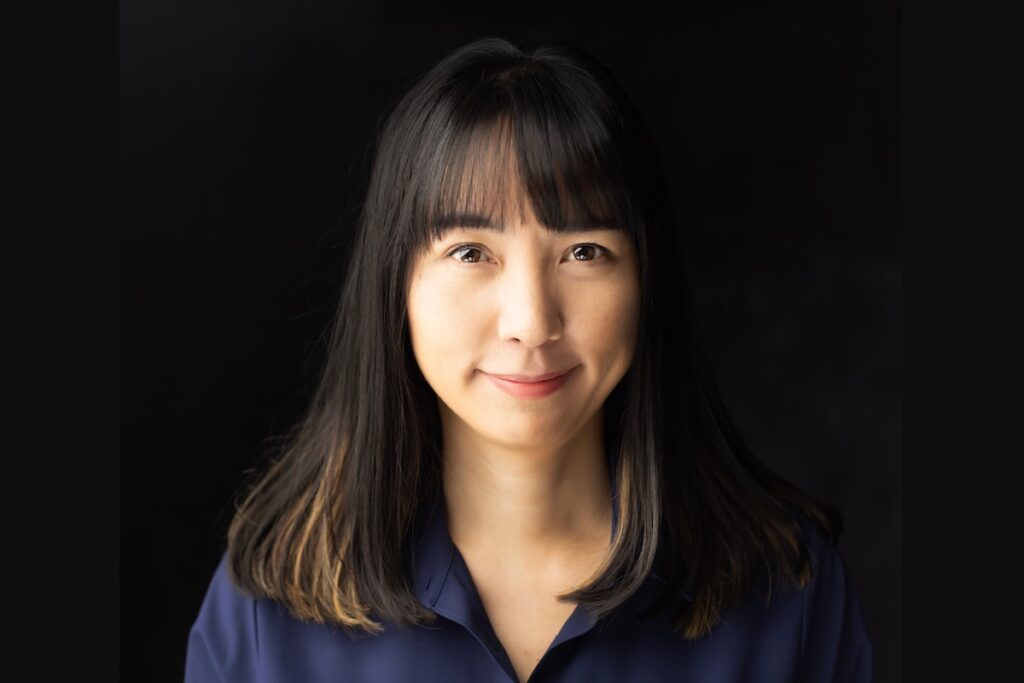
Juri Seo thrives in the balance of complex compositional processes and aesthetic bliss. In an essay analyzing her 2016 piece More Semi Simple Variations, Seo describes recomposing the “brilliant surface” of Milton Babbitt’s total serialism into a polystylistic romp through loose harmonic and timbral fields. These qualities pervade Seo’s catalogue. Her music feels instantly familiar as references, forms, and sound worlds across genres come together in an alluring collage. Yet, the subtle activity beneath the surface invites attentive listening, curiosity, and playfulness.
Her recent portrait albums perfectly embody these values, treating the canon as a prism through which musical traditions are filtered. Toy Store (2024) for violin and electronics oscillates widely, evoking memory and nostalgia as musical references whizz past in constant transformation. Some movements feel like a postmodern jukebox precisely glitching between minimalism, pop metal, and romantic violin licks; others are expansive soundbaths swirling through indie electronics and post-minimal riffs.
Obsolete Music (2025) summons medieval “cantus firmus” textures, baroque forms, and counterpoint to animate seemingly distant genres. Funk grooves build from driving fragments of fugal motives and harpsichord inventions. Spectral masses emerge from ground bass motion and imitative polyphony. Across her work, serious play with style and compositional techniques pushes aesthetic traditions beyond their limits with gleeful abandon.
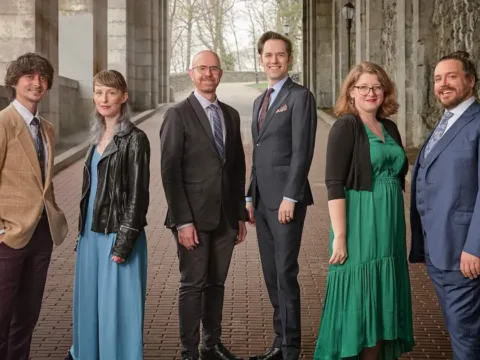
Three of Seo’s works will be featured at the upcoming 30th anniversary of Other Minds Festival on Oct. 8-11, 2026. Just Intonation Etudes and Wildflowers home in on Seo’s interest in microtonality, mapping intricate tuning systems onto medieval techniques, blues, hard-bop, and modernist abstraction. And the world premiere of Bad Decisions by Friction Quartet, Michael Minor (double bass), and Shawn Myers (drums) attempts to translate “improvisatory energy” into motivic density, soaring romanticism, and virtuosity in baroque and funk styles. We caught up with Seo to discuss her compositional practice, the Other Minds premiere, and other upcoming projects.
Across your compositions, your serious approach to play and curiosity is palpable. How do you cultivate this disposition in your artistic practice and day-to-day life?
Conventionally, playfulness and seriousness are seen as opposites. But I’ve always felt that the most serious artistic endeavors involve play. Broadly speaking, play is about being willing to try new things, accepting unpredictability, and embracing an experimental spirit. Music can also directly express playfulness as an aspect of human experience. I’m drawn to art that encompasses both the tragic and the humorous, the light and the playful.
So they are essential qualities for me, and they lead me to seek out new things that are both challenging and fun. In my artistic practice, I try to expose myself to new musical experiences — for example, I started learning the Korean flute (daegeum) last year and have been practicing every day. Outside of music, I’m learning to swim, despite having been afraid of water my whole life, to experience a different way of moving my body through an unconventional — and terrifying — medium. I try to find things I’m unfamiliar with or not very good at and make time for them in my daily routine. And when I am learning something new, I like to spend enough time with it and engage with it physically when possible, so that it becomes part of me.
Curiosity is also integral to my work as a professor. I want to offer broad perspectives to my students, which requires me to keep expanding my own views and knowledge. In this sense, my curiosity comes partly from my personality, but also from the nature of my work.
Genre labels often signal boundaries. Yet, you find throughlines between wide stretches of time and disparate musical traditions. How do you approach studying or writing music to make these connections?
My eclecticism is a natural extension of the curiosity I mentioned. It is a way of entering unfamiliar territory and finding ways to bring what I discover into my own art as authentically as possible. When I first began combining contemporary music with 19th-century tonality about a dozen years ago, I approached tonality somewhat ironically, in a manner similar to that of composers like Schnittke. Over time, however, I became less interested in differences and boundaries and more interested in synthesis: finding commonalities across styles and periods and using them as portals between different musical worlds.
As a concrete example, my 2018 piece Rondeau mixes elements of medieval music with a subtly jazzy character, drawing on rhythmic vitality, sectional forms, and aspects of improvisatory solo writing. These shared qualities serve as portals between the two musical worlds, while the harmonic language remains more closely rooted in medieval music.
With the upcoming performances of Wildflowers and Just Intonation Etudes at Other Minds, can you describe your general approach to employing tuning systems and microtonality in your composition?
Extended just intonation, a tuning system based on acoustically pure intervals, has become a significant part of my work. I use it selectively, mainly with performers who have extensive experience executing it, such as the JACK Quartet. They have internalized these sonorities through years of working with the system. This is important because it’s theoretically and notationally complex, but it has to be executed fluidly, in real time.
What excites me most about the system, though, is the possibility of finding finer shades of consonance. I’ve always been interested in continuing to develop counterpoint, voice leading, and chromatic harmony beyond the 19th century, but I sometimes feel that harmonic language has exhausted much of its potential within twelve-tone equal temperament. Just intonation offers another way forward without relying on an arbitrary system. In extended just intonation, the same interval can exist in multiple forms. For example, there are several ways of tuning a consonant minor third, with acoustically distinct frequency ratios, each with its own character.
For me, this opens up new possibilities for counterpoint and harmony while remaining grounded in simple physical principles. Some of these intervals may initially sound strange simply because listeners aren’t accustomed to them, but our ears can evolve through exposure. That combination of a highly complex system and a fundamentally simple, natural basis is what draws me to extended just intonation.
So far, I have used it primarily as an extension of my existing harmonic vocabulary. Wildflowers and Just Intonation Etudes are both designed to train performers’ and listeners’ ears and are quite polystylistic. Other pieces are less didactic. Three Imaginary Chansons combines medieval harmonic syntax with just intonation, while my more recent piece Dahlia is more Romantic in character, mixing late-19th-century chromaticism with just intonation. This is still relatively new territory for me, and I’m excited to discover where it can lead.
Your new piece Bad Decisions takes inspiration from 1970s jazz icons (e.g., John Coltrane and Miles Davis) but develops through a series of “unforeseen consequences.” What new or unforeseen routes have you taken in composing this piece and workshopping it with the ensemble?
For more context, Bad Decisions was written for a traditional string quartet (Friction Quartet) and a jazz bassist and drummer who are great improvisers (Linda Oh and Christian Euman). Bringing these different performance practices together was challenging because my normal instinct is to compose every note; in my mind, every note has consequences for the way the music unfolds. So improvisation wasn’t something I could simply throw in. My decision (bad decision?) was to place the improvisation toward the end, so it’s more of a culmination than a build. The first half is mostly fully composed, building toward something wild and almost out of control. Once the music breaks down, the improvisers have more freedom.
The workshop was about discovering what needed to be fixed and what could be set free. I found it exciting to hear the performers add their own musical vocabulary while still working within the constraints of what I had written. I also liked that the humor survived the difficulty, thanks to the high level of virtuosity of all the players. It’s one of the funnier pieces I’ve written, with funky bass lines and unexpected tempo changes. Humor is another way of dealing with unpredictability. In this piece, it is an important force that makes a somewhat incoherent form congeal.
It’s no surprise that your wide-ranging music is presented for a variety of venues, workshops, and audiences. What do you hope to cultivate, musically or personally, as you move through these different spaces?
In graduate school, I was mostly thinking about myself, my professors, and my peers. Composers can easily become isolated in their own community, often unhealthily encouraged to ignore the audience for the sake of musical innovation. Much of my postgraduate life has been an attempt to move away from that mindset and think more about performers, and by extension, the audience.
I usually write for specific chamber groups or soloists, so I start by trying to get to know them deeply — listening to their recordings, learning their artistic preferences, and considering what they might need or want. Of course, I also have my own artistic priorities, but I know that will happen no matter what. So I am primarily focused on cultivating my relationship with the performers. I often become good friends with them too, because friendship is an extension of art.
I think less about the audience and venues because I have little control over them. They are more closely connected to the performers, so my relationship with the performers will naturally extend to the venues and audiences. The one listener I do think about occasionally is my dad, who isn’t a professional musician (he has been playing saxophone since retiring from a long career in finance). He listens to music with care and attention. My ideal listener is someone like him: someone who trusts the composer enough to listen carefully and repeatedly, and most importantly, with love!
With recordings, we have an opportunity to transcend physical venues (though we are unfortunately at the mercy of algorithms and various promoters). With the increased access afforded by recordings, I hope that even unconventional music can find small pockets of listeners all over the world.
I CARE IF YOU LISTEN is an editorially-independent program of the American Composers Forum, and is made possible thanks to generous donor and institutional support. You can support the work of ICIYL with a tax-deductible gift to ACF. For more on ACF, visit composersforum.org.