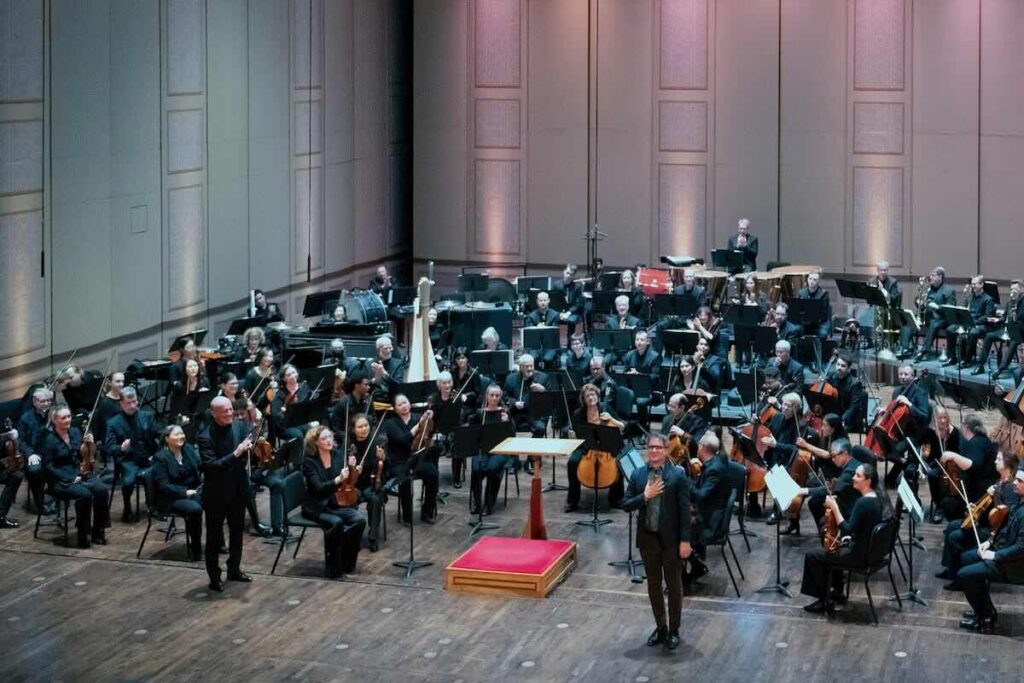
The Ohio Theater can easily swallow one’s attention. The vibrancy of the Spanish-Baroque style is a feast for the eyes, the amber glow of the limited lighting adding an air of foreboding. It was a perfect setting for the Columbus Symphony Orchestra’s Oct. 24 program titled “Mysteries, Anthems, and Victories,” though the theme of the night, to me, was one of energetic communication. Featuring works by Gregory Spears and Davóne Tines, the performance had a dynamism amongst those on stage and the audience. It was a stellar experience of clear interpretive choices in the performance of new works when the focus is on heart and passion.
Gregory Spears’ The Mysteries, officially premiered the previous night, is an immediate and highly emotional work that leans into the instruments’ strengths rather than pushing them to their limits. The structure of the three movements spoke to the cohesiveness of Spears’ ideas and narrative direction; forming a steady throughline was a theme of repetition and fragmentation as modes of transformation.
The episodic first movement, “♩= 62,” featured short motivic passages set in consonant harmony and lush timbres. One particularly dynamic moment featured three percussionists positioned as a crescent from left to right behind the orchestra, their woodblock call-and-response syncopation bouncing from one side of the stage to the other. “Solemn” was defined by fragments of the minimalist yet Romantic main melody that moved through the orchestra. In “Grazioso,” this theme is cut up into an exposition of false starts. When we do hear the gorgeous melody in full, it is quickly soured with a dissonant pitch from the piccolo and slow thick glissandi in the lower strings that help the orchestra slowly phase apart.
In Davóne Tines’ collaboratively-composed Concerto No. 2: ANTHEM (2022), core songs of American patriotism and African American history are brought into conversation with original music and arrangements by Michael Schachter, Caroline Shaw, Tyshawn Sorey, and Tines. An original poem by Mahogany L. Browne weaves through this medley-esque work in a commentary on the hypocrisy and possibility of the American promise.
The first movement, “CODE: The Star-Spangled Banner,” featured Schachter’s setting of the U.S. National Anthem and the lesser-known stanzas from the original Francis Scott Key poem. Tines and the CSO began with triumphant bombast, but the move to dissonant and angular settings of the less celebratory verses was too on the nose.
Next, we were treated to a pre-recorded recitation of Browne’s “Let America” played over the sound system while the onstage performers sat in silence. With smooth lines like “Still shot Kill shot Boom-bap” and “America has yet to rise to its ancestral potential,” it was a missed opportunity to not have the entire poem set to music.
In “CODE SWITCH: Americana?,” Shaw’s whiplash musical setting jumped between Irving Berlin’s “God Bless America,” “Simple Gifts,” “Dixie,” and other minstrel tunes. Though the juxtaposition of “God Bless America” with sonic symbols of slavery felt like an obvious choice, it was still excitingly jarring to hear Tines sing the word “pickaninny” in a concert hall — looking that ugly word and its connotations right in the face.
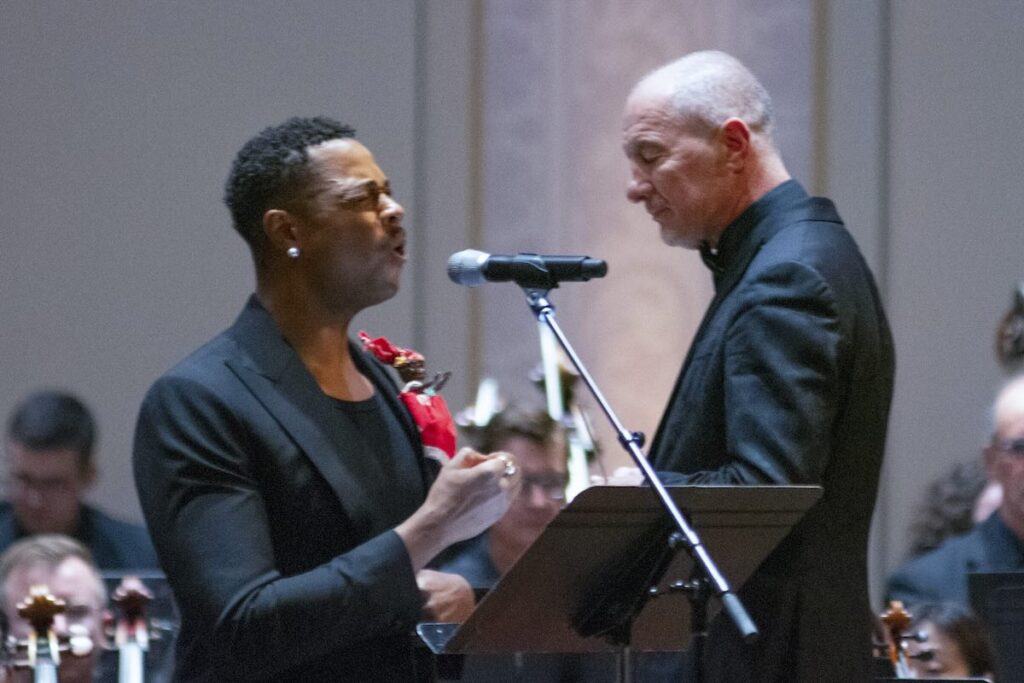
Sorey’s setting for “after ‘Oh, Freedom’” leaned into the despair of what comes after the determination expressed in the traditional spiritual with a distant trumpet and trombones, drum roll, and atonal harmony. “NEW CODE: ‘Lift Ev’ry Voice and Sing’” featured an epic and truly moving arrangement of the Black National Anthem. As Tines sang “our native land,” it underscored that amidst the mess and ugliness, this is home: a message that caused an older Black woman to gently nod her head, a knowing smile on her face. Despite some cliché creative choices, Tines and the CSO performed Concerto No. 2: ANTHEM with focus and dedication that led to a standing ovation.
At intermission, an audience member remarked, “Now we can enjoy the Tchaikovsky.” I heard that two ways: 1) now we can listen to something that’s not trying to teach us something; 2) now we can listen to something we know and love. Orchestras everywhere are navigating this tension: perform new works that are exciting and challenging, or bring back the old chestnuts that will ensure you have an audience.
Tchaikovsky’s Symphony No. 5 in E minor clearly filled the “here’s a canonical work you know” role. And yet it was a beautiful pairing with the works by Spears and Tines. Music director Rossen Milanov made expert use of rubato and acceleration, oscillating between guiding the orchestra and getting out of their way.
Throughout the night, the Columbus Symphony Orchestra never wavered in their expressive dedication or direction. Each of the three pieces on this program leaned into the possibilities of orchestral writing: lush, long phrases; wordless and supportive storytelling; and fortissimo that can blow your hair back and make your heart leap into your mouth. Hopefully one day we can listen to these works by Spears and Tines like we listen to Tchaikovsky: leaning back, relaxed, and enjoying the ride along the road of familiarity.
I CARE IF YOU LISTEN is an editorially-independent program of the American Composers Forum, and is made possible thanks to generous donor and institutional support. You can support the work of ICIYL with a tax-deductible gift to ACF. For more on ACF, visit composersforum.org.