How does it feel to look at nothing? The title of Holland Andrews and yuniya edi kwon’s experimental opera was a guiding light to experience the piece in its Oct. 23 staging at BAM. How does it feel for me, the performers, the collective audience? The piece engaged its own question on many levels in a performance that was conceptually consistent, sonically riveting, and shot through with virtuosity.
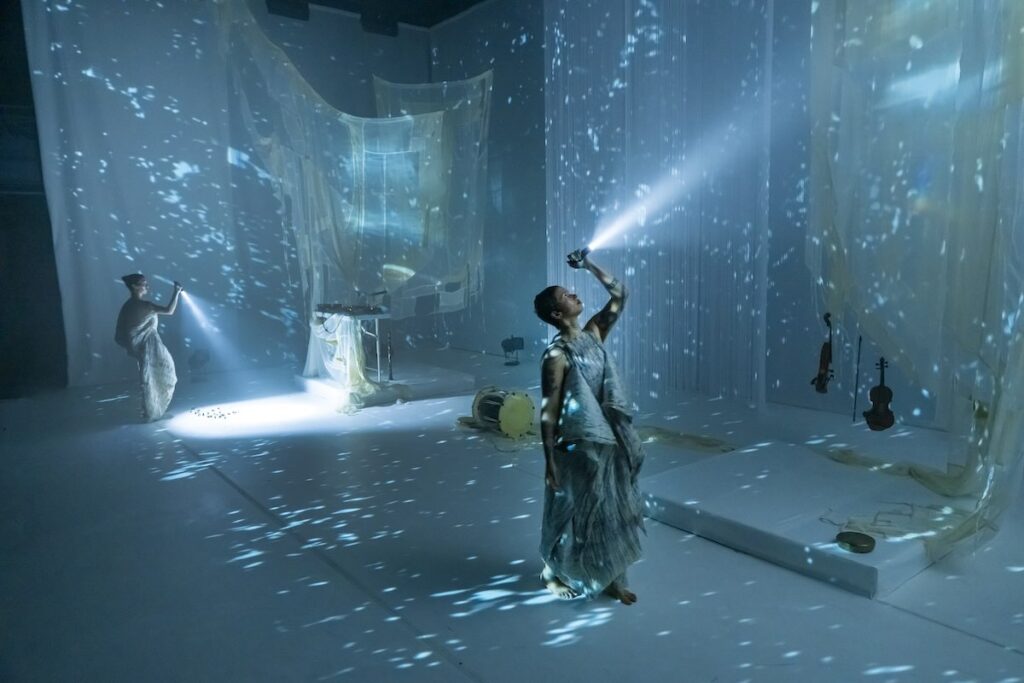
We weren’t looking at nothing, exactly. KC Englander’s scenic design converted the large black box into a monochromatic dreamscape through white floor-to-ceiling curtains surrounding the perimeter of the white stage, a fixture of white fringe hanging from the tall ceiling, and white and cream quilt textiles draping two white raised platforms. The scene was almost otherworldly, with kwon’s violins hanging from a textile, but the platform of electronics and cables kept us in 2026.
Both artists’ practices draw from a full range of training methodologies, creative applications, and spiritual philosophies. kwon has channeled her classical violin training into entrancing improvisation; Andrews is a clarinetist and self-taught vocalist who can sing gorgeous coloratura before diving into a punk scream. Contemporary opera, Japanese Butoh, Korean shamanic rituals, and vocal channeling inform the co-creators’ storytelling and spiritual perspective. With the strength of those traditions behind it, How does it feel to look at nothing was never going to achieve its intended emphasis on decay and disintegration — there was just too much life force and artistry involved.
This was truly an opera: dance, staging, characters driven by music. Maggie Heath’s lighting design was beautiful and critical to interpreting the story. Andrews and kwon sang almost nonstop, stopping for some dance breaks or instrumental passages. Except for kwon’s transfixing solo song, accompanied by a small handheld gong, the entire opera was in an improvised “deconstructed” language. Though unintelligible, it pointedly avoided any feeling of gobbledigook.
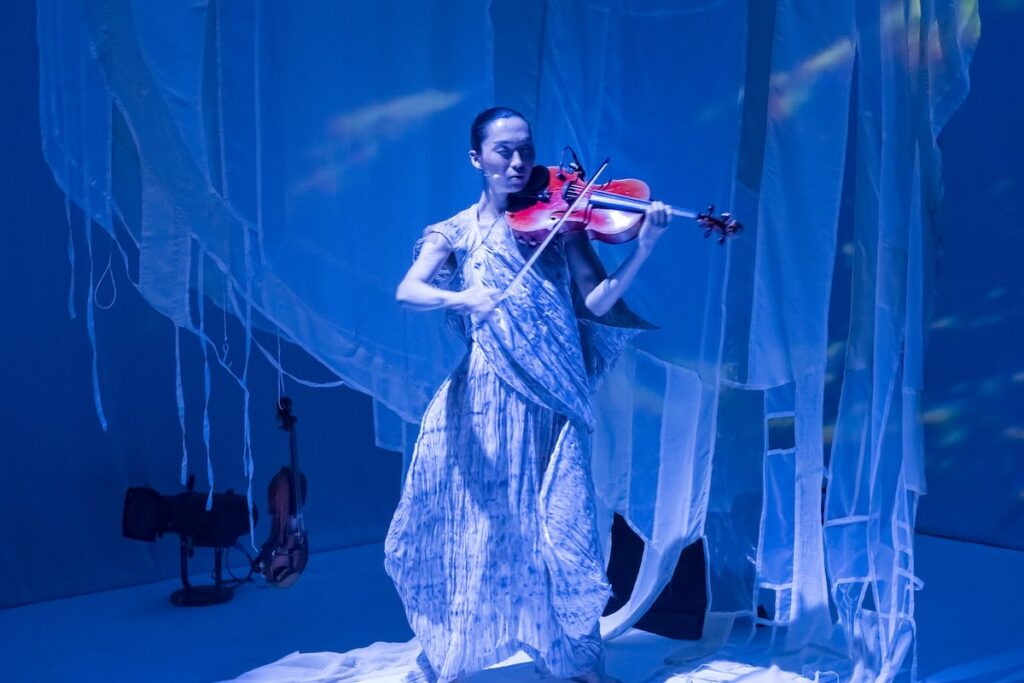
The production tried to anchor the audience with various English projections. Unfortunately, the textile seams or gaps in fringe prevented most of the text from being readable, so there was almost nothing to latch onto throughout the performance. The music, interaction between performers, and three-act structure of Fire, Water, and Cosmos created a surprising amount of perceivable narrative meaning, but the failed projections amplified a feeling of disorientation and chaos that felt beyond the intention of the opera.
Still, the piece gave the impression of absolute freedom married with meticulous craft and preparation. Operatic form gave loose but helpful guidance, with arias and duets gently structuring wild experimentation and choreography, bits of sudden sonic shock, and omniscient viewpoints moving the piece along. One particularly unique moment was when the two musicians walked around a dark stage with powerful flashlights, cutting large swaths of light on and off through the gauzy, smoky air (although this and other moments warranted more obvious strobe light warnings).
How does it feel to look at nothing pondered what is life-giving to both individuals and the collective. The abstract piece somehow questioned and made meaning mostly without any language, though the explicit mention of the rise of American fascism in the program notes converted some of the screaming and primordial characterization into a public audience catharsis. But the opera’s concept was grounded by the reality of the artists — a married trans couple who formed their family and started trying to become parents while creating the opera — and their intensely physical performances.
Most of the show had an undercurrent of live or preset electronics that alternated with moments of silence and simple shamanic percussion of janggu (double-headed hourglass drum) and kkwaenggwari (small flat gong). Extended trance-like periods were shattered by lighting changes, sudden house music drops, or primal screaming.
Although the blocks of disjunct choreography felt somewhat unnecessary and formally imbalanced, they also focused attention for many minutes at a time on moving, expressive bodies. Choreography inside the fringe circle fell flat, but interactions with the fringe created a beautiful visual reaction to the music. Bonan Li’s costumes, influenced by shamanic garb and elevated through shimmering layered textiles, were simply gorgeous.
In the hours and days that followed the opera, the memorial feeling that settled within me was that of a beloved body shrouded in sound. Without language, Holland Andrews and yuniya edi kwon communicated that even through effort, loneliness, or rage, they have come to know and adore their corporeal selves. It was impossible to tell where their gentle work ended and raw daring took over; somewhere in the overlap, How does it feel to look at nothing invites us to honor ourselves and extend that gift to those around us.
I CARE IF YOU LISTEN is an editorially-independent program of the American Composers Forum, and is made possible thanks to generous donor and institutional support. You can support the work of ICIYL with a tax-deductible gift to ACF. For more on ACF, visit composersforum.org.