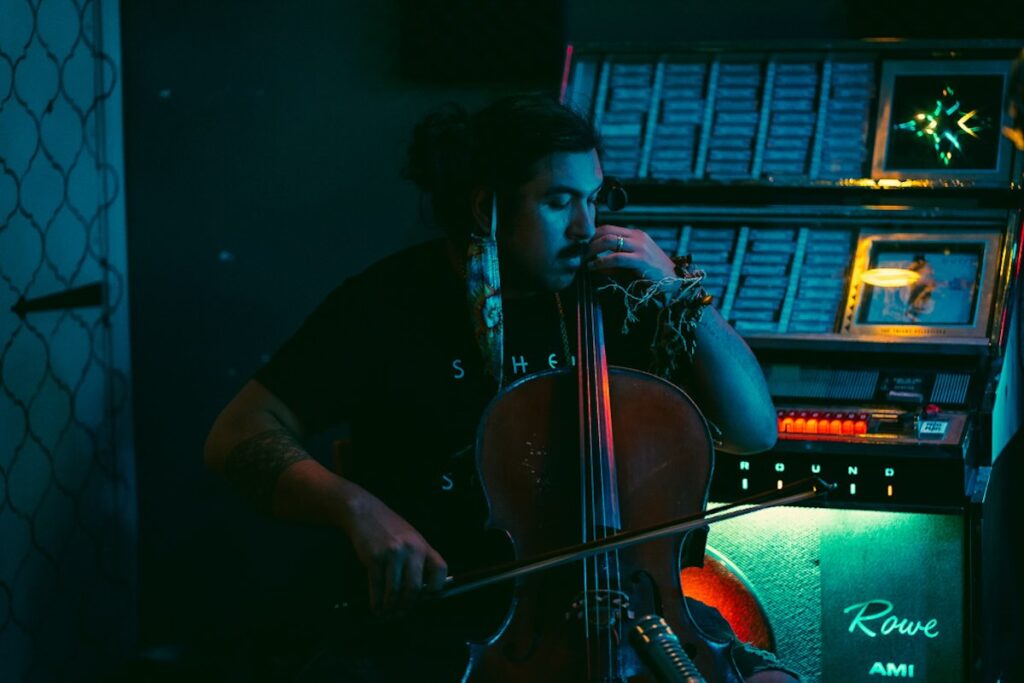
Ishmael Ali carries many titles and is in no danger of running out of projects. He is a cellist, improviser and bandleader; co-founder and audio engineer at Marmelade (a recording and rehearsal space in Chicago’s West Loop); co-curator of the Thursday night Improvised Music Series at Elastic Arts; and he runs the cooperative music label Amalgam Arts with close friend Bill Harris. He has been described by John Lewis in The Guardian as “slightly insane” and “quite unlike anything you’ve heard before.”
Diverse and many, Ali’s projects coalesce around a truly distinct and singular creative lifeforce. His compositional voice follows in the footsteps of fellow Chicagoans and group improvisers such as the Art Ensemble of Chicago, with a sonic palette more akin to the collaborations of Oren Ambarchi, Keiji Haino and Jim O’Rourke. Still, Ali’s voice moves into a quirky and idiosyncratic space that is all his own.
His latest collection of compositions and improvisations, entitled Burn the Plastic, Sell the Copper, is out Feb. 13 on Amalgam Arts. Across ten intricate and beautiful pieces, Ali performs cello, voice, and electronics, and is joined by Ed Wilkerson Jr. (tenor saxophone and alto clarinet), Corey Wilkes (trumpet), Jim Baker (piano, ARP), Brianna Tong (voice), and Bill Harris (drum set and percussion).
The opening track, “Reflected, Refracted,” makes a brief exploration of the cello’s harmonic spectral palette, while bell-like, dissonant chords circle around the upper octaves of the piano. Unlike most of the following tracks, the ending fades into silence, giving the sensation of suddenly opening one’s eyes and emerging from a deep and focused daydream.
“The Cut and the Turn” establishes itself in a wash of wonderfully disjointed percussion samples reminiscent of a Roland 808 drum machine. Harris’ live drums and percussion emerge, mixed with wordless vocalizations that combine with pizzicato textures from Ali’s cello. Wilkes’ trumpet joins Ali and, following a period of improvisatory counterpoint, resolves with the unison statement of a gentle, melodic earworm. A driving, rhythmic precision propels the piece forward, and though it never settles into an established groove, there is a satisfying order to its unique language and logic.
“Stars in my Pocket” feels distantly reminiscent of an 80s New Wave song, with the loose vocalizations of the previous track coming into focus and carrying cryptic texts over a chant-like baritone. Electronic textures and halting drum patterns again establish a pressing, forward motion, this time setting the stage for Wilkerson’s lyrical saxophone solo. The track continues without a break into “Fear Chased Hope in Tight Circles,” which recalls the spectral improvisations of amplified cello on the opening track.
“Everness” sets the recorded spoken word of Argentinian poet and philosopher Jorge Luis Borges over gurgling, percussive electronics, freely constructed piano licks and pizzicato cello. The piano persistently implies the structured changes of a jazz standard, but it never takes shape before the audio again fades to silence. “Pastiche” expands on the album’s previous solo cello interludes by shifting from bow to pizz and layering in stabs of electronic sounds that briefly take on the quality of a radio dial scanning for a clear signal.
The rhythmic insistence of “Anathema” stirs echoes of the late, great Hermeto Pascoal, particularly the juxtaposition of sampled vocals and Tong’s neutral-voweled soprano. The final interlude for cello solo, “Vitality of Brushtroke,” explores the harmonic richness and depth of a single, droning arpeggio before bursting into an aggressive dyad that drifts from unison to dissonance between two adjacent strings.
The album concludes with “Every Circle a Moon,” which has also been released in a trippy, extended music video produced by Ali and Augustine Esterhammer-Fic. Tong offers melancholic, sing-songy vocals that feel like a dreamy children’s playground rhyme. A kinetic drum-and-bass foundation gives an almost industrial character to the piece, punctuated by rambling solos that emerge and recede on saxophone, alto clarinet, and trumpet. The track pulls together all of the previously-heard material with a satisfying sense of cohesion — the album drawing to a close with a palpable sense of community among Ali and his collaborators.
I CARE IF YOU LISTEN is an editorially-independent program of the American Composers Forum, and is made possible thanks to generous donor and institutional support. You can support the work of ICIYL with a tax-deductible gift to ACF. For more on ACF, visit composersforum.org.