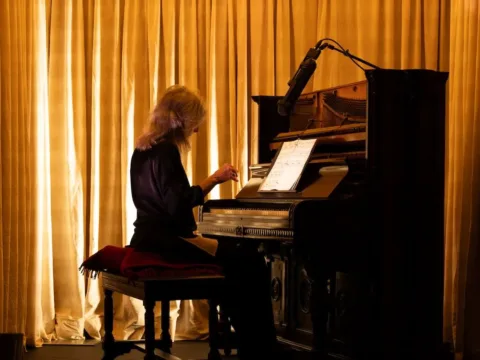
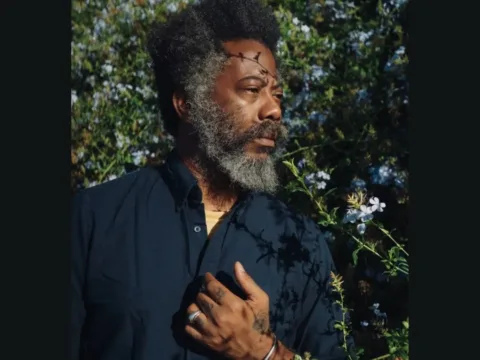
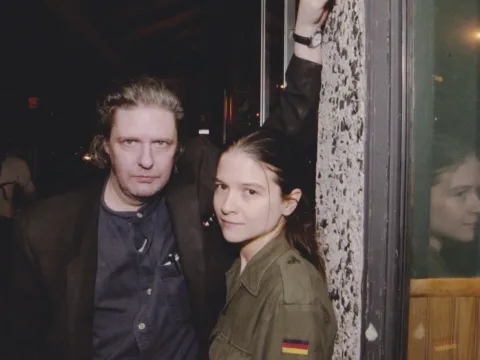
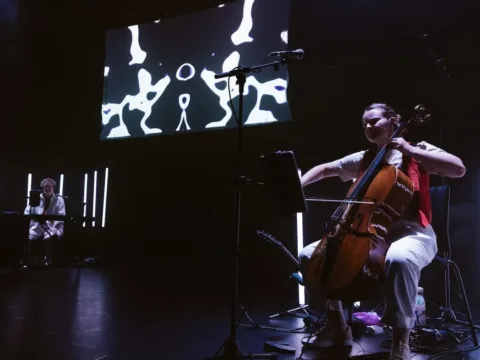
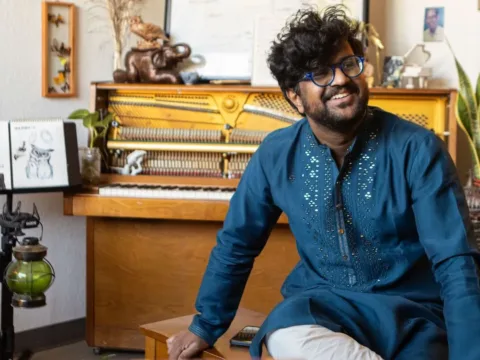
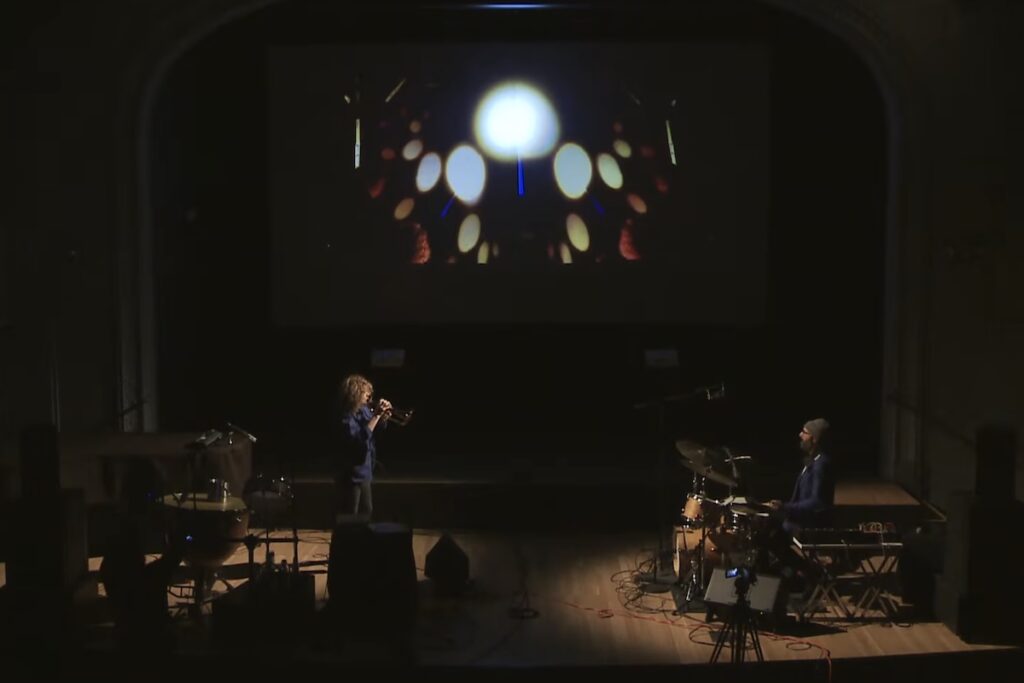
An audience of all ages flooded Brooklyn’s Roulette Intermedium with curious energy on Feb. 26 for the east coast premiere of Miss America, the newest project from Talk Show. The duo is the artistic child of drummer/modular synthesist Qasim Naqvi and trumpeter Steph Richards, created nearly two decades ago through shared sensibilities around experimental theater. Joined by shadow-puppeteer and live visual artist Steven Wendt, this iteration of Miss America attempted to extrapolate the absurdity and horror of late 20th century daytime television through sound, theatrical staging, and projections.
80s and 90s daytime programming brought forth a slew of entertainment and discourse that have made lasting impacts on the American zeitgeist. These eras saw the rise in direct audience participation; the quotidian ritualization of soap operas; sensationalist, exploitative reality TV in the form of talk show segments and “documentary” style shows; and gossipy tabloids.
As we entered the space, archival clips of various TV shows played without sound. Hypnotic, oozing light prisms were occasionally overlain, gently obfuscating the original images. I recognized old clips from Maury (1991-2022), a show that notably featured one segment that ran paternity tests to determine fatherhood of participants; and another titled “Man or Woman?” in which live audience members excitedly guessed whether or not women were cis or transgender.
This was unfortunately the first time I saw transgender people represented in the media as a child. While extremely problematic, trash TV has been a catalyst for deeper reflections and scholarly interrogations of social and cultural issues. Miss America, then, had an immensely vast array of existing material and paths to explore.
It was shocking that the overall performance lacked any of the real ingredients necessary in a portraiture of daytime television beyond the use of videography before a live audience. The performance began unexpectedly — Richards walked on stage in a rush while Wendt followed her up close with the camera. Applause was brief and scattered, as the cold open happened too quietly for us to recognize whether or not the show was starting.
There was, however, a clear relation between the projected video of Richards and the paparazzi-like chase scenes in which embarrassed reality characters run off stage during an episode of TV. Richards’ horn buzzed erratically, but muted, with Naqvi whirring the snare on his drum with his mouth as an extension of her sound. The sonic landscape was surprisingly empty and sparse, despite the maximalist concept and presentation of ideas.
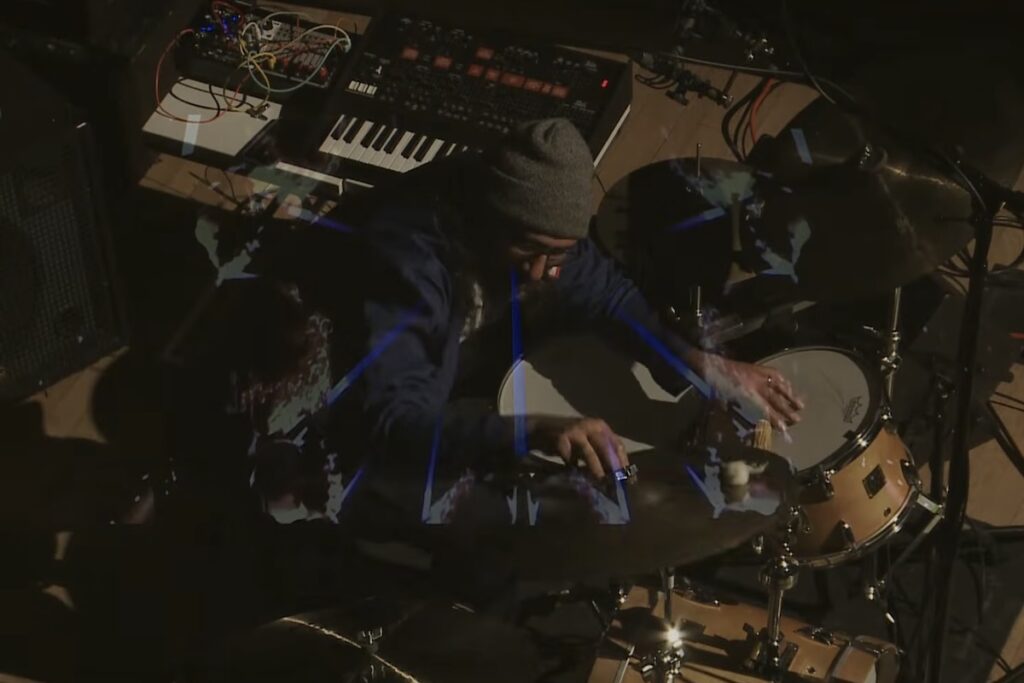
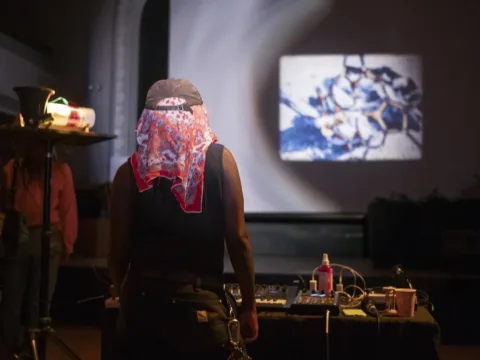
The archival video collage suddenly turned off — seemingly by mistake — leaving only projections of the two performers soon after the sound started. Wendt’s camera and light projection work was certainly the highlight of the project though, as he crafted stunning psychedelic fractal images using live video feedback with two Sony camcorders. He moved around the space constantly, grabbing different angles and using light to paint directly onto the projections. At the same time, the beautiful visuals felt once-removed from centering the ugliness of reality television.
Richards began to yelp in between sputtering trumpet sounds while Naqvi pattered around the drum set, building up to a splashy cymbal climax. Wendt expertly glitched the cameras in rhythm, bouncing between different shots. The instrumentalists shifted to an eerier modality with Naqvi generating amorphous groaning chords on his synthesizer, and Richards dipping the bell of her gurgling trumpet into a tray of water and onto the surface of a timpano, using the pedal to acoustically bend pitches.
The theater grew darker, and Wendt reinstated the archival footage layer of the projections — this time featuring only close-up shots of audience members. This combination of sounds, lighting, and imagery was the most successful juncture of the evening, evoking a sense of discomfort around spectatorship and the twisted theatrics of reality TV and its ill-treated participants.
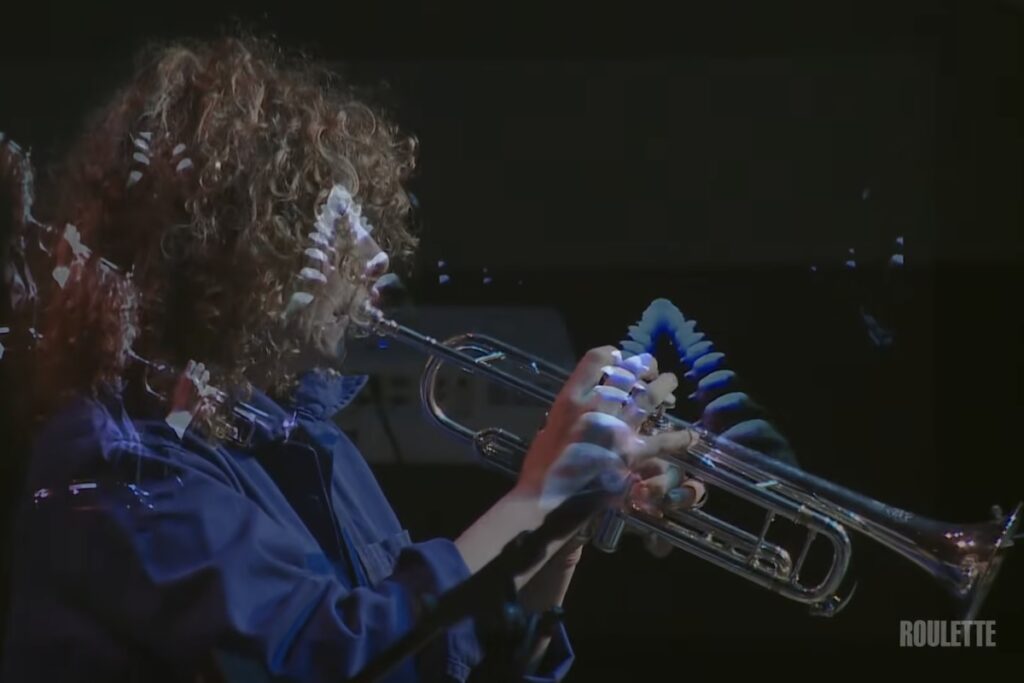
At one point, the two musicians turned to face each other at the start of an improvisation. I speculated whether their performance would formally or conceptually emulate an interview or game; or if we as the audience would be activated at some point in the evening. Throughout the performance there were small moments of connection, like Naqvi inspiring some laughs by removing his beanie and rubbing his bald head when his camera was kaleidoscopically mirrored, or Richards sharply turning to directly face the lens. Unfortunately, the program notes did much of the heavy-lifting in communicating central ideas. The duo alongside Wendt’s innovative contribution offered a unique experience, but decidedly obscured any salient ties to their source material through over-abstraction.
I CARE IF YOU LISTEN is an editorially-independent program of the American Composers Forum, and is made possible thanks to generous donor and institutional support. You can support the work of ICIYL with a tax-deductible gift to ACF. For more on ACF, visit composersforum.org.