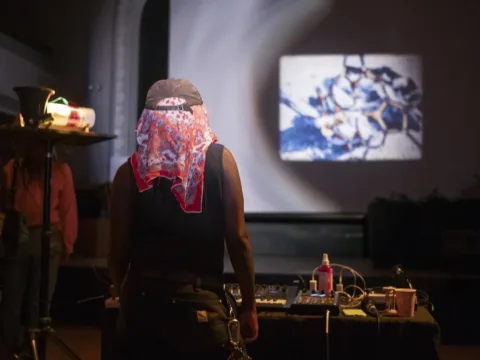
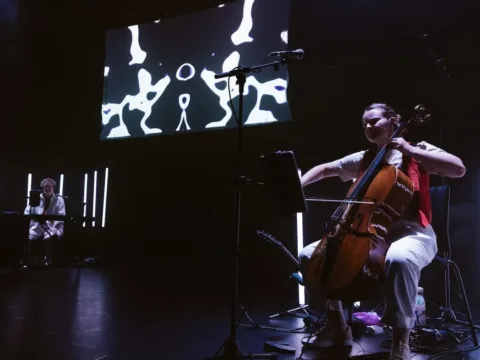
Before she took the stage as “Babygirl,” we were preparing for Lucy Liyou’s character to bleed. Ushers had proactively cautioned audience members in the first two rows at Performance Space New York that they were sitting in the splash zone for fake blood. The anticipation of inevitable gore mingled with the sea of trash onstage and the promise of a humiliation ritual, a relatable conceit in the time of AI slop and everything being embarrassing.
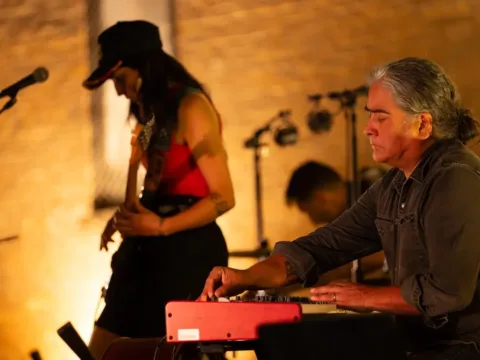
The multimodal show “Mister Cobra” transmuted accumulations – of trash, generalized pop yearning, digital conversations, and “discourse” – to encounter and process self-actualization amid harm. Liyou’s self-directed Mar. 28 production propelled us through her forthcoming album MR COBRA track by track with maximalist verve. With musical contributions from an assortment of collaborators including Nick Zanca, Mingjia Chen, Laura Cocks, to name a few, songs ranged from ghostly, heartfelt ballads to noisy onslaughts and pulsing, eerie club pop. Liyou’s no-holds-barred performance was anchored by an accompanying film that guided us from song to song: at some moments featuring the predator Mister Cobra, and at others acting as karaoke slides or doomscrolling-esque visuals.
The creative references in the program notes were numerous, nearly to the point of overwhelm, but they cohered under Liyou’s discernment as a mirror for the unceasing waves of Stuff that bombard us. Earnest innocence became disquieting nonsense in Liyou’s rendition of “Old Macdonald.” Reddit screenshots, shitpost text, a photo of Moodeng, and a group of furries flashed across the screen as the din reached a fever pitch. Babygirl played the piano with a can of SPAM; Babygirl waded through the trash field to pleasure a mannequin plastered with classical piano sheet music before she dismembered and discarded him. Throughout, eyes were used to connect, digest, and haunt: first in clips of bare eyeballs with direct lines to the world, then through ocularly vandalized images of public figures and flowing lava, juxtaposed with Liyou’s own wide-eyed, unsettling smiles.
“Might not be what you’ve envisioned / might not be what you’ve been missing / but losing your temper will prove me wrong” she crooned against a lithe synth beat in “Crisis (Identity).” Later, a sinister voice emerged as the song progressed and dissolved into no wave-kuduro miasma: “Look at me…look at me…don’t be scared.” But we were terrified of desire and Mister Cobra, of predatory relationships that nevertheless render us seen. And as we bore witness to this humiliation ritual, we might as well buy some merch, per the artist’s request via a fourth wall break.
Liyou’s particular assemblage of performance traditions provided multiple jumping-off points to think on, some of which are situated in Asian diasporic consciousness: the BTS comeback, f(x)’s Sulli, Perfect Blue, and Dictee among them. Flashes of Korean text and art skirted legibility for the non-Koreans in the audience, though if it was anything like the English text, it was darkly funny. The overlaps between personal and national narratives across the performance and these cultural touchpoints further emphasized the precarity of being a popstar, a young girl, a representation.
With trend cycles shorter than ever and a never-ending slew of novelties, it’s hard to pin down how violence, beauty, and humor currently coexist. It’s the murky boundaries between them that imbued the final stretch of “Mister Cobra” and Liyou’s final, drag-like reveal with an arresting pathos that was completely climax-appropriate. The interactive space between the video and the live performer began to collapse. As a Street Fighter brawl ensued between her avatar and Mister Cobra himself onscreen, Babygirl mashed the piano keys wearing boxing gloves. She removed her coquetteish white dress to reveal a white t-shirt and gray shorts, the same clothes she wore in a childhood photo projected behind her. Cartoon weapons and Looney-Tunes sound effects bludgeoned the kid photo as Babygirl underwent her metamorphosis, slapping herself with blood from a bucket and dumping it over her head before crawling through the trash once more to emerge anointed with crown and sash like the iconic scene from Carrie played in reverse.
Liyou’s character stood bloodied and nearly dead, yet triumphant, crowned “Tranny of the Year” after performing with the “it’s-all-for-you” flair of a true entertainer. Or perhaps she was bloody in a newborn way, having “successfully” transitioned. Either way, we stood and cheered. “Mister Cobra” both affirms the process of becoming and grieves the person who is left without a defined beginning and end. Linearity gives way to simultaneity, as it must.
“Mister Cobra” Crew
Lucy Liyou, Performer, Composer, Director, Filmmaker, Producer
Maura Nguyen Donohue, Dramaturg
Cleo Henman, Assistant Producer
Rustin Wollin, Technical Artist (3D Modeling & Mapping)
I CARE IF YOU LISTEN is an editorially-independent program of the American Composers Forum, and is made possible thanks to generous donor and institutional support. You can support the work of ICIYL with a tax-deductible gift to ACF. For more on ACF, visit composersforum.org.