A sign on the door outside The Museum of Russian Art listed something between a manifesto and a user’s guide. At <MASS>, there’s no talking, no phones. “You are a participant, not an observer.” “It’s ok to be bored.” “Don’t listen too hard.”
It’s a lot of prelude to the actual music, but it’s not bluster. It’s a tone-setting introduction to the second installment of <MASS>, its first at the Minneapolis venue. Inside, attendees milled through the galleries until a low, steady electronic pulse whispered into existence. Its rising presence gradually silenced the footsteps and rustling paper of “participants.”
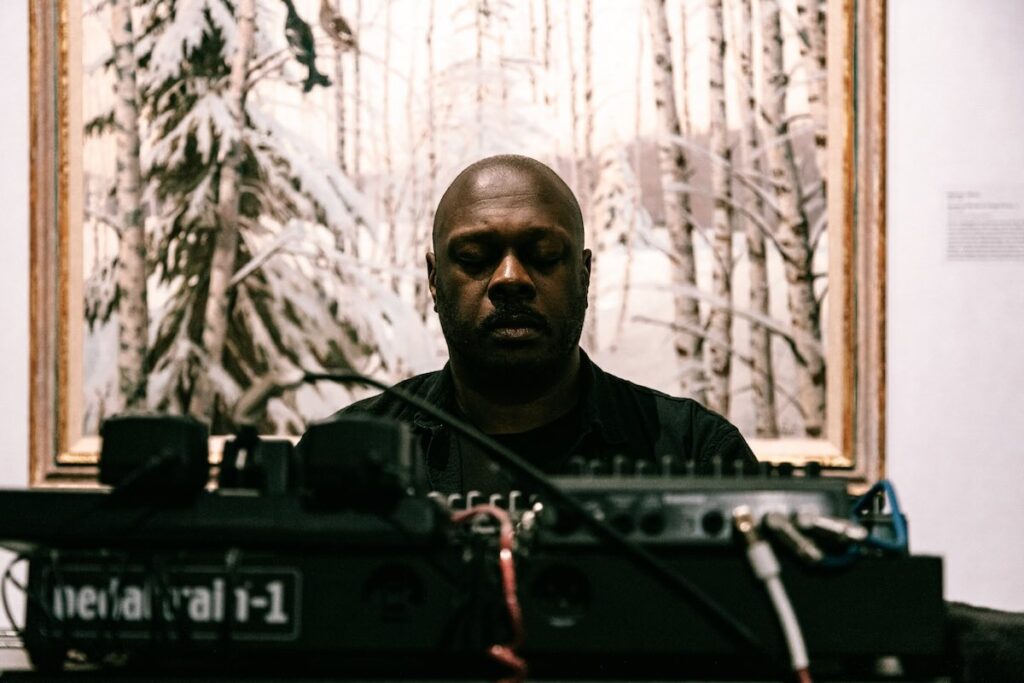
<MASS> is a Minneapolis-based listening series led by musician and artist Zak Sally. For this activation on Oct. 23, seven performing stations were spread throughout the museum’s main gallery for the six musicians. Sally’s bass sat in front of Viktor G. Tsyplakov’s “Winter.” Emma Garau’s drums sat at the opposite end, separated by an exhibit from guitarist Meghan Irwin. A glass case of matryoshka stared over deVon Russell Gray’s Rhodes piano.
Blue folding chairs were scattered across every corner of the museum, including one floor up where listeners could peer over the balcony. They’re haphazard; no two adjacent seats face the same direction.
As the music began, Sally was crouched in a brown flannel shirt between two amps on folding chairs, building the heartbeat underlying the two-hour performance. The pulse settled in solitude until Garau began striking the legs and body of a tom, teasing tone from the kit’s edges. When she finally struck the drum’s head, it was like a riptide: sudden, shocking, encompassing.
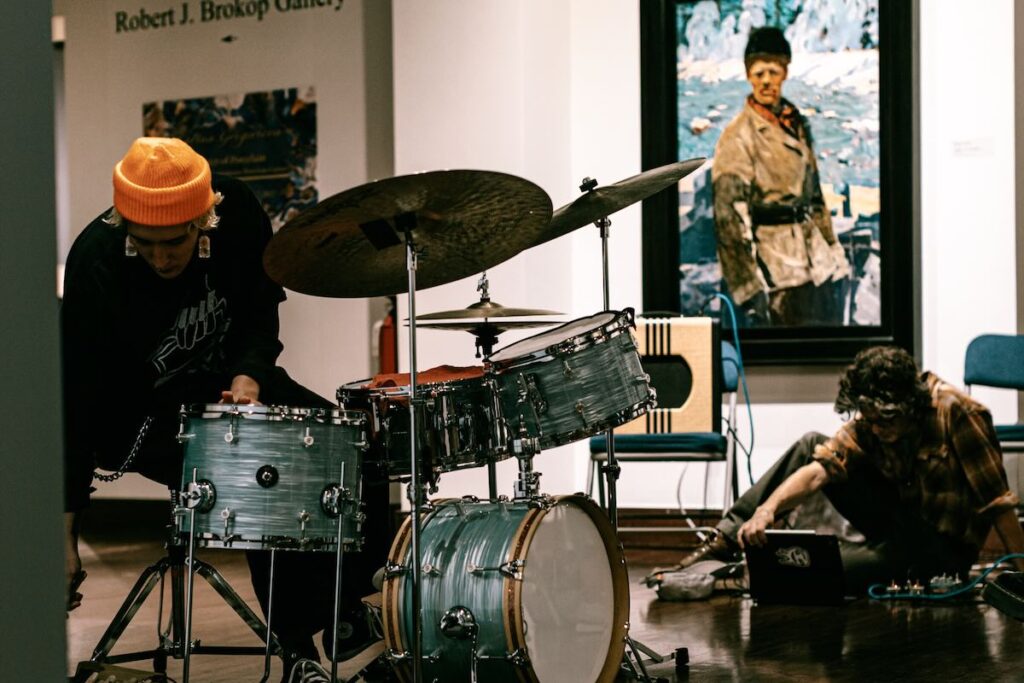
Gray drew in next with unearthly exclamations from the Rhodes that were processed through delay and other effects, shifting between short phrases and sustained chords that welcomed other sounds into the fray. Sally crossed the gallery to take up the bass at the far end of the room. Matt Irwin’s electronics set an atmospheric hum, while guitars from Meghan Irwin and Ben Durrant edged into the piece’s periphery.
The constituent pieces of <MASS> appear to be the recipe for a lulling drone. In practice, it’s bolder. It’s loud, occasionally chaotic, with that low, marching thrum perpetually holding everything together, even when it disappeared below the waves.
Elements of the introduction are familiar: the additive build, drawing in a performer at a time. Yet, the performance doesn’t gently dip a toe in the waters or content itself with drowsy ambiance. Garau’s drums set the expectations; they’re closer to jagged art punk percussion than the gentle punctuation of a jazz drummer laying back behind a solo.
The resulting work — and the experience — are more akin to purgatory than any kind of heaven implied by the series name. <MASS> is an in-between place. It’s composed and not. It’s improvised and not. It’s classical, jazz, drone, EDM … It’s not a single thing to pin down, and any attempt to do so is probably antithetical to the gathering’s goals. It might be best to embed yourself inside the reverb-rich wall of sound and allow it to perform the unseen magic that rain does when your attention is elsewhere.
Yet, it’s difficult to abide by their edict to not “listen too hard.” It feels more ideologically aligned with Pauline Oliveros than Erik Satie’s musique d’ameublement. It invites “participants” to take an active role in their experience. From the balcony, robotic thrusts from the guitars rose above the sonic foundation. From the floor, it was powerfully loud, with entrancing stereo effects that emerged when heard from different seats.
The pulse functioned like a shy leitmotif, drawing echoes and counterpoints. Gray trilled the keys in what began as a jazzy flourish inside the piece’s low, throbbing heartbeat. It was soon swallowed by delay, erupting into an ambient wash that flew off into the synth chords vibrating above the ever-present bass thrum.
After two hours, Sally again walked around the room, whispering to performers. There’s tension in those small actions, a cue that things are changing and that the endgame may be arriving. He strides between stations with a handbell. Its tinkling takes a familiar turn; the staccato ringing transforms into something sustained, joining the dense aural landscape that pneumatically filled the room with sound so thick it feels like it could be breathed in.
It’s possible to sink into boredom, at times. Every flourish, bracing exclamation, and retreat into texture revolved around the low thrum that, while it evolved in small ways, permeated the entirety of <MASS>. However, if boredom is any part of the goal, the goal remains only partially accomplished.
<MASS> was more often an exciting immersion in its structure and what it asks of the listener. That clear vision elevates the music into an experience that feels singular, almost existential. The listener is present in a moment that will not be replicated. No phones to record and share the show. Each installment has changed locations and features different performers. That’s part of the joy of going to <MASS>.
I CARE IF YOU LISTEN is an editorially-independent program of the American Composers Forum, and is made possible thanks to generous donor and institutional support. You can support the work of ICIYL with a tax-deductible gift to ACF. For more on ACF, visit composersforum.org.