There is no music without the body. String players live with rock-hard finger callouses. Wind and brass players could shift sails with their pulmonary exertions. Pianists and percussionists fire up muscles that produce sounds ranging from miniscule to gargantuan.
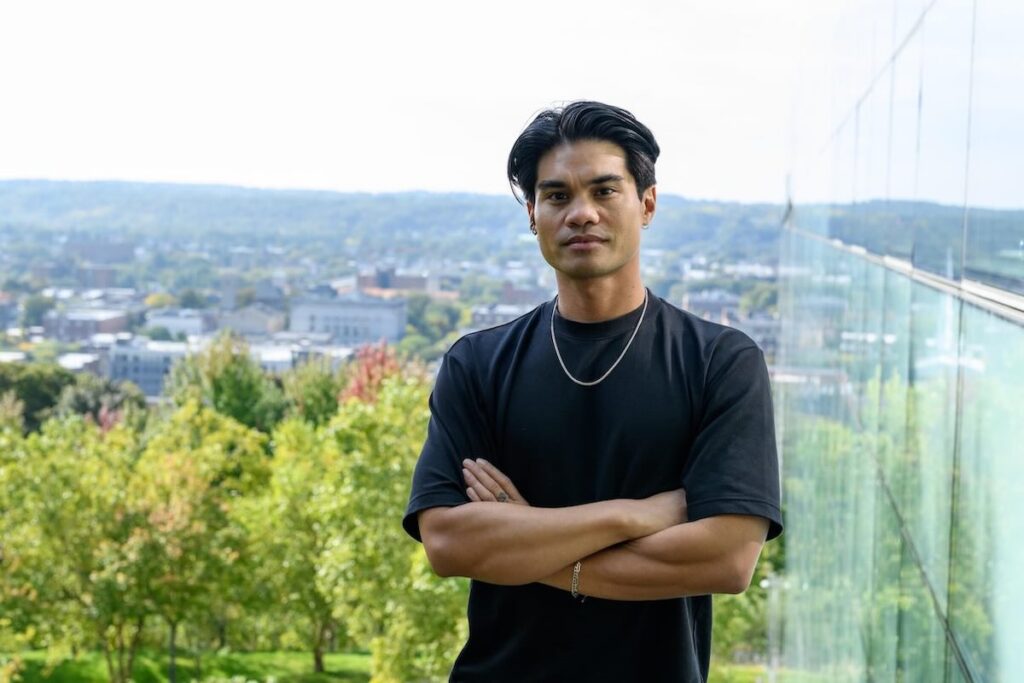
In composer Amadeus Regucera’s work, highlighting the physicality of the body is a given: “I want to sonify the body,” he told us at Talea Ensemble’s Spotlight Concert on Oct. 9 — the first in a multi-season portrait series held at the ensemble’s home base of the Church of St. Luke & St. Matthew in Brooklyn. For Regucera, composition starts with the “sensuality of music making” — pushing artistic material to its limits. On this particular evening, five works embodied a relationship between physical exertions, sonic space, and imaginative artistry.
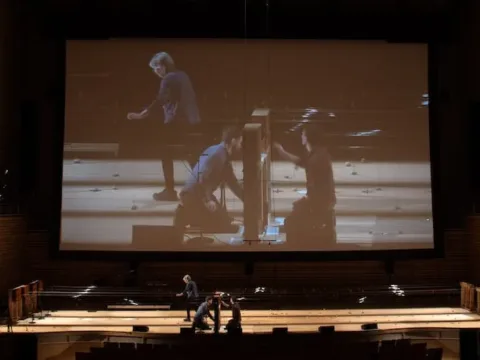
A Blank Page, A Deep Breath plunged the concert space into darkness with only a shadowy spotlight illuminating the players. Gimmicky it was not. From the bassoon’s opening two-note harmonic motif that met a soft strike on the bass drum, the pitch-black space heightened the sensory journey that unfolded between the two isolated musicians. Regucera’s understanding of sound relationships created a unique feeling of vulnerability that extended beyond the performers and reached into the space of the listener. The hostility and corporeality of music emerged in climactic moments where Adrian Morejon pushed the bassoon to emit mournful, piercing pitches and Sae Hashimoto’s gentle touch shifted into loud, bodily-quaking strikes.
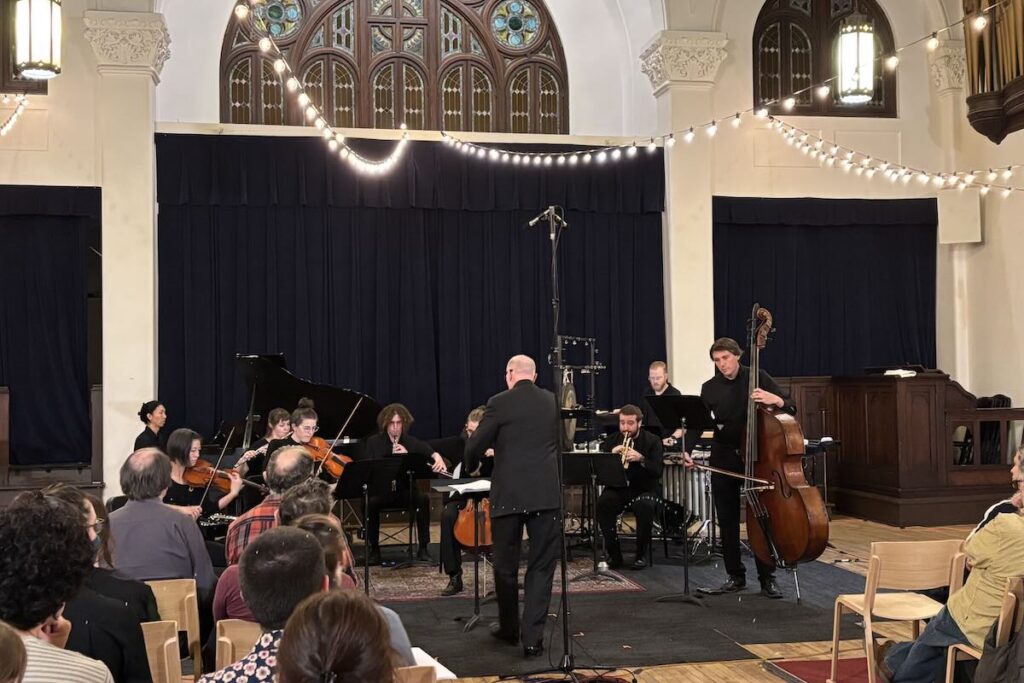
Raw for violin, piccolo, oboe, bass, and percussion embarked on a kind of clash-and-retreat relationship. Instrumental sounds knocked together then separated while conductor James Baker sensitively realized the score to great effect. Jagged piccolo textures tangled with percussive wooden taps before tapering off. Regucera emphasized the materiality of string instruments with generously long slides and tensely pressed bows venting a variety of scratching sounds. Joseph Jordan’s blaring oboe solo deftly tackled raw technicalities, pushing long breaths through a resistant instrument while gasping loudly for air. As the work finished, I felt as if the music and my perspective had been turned inside out, yet cacophony never reigned.
Regucera is senior curator at the Experimental Media and Performing Arts Center in Troy, New York, so experimenting with interdisciplinary work is his bread and butter. This curatorial mindset was evident in OPHELIA. Her heart is a clock and SKRWL (pronounced “scrawl”). OPHELIA opened with an overture-like aesthetic, and the eight musicians established an emotional momentum that maintained itself throughout. Theatrical mood shifts emerged when the piano took the lead in a gentler central section, sprinkled with picking and fluttering sounds from other instruments. In another test of limits, each player gradually initiated bits of verse while also providing the accompanying jungle of sounds.
SKRWL, on the other hand, draws on Cy Twombly’s dripping, splattered, doodled, and smudged canvases. The program notes explained that Regucera aimed to perforate the sonic space with each instrument; the effect was audible. SKRWL had a short, anecdotal quality that benefited from crafty sounds like stunted brassy trills textured by Mike Lormand on the trombone.
To close, UNFEELING (She sketches out her dreams on his skin) was a voluminous tour-de-force. Performed with expertise and an extra infusion of imagination, the 40-minute work confirmed Regucera’s ability to combine a vast knowledge of 20th century modernism with the bravery of experimentalism while still embracing the relevance of style. Instead of a conductor, Dennis Sullivan sat before Talea to command the electronics and sonically lead the ensemble. Like a modern-day Hephaestus, his full-body movements pulled percussive sounds from a large tam-tam laid horizontally on a table that he beat with mallets or scratched with a drum key.
This polyphonic work included composed material that drove its urgent pacing, while improvised sections created ephemeral moments that allowed instrumental groupings to break off into their own modular spaces of expression. Most of the electronics amplified isolated sounds from the live players, often looping them into a captivating steady beat. So it came as a great surprise to the audience when about two thirds way through, the speaker emanated the recorded screams of a man falling against the backdrop of this harmonic jigsaw. Regucera, again, reminded us of the human body: an organic form that emanates sound, ever willing to tax itself for the sake of an instrument — always in the name of expression.
I CARE IF YOU LISTEN is an editorially-independent program of the American Composers Forum, and is made possible thanks to generous donor and institutional support. You can support the work of ICIYL with a tax-deductible gift to ACF. For more on ACF, visit composersforum.org.