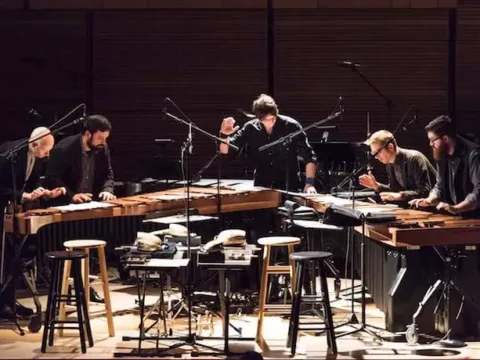
How big is a moment of music? For composer Elijah Daniel Smith, the question isn’t just rhetorical; it’s an organizing principle of his music that guides his latest album, Forbidden Oracles (Oct. 23, New Focus Recordings). The bulk of this recording is its eponymous piece, which transforms short but punchy texts from the sixth-century manuscript The Gospel of the Lots of Mary into five movements for saxophone quartet and percussion ensemble, performed spectacularly by ~Nois and Sō Percussion. As a bonus, Smith’s saxophone quartet Perihelion rounds out the album. In each work, Smith builds up, breaks down, and elegantly reconstructs sound masses to illustrate the progression within and between these moments.
The titular work gives a cinematic impression, a bit like a slow motion camera pan-and-zoom. “Human Evil,” for example, opens with a catchy rhythmic core that is subject to endless permutation. In alto and tenor saxophones, it’s microtonal and ascending; it’s inverted for the lower horns; and it’s stuttered and reconfigured in percussion. A gradual thinning of the texture, then abrupt bottoming out of the pulse, therefore, feels emphatic and resolute, mirroring the surprising shifts of tone in the source text.
If the beginning of “Human Evil” reflects the exhortation to “fight for yourself” and to “get up and go immediately,” Smith’s sudden shift of energy brings a sense of world-weariness. The core motive is smeared, drooping, in slow motion, as if the panning camera has briefly drifted out of focus. But Smith’s approach is not just imagistic; no matter the size of the moment — micro or macro — detail abounds.
Equally important is the well-paced rate of change. Although Smith describes his style as “repetition with variation,” it rarely relies on tropes of microtonality like long stretches dedicated to atmospheric figurations or timbral change. Rather, Smith’s attentive focus and organization enable a more dynamic, juxtapositional technique. Frequently, Smith uses tutti passages to focus on important melodic statements, running the gamut from organ-like homophonic textures to densely interwoven lines unique to each player — made all the more visceral by the thrumming pulsation of microtones.
Throughout the album, Smith emphasizes what he calls “sonic versatility” in the orchestration (and perhaps even more particularly, the person wielding each instrument). It’s a description that’s nominally true when any percussion ensemble comes into the picture. But beyond the inclusion of lesser-used instruments like steel pan or almglocken, some genuinely novel composite timbres emerge through the interaction of metallic instruments.
In “Do Not Follow Your Heart’s Desires,” an elongated articulation from steel pan allows for the subtle emergence of a quietly sustained multiphonic, which competes with, then dissipates against a vibraphone. Later, heavy articulations on steel pan and low-register marimba emerge from a captivating texture of clear-toned saxophone. In this final movement of Forbidden Oracles, the environment Smith has established creates a rich substrate from which any number of constituent elements can surface, fully-formed, into something alchemically separate from “saxophone” or “percussion.”

The album’s capstone, Perihelion, is no less interested in maximizing its timbral range, even in the absence of percussion. Stinging statements in clear unisons and octaves emphasize differences of color produced naturally by the individual horns and each performer’s precise microtonal variations. So too does this piece journey through a number of motivic cells; but whereas Forbidden Oracles ends introspectively, Perihelion relishes the build-up to a forceful conclusion. The ending is foreshadowed from a kernel: a baritone multiphonic stretching over nearly the range of the horn. Through the last two minutes of the work, each member of the quartet brings a different flavor of multiphonic, each harmonically branching from a shared pitch first heard in the baritone: some sharp, others wobbling, aggressive, gurgling. With each new multiphonic, microtonal upper partials build into a dense sound mass until, finally, the quartet locks into a powerful unison.
Like a fractal’s ability to maintain interesting structures at infinite zoom, Forbidden Oracles is equally dynamic and fascinating whether one listens for broad strokes or minute details. It’s a testament to Smith’s considerable ingenuity in fabricating a seemingly endless well of new sounds and textures from an ensemble of eight musicians.
Knowing that the album is suffused with the dark tone of its source texts, it’s tempting to approach that multiplicity of sounds and characters as dramatization. (The full text is included in the liner notes, and it’s well worth the read.) But the words and mythos of The Gospel of the Lots of Mary are not the sum total of the album — they are merely an evocative jumping-off point for Smith’s imaginative ruminations on the composition of color and time.
I CARE IF YOU LISTEN is an editorially-independent program of the American Composers Forum, and is made possible thanks to generous donor and institutional support. You can support the work of ICIYL with a tax-deductible gift to ACF. For more on ACF, visit composersforum.org.