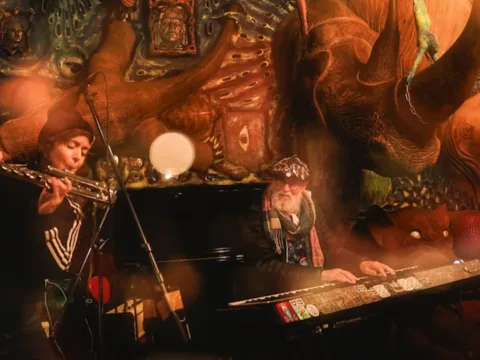
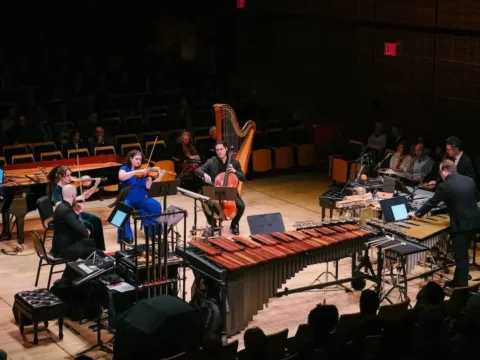
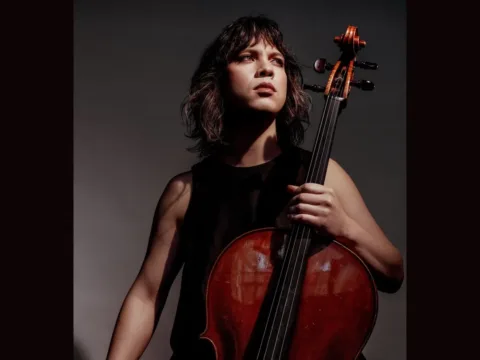
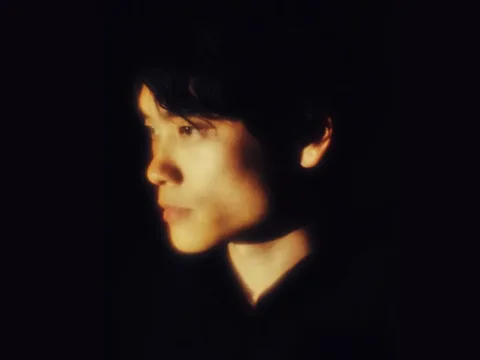
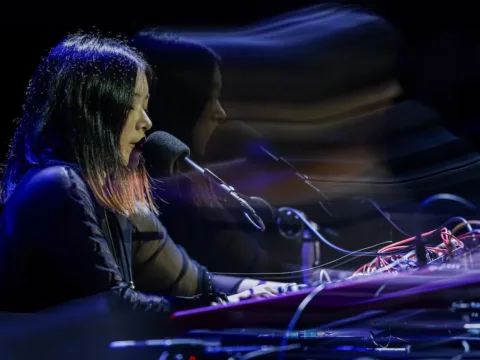
TAK Ensemble’s SWOONFEST is a true community initiative, emphasizing the ethos of an experimental mentality and offering a new platform for New York City’s musical ecosystem. Free spirits, creative thinkers, and trailblazers — the folks TAK promotes — need places to test their ideas. SWOONFEST offers a flexible, kind, and riotously genre-inclusive space for friends and colleagues to perform, workshop, and take big swings without judgement — even if a swing doesn’t quite hit the mark.
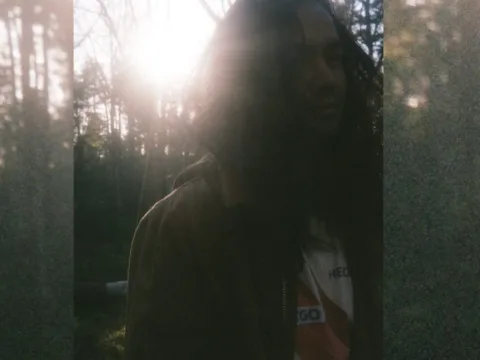
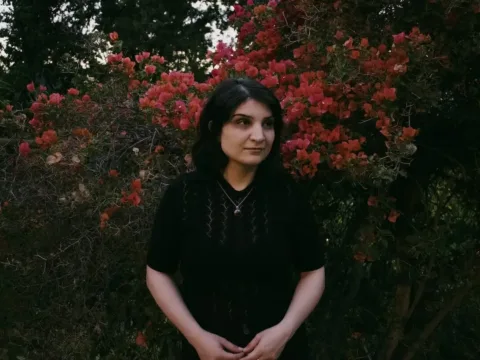
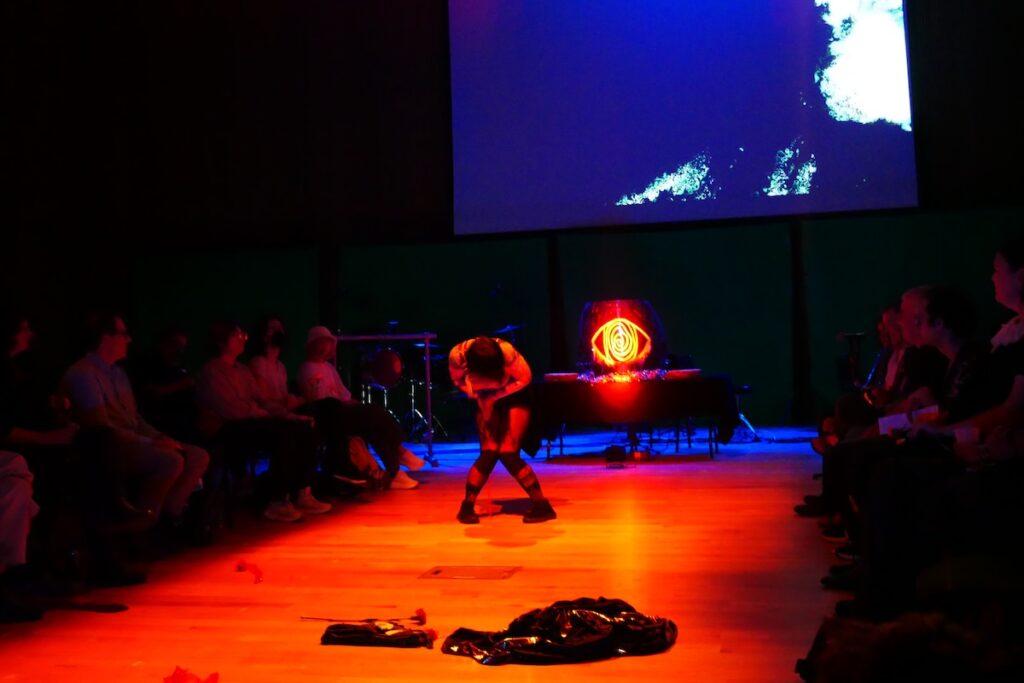
This year’s two-day festival ran Sep. 12-13 at The DiMenna Center for Classical Music and opened with a performance by gushes, the performance project of interdisciplinary artist Jennae Santos. Doubling as an album release party for their aptly-titled debut Delicious Collision, their performance at SWOONFEST set the tone for the weekend, writhing inside a sonic world of metamorphosis that blended Jas Lin’s choreography with performance art.
Backed by the guitar loops and orchestration of their tracks “Game Cut” and “ONE,” which provided a soundtrack to blue and grey projected animations, gushes emerged from the womb of a shimmering metallic shroud to evolve floor-based choreography into running bipedal rage. They almost destroyed an electric guitar before deciding to confront modernity a different way: initiating the audience into one of their political tea ceremonies.
Handing out flowers, cups of burnt rice representing Filipino coffee, and shakers with rice in honor of Egyptian civilian aid to Palestine, gushes invited the transfixed observers to express shared admiration, aggression, and support of Indigenous land movements by contributing their own improvised vocal and percussive sounds. When they grabbed some flowers back to chew and spit them into the air, it was a communal catharsis.
Next up was RAGE Thormbones, the duo of ex-classical trombonists Weston Olencki and Mattie Barbier, who have quite a sense of humor despite maintaining a presence in major venues around the world. Their low-frequency work “exists at the intersections of ‘fuck around’ and ‘find out,’” a fabulous tagline that could also be happily shared by SWOONFEST.
The duo uses circular breathing, various mutes, and occasional electronics to produce a mass of high-density sound that changes the physical feeling of the room. Experiencing the performance was transformative and could be deeply moving for people with a range of hearing abilities: as RAGE Thormbones’ sound unfolded in the midsize room, the physical sensations became almost more powerful than the perceived sound. After astonishingly long periods of human-sustained drones that disturbed the air and buzzed through the floor, silence was both heard and felt through the shocking cessation of bodily vibrations.
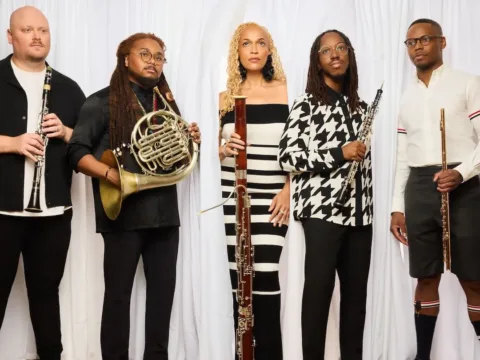
Composer Qiujiang Levi Lu teaches at the University of Pennsylvania, and even though TAK was recently a visiting ensemble-in-residence at the school, Lu first encountered them through a YouTube video. Lu was struck by the visual symmetry of the quintet’s arrangement and was inspired to consider how a composition could harness both their visual and sonic capabilities.
The resulting world premiere, 觀世音 (GuānShìYīn) – Perceiver of the World’s Sounds, utilized hyperrealistic audiovisuals to interpret the 25 realms of existential desire, form, and formlessness taught in Buddhism. TAK performed in front of green screens, and each member’s livestreamed image was layered into a composite projection that was modified throughout 25 short episodes.
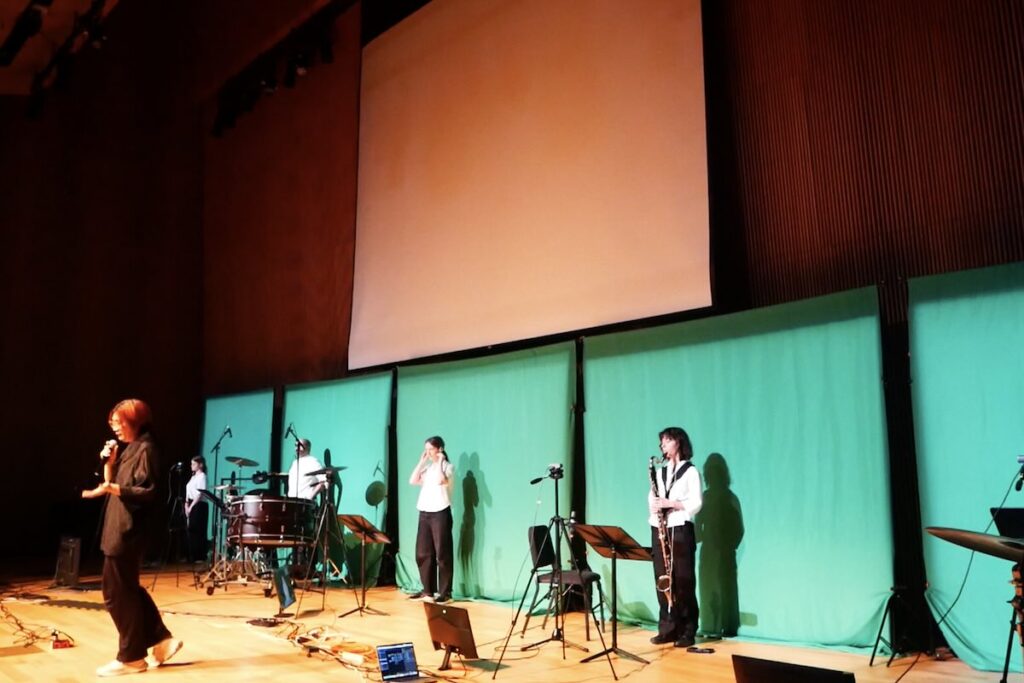
Responding to realms such as “Hell – Suffering,” “Brutality,” “Competitive Egos,” “Heaven of Light,” and “The Boundlessness of Empty Space,” Lu created a brutally cohesive sonic world comprising vocalist screams, laughter, silly x-ray filters, and solo features of TAK’s flute, clarinet, voice, violin, and percussion performers, which lurched through the most extreme usages or negations of their instrumental range.
This was not the relaxing trance of commodified Western mindfulness: Monsters tended toward abrupt, disjunct, and wildly spiraling sounds that alternately supported or distracted from the choreographed live projections. The realms of formlessness were, in fact, meticulously formed by an aural interpretation of chaotic symmetry; accounting for all the timbres and frequencies possible within the TAK performers, Lu composed scenes of explosive madness revealing the full range of sonic possibility within the ensemble. The work concretized the violence within religious practice; like the experience of frustration within meditation and embodied suffering, it revealed the challenges of seeking wisdom in a world pulled between order and destruction.
The second night opened with a performance of Jad Atoui’s In Memory. Performed by Yarn/Wire in memoriam of Scott Pollard, the piece utilized repurposed hard disk drives as instruments to explore recollection and transformation of memory. In memoriam presentations offer a rich artistic opportunity to illuminate those who have passed away and their treasured relationships.
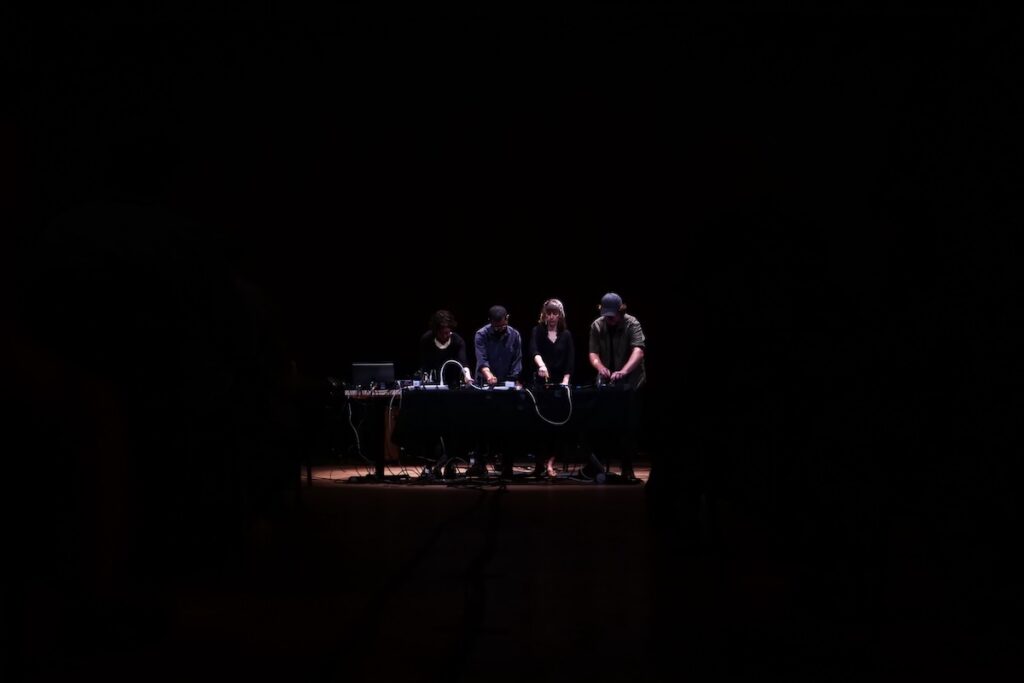
Unfortunately, the piece’s manipulated vintage motors and needles — upon which the title and meaning of the piece rely — were not clearly visible, and no musical context was offered in program notes or the otherwise lovely remarks before the performance. The texture of clicking and amplified resonant feedback offered little guidance, so without a clear context for the work’s construction, the deeply personal emotional intent was sadly diluted and confused.
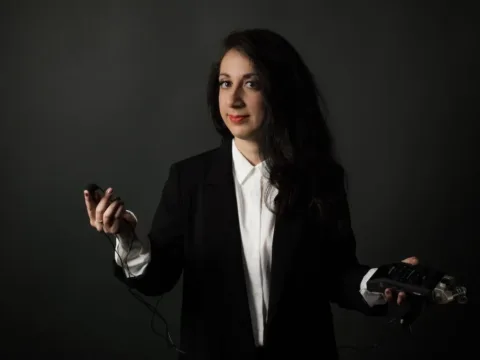
Truly experimental artists need places to fail and iterate, and supportive, relaxed spaces like SWOONFEST meet that desperate and underserved need. In moments of murky creative evolution, spectacular failures are in a sense more exhilarating than an obvious success. They point to unexpected new paths that might be cleared through the underbrush. Yet somehow, the workshop-premiere of Victoria Cheah’s new work for TAK landed almost incomprehensibly flat. Despite an emotional introduction by the composer about themes of multifaceted loss and longing, the piece felt oddly devoid of emotion.
There was a tantalizing possibility in Cheah’s attempt to sculpt distortion products — the psychoacoustic phenomena sometimes called summation tones — beyond an acoustic curiosity. But the result was three continuous movements of physically distressing frequencies produced by beating electronics, entangled distortion products, and interminably long soundstreams.
Perhaps the experiment’s goal was to simulate the depressive and emotionally void vortices one can experience in grief; in that case, there is strong potential for contrasts between the forthcoming movements in the multi-part work to illuminate greater meaning. But as an imbalanced standalone work utilizing the DiMenna Center’s powerful sound system, the work was a literal migraine.
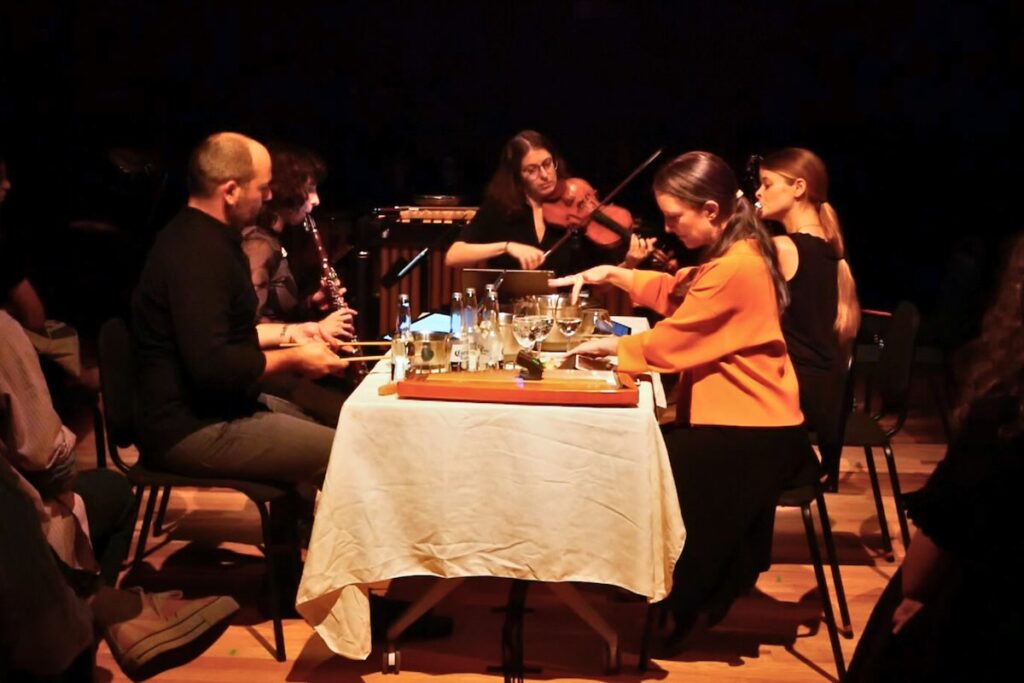
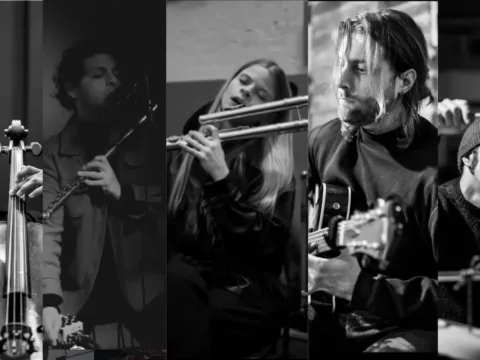
In stark contrast, TAK’s performance of BREAD by Eric Wubbels, taken from their ongoing collaboration interbeing, offered a gentle and reflective option to existing in a world on fire. In addition to melodic flute, light violin, ambling clarinet, and finger harp, TAK evoked the gentle intimacy of the kitchen table using tuned glasses, glass Corona bottles, and a variety of resonant metal bowls struck with mallets. Like any late-night conversation, the texture wandered from the clarinet’s lowest tones or near silence to moments of unison winds and glasses. Performing seated at a communal table surrounded by listeners, the piece successfully brought TAK’s values of curiosity, community, and collaboration to life.
Given the state of arts funding and national politics in 2025, it’s especially impressive that TAK continued SWOONFEST beyond its inception as a tenth-season birthday party. And at a time where explicitly gender-inclusive and politically assertive artistic spaces feel vulnerable, SWOONFEST saw TAK standing radically firm in their values with the inclusion of neo-afro post-punk band Blasé and New York’s queer and trans salsa band Las Mariquitas. Political outrages — by “heinous tyrannical hydras” that fear the power of art — are precisely why TAK must be applauded for their bold embrace of the artists who act as transgressive voices of sanity — and their invitation for people to scream, shake, and dance in support.
I CARE IF YOU LISTEN is an editorially-independent program of the American Composers Forum, and is made possible thanks to generous donor and institutional support. Opinions expressed are solely those of the author and may not represent the views of ICIYL or ACF.
You can support the work of ICIYL with a tax-deductible gift to ACF. For more on ACF, visit composersforum.org.