How do you craft queer joy, kinship, and homes in music? Mainstream culture is filled with ready-made anthems for pride, queer desire, and safe spaces like Chappell Roan’s “Pink Pony Club” and “Hot To Go” among others from recent queer pop waves. While mainstream queer musical culture can be deeply satisfying and rally community, it can also feel hollow when representation and inclusion fail to provide safety.
As queer/trans lives are increasingly imperiled in the US, there’s something quietly radical about art that thrives in the affective and interpersonal subtleties that make community possible. What if We’re Beautiful, a recent collaboration between composer Daniel Thomas Davis and Hub New Music, finds an intriguing niche in this space between folk art, pop, and poetry. Over six short tracks, the album presents a decidedly homespun take on queer kinship and joy that grasps at the ineffable experiences of queer community.
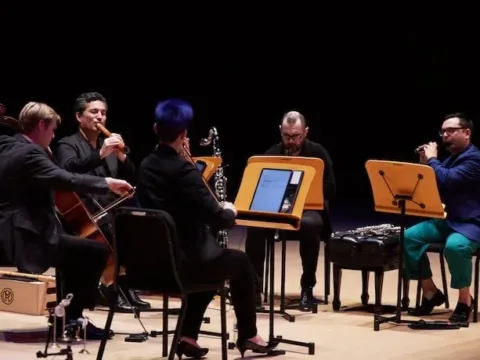
Born from Hub New Music’s touring/commissioning program exploring identity, chosen family, and “home,” What if We’re Beautiful departs slightly from Davis’ penchant for operatic camp theatrics and multilayered drama (his opera Six.Twenty.Outrageous gives Cole Escola’s Oh, Mary! a run for its money). The work is an exercise in “gift-craft,” offering songs as mementos to queer friends and kin. From the outside, there’s an alluring opacity to these musical gifts: names are furtively and tenderly rendered as initials, and text is eschewed for refracted instrumental affects. What coalesces is an intimate appreciation of the varied and often complicated ways we feel, experience, and give joy as queer people.

The opening tracks weave contrasting textures to create buoyant scenes that allude to the dynamic intimacy of queer kinship. “Song for L.H.” begins with an inquisitive yet insistent ensemble melody filigreed with agile cello and bass clarinet ornaments and delicate suspensions that stretch across cadences. A rapid violin arpeggio enters to recontextualize the ensemble melody, giving it rhythmic urgency and textural depth.
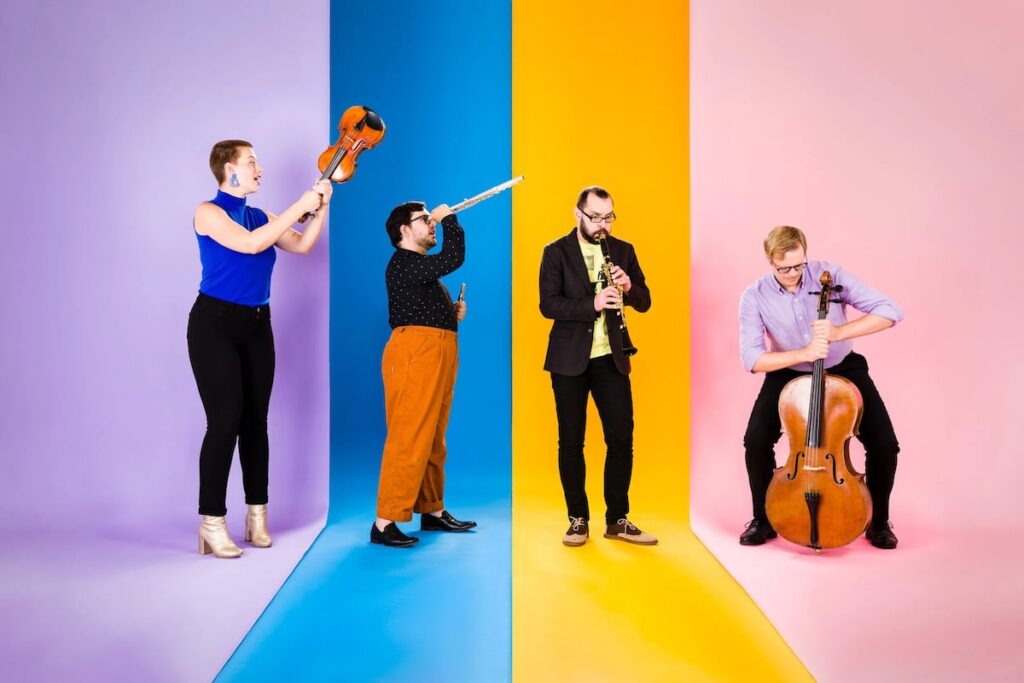
“Prelude for J.W. and K.H.” similarly plays with transformation and texture. Michael Avitabile and Gleb Kanasevich deftly stitch tight clusters of flute and clarinet pitches together with crisp articulations, relaxing into open harmonies and a fluttering melodic line. Jesse Christeson and Magnolia Rhorer border these shifts with string pizzicati and percussive tapping, shifting to spacious arpeggios stretched across octaves.
A standout track on the album, “Anthem for M.M.,” finds space for queer nostalgia by refashioning and reimagining tradition. The opening violin and cello duet introduces a rich, low chorale, finding luxurious double stop harmonies and breathy/twangy bowing reminiscent of Southern congregation singing and fiddle traditions. Hub’s interpretation develops out of these well-worn comforts: vibrato, trills, and glissando emerge from cadences in a delicate flamboyance, and exuberant countermelodies grow from cadential harmonies and phrase breaths.
Although initially distinct, tradition and transgression gradually, and beautifully, transform one another. The string chorale rises in pitch to allow soaring wind melodies to land comfortably — an arresting sense of homecoming that is mirrored in the music video for the track. Dressed in satin gowns, dancers Aaron Loux and Brian Lawson tenderly embrace in a dimly lit barn, then leap through a field in a liberated duet before returning confidently inside.
The album also finds a kind of slower-paced, nuanced transformation, queerly rendering joy as pensive, sensuous, and searching. Avitabile shines across the extended flute solo in “Arietta for M.A.,” finding rich, breathy vibrato in the low register and a dazzling, harmonically-saturated tone in the upper. The ensemble supports with a delightfully disorienting wash of tone colors ranging from wavering crystalline harmonic clusters to low, groaning drones.
The various musical and thematic threads of What if We’re Beautiful are tied together in two versions of “Verses for A.L & H.R.,” which also reveal the relationship Davis and Hub developed during the project. Originally written for hurdy-gurdy, the instrumental version transcribed for the ensemble finds a quiet, boisterous exuberance through the ornamentations, chord clusters, and textures previously introduced throughout the album.
The inclusion of the original version for hurdy-gurdy ruptures the album’s sound world; Davis conjures choruses of drones pulsating with vibrato and overtones that overflow across harmonics, underscoring an electrifying melody viscerally coaxed out of the instrument’s keyboard.
What if We’re Beautiful sees Hub New Music and Davis finding homes in their work. For the ensemble, it marks an exceptionally well-produced product from a growing track record of highly successful and affecting commissioning. For Davis, the piece marks a breathtaking turn to chamber music and a poignant foray into more personal subjects.
As a white queer person living and working in Western North Carolina and Appalachia, this album resonates with subtler frequencies of my life. It reminds me of meals and jokes shared in apartments. Of jukeboxes riotously co-opted in local dive bars. Of long texts, phone calls, and FaceTimes with friends and partners. In What if We’re Beautiful, I’m invited to hear the queer feelings, practices, communities, and places that give me joy and sustain me.
I CARE IF YOU LISTEN is an editorially-independent program of the American Composers Forum, and is made possible thanks to generous donor and institutional support. Opinions expressed are solely those of the author and may not represent the views of ICIYL or ACF.
You can support the work of ICIYL with a tax-deductible gift to ACF. For more on ACF, visit composersforum.org.