I find myself circling the drain of uncertainty these days; am I wearing clothes or styling them? Do I have a personal style, or am I a performative she/they? Where can we place our curated sensibilities when the ground constantly shifts, when time repeats and folds in on itself? In new music, will it always be the year of the slash, with composition titles punctuated to imply multiplicity or ineffability?
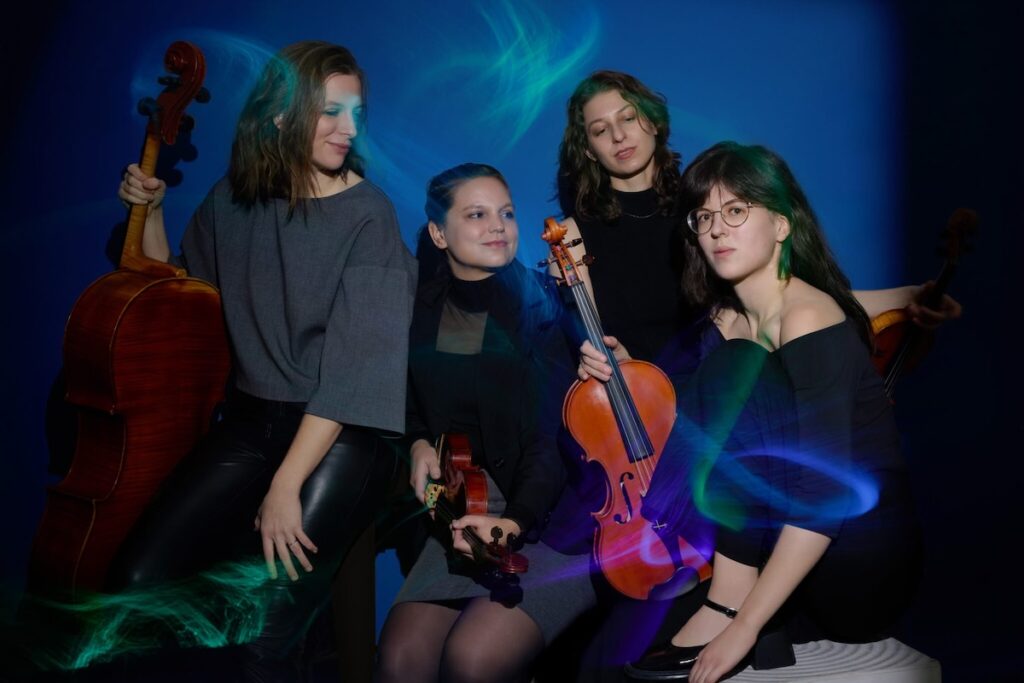
String quartet/girl group The Rhythm Method keeps me wondering on Seaglass (Oct. 17, Gold Bolus Recordings). Performed with guts and gusto by this ensemble of performers/composers, Seaglass manages a balancing act of intrigue and revelation with four works by the quartet’s violist Carrie Frey.
Liner notes, like museum wall text, can play an illuminating role; the notes for Seaglass, written by TAK Ensemble’s Madison Greenstone, reference Frey’s score directions and allusions to add a conceptual ground for the sonic gestures across the album. Notably, the opening and closing tracks both draw upon science fiction by Arkady Martine, particularly her engagement with collective and individual consciousnesses.
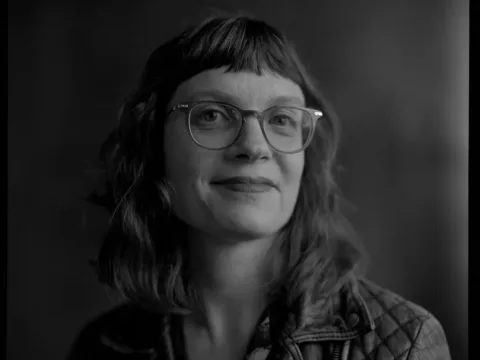
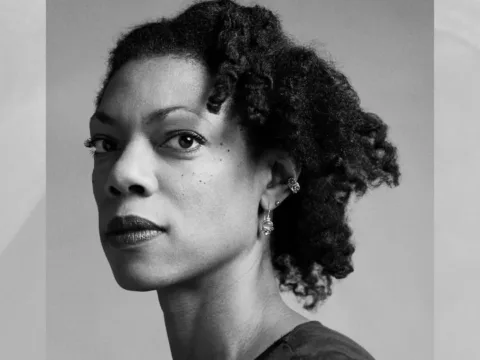
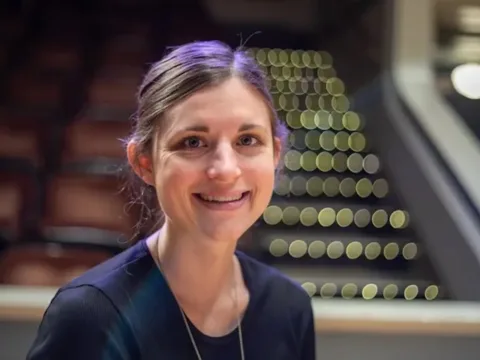
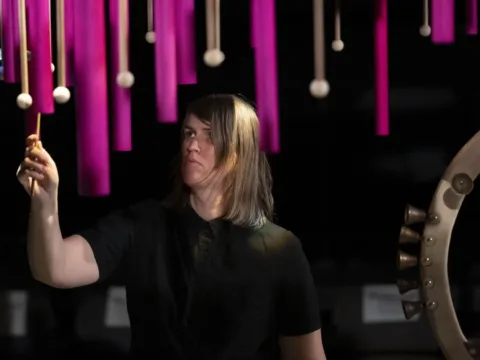
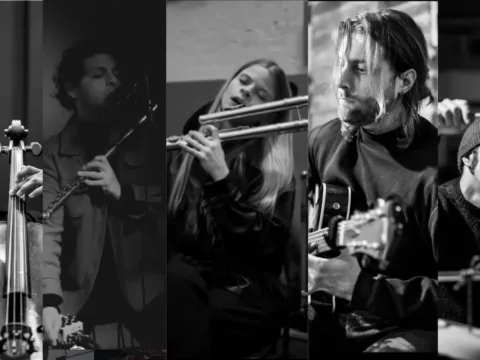
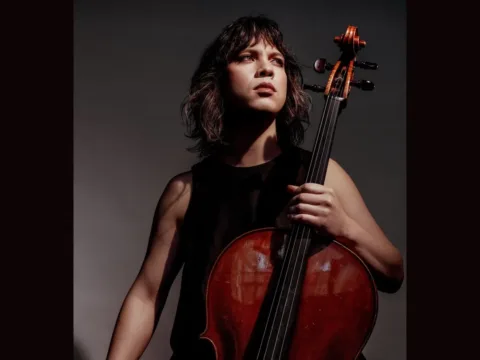
This rumination — already befitting a meditation on chamber ensemble dynamics — also extends to the artistic identities of The Rhythm Method’s members. Leah Asher, Marina Kifferstein, Carrie Frey, and Meaghan Burke are each superb performers and composers who have written for the quartet, and none operate alone for long on this project. Frey’s compositions traverse a sort of nautical theater in a way that calls to mind the eponymous roving structure of the beloved Studio Ghibli film “Howl’s Moving Castle” with its charming assortment of bits and baubles and its lurching yet magical movement.
Stepwise movements unfurl outward in “A chorus like distant screaming,” stretching tightly huddled chord clusters ever sheerer. The ferocious swarm effected by unsteady, wavering drones gives way to soupy drawls and glissandi. Before long, simmering whispers erupt into a peak of whoops and howls before receding into the tranquil, perhaps stoic opening theme.
Players pass around figures of trills and flurries in “LATHE” before convening as one unit, spinning a weighty work song. The industrious lumbering fades into the sung phrase “when I love you then you leave me and the time comes to be far away from you” repeated into squeaky oblivion.
“Gone/Back” opens with clear double-stopped attacks like peals of a striking clock that converge into an octave, yet quickly unravel. A brief pause marks the midway point as the quartet breathes into a new chorale section. Transformations happen together here; as one player begins a new section, the rest of the group is close behind — the organism reaches its destination in a dissonant fan-like gesture.
By the time we reach “Seaglass/Pebble,” which feels the most exacting and lean, we have become well accustomed to The Rhythm Method’s ability to switch from full-throttle grime to sheer rippling in a snap. A shower of furious slides wanes into another shared, unwieldy octave, which prepares the way for a sensitive dirge — a plaintive dissolution to the album.
The dual tension of collective and individual consciousness highlighted in the liner notes opens and re-opens the question of what a listener ought to know — what embedded secrets or accumulated lore is pre-requisite knowledge to receive work honestly and completely? Though folks may be unfamiliar with Martine’s writing or The Rhythm Method’s ethos, their shared consciousness is as clear in this as on their other projects. The ensemble’s collaboration and performance is the clear highlight amid the smattering of new music touchstones like titles with slashes and dramatic yet whimsical album art, which are largely external to the music anyhow. Each member builds on anotherʻs energy, and Frey’s compositions create space for the quartet to push deeper into each section and for us to get the wheels turning.
I CARE IF YOU LISTEN is an editorially-independent program of the American Composers Forum, and is made possible thanks to generous donor and institutional support. Opinions expressed are solely those of the author and may not represent the views of ICIYL or ACF.
You can support the work of ICIYL with a tax-deductible gift to ACF. For more on ACF, visit composersforum.org.