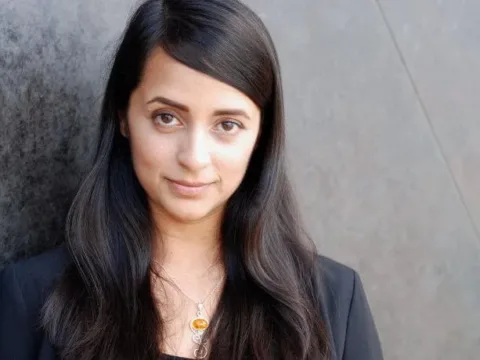
Mari Esabel Valverde is an award-winning transgender Mexican-American composer in steady demand in the United States and abroad. Aspiring to create music that emboldens people to unlearn shame, her works center the voices of historically marginalized authors and address questions of gender, sexuality, social justice, and love of the natural world.
I categorically reject the narrative that being transgender means “I’m hiding who I really am.” On the contrary, I would describe it as being naked or the most vulnerable version of myself. And it is a gift, not just to me, but to the world for us to be able to hear and learn from gender-marginalized artists telling their stories authentically on their own terms.
In the month of Marsha P. Johnson, I would like to focus my playlist on a topic that impacts potentially everybody, and that is bodily autonomy. Consider this a shout out to some of my favorite living composers and poets. As you listen, please follow along the lyrics which I’ve also linked to.
My name is Mari Esabel Valverde, and this is my ListN Up playlist.
“Release” by Saunder Choi, Text by Amir Rabiyah, Performed by California All-State Choir
Days following the second inauguration of Trump, allegedly in response to a member of their state legislature threatening to sue, the Arkansas Choral Directors Association voted to remove “Release” from their All-State Choir program and, in effect, censured the words of the incomparable, openly trans poet Amir Rabiyah. The piece is a reflection on masculinity and, in the composer’s words, “speaks of emotional vulnerability as a source of strength and power.”
“1991” from LISTEN (2019) by Melissa Dunphy, Text from Anita Hill, Performed by Resonance Ensemble and Katherine FitzGibbon, conductor (Content warning: disturbing themes)
During a residency at Amherst College in November 2019, I recall picking up a pin that read: “I believe Anita Hill.” It was at that late date that I learned who she was—a Black woman, lawyer, and survivor who testified before the Senate Judiciary Committee to protect democracy from the confirmation of Clarence Thomas to the Supreme Court. Melissa Dunphy’s stirring two-movement work LISTEN sets her words.
“Whole” from Verum Corpus (2020) by Saunder Choi, Text by Amir Rabiyah, Performed by SACRA/PROFANA
Verum Corpus, Latin for “true body,” is another Choi-Rabiyah collaboration. This 20-minute work for chorus and string quartet is inspired by Ovid’s mythical hero Caeneus, who in modern language, was designated female at birth. Upon being violated by the god Poseidon, Caeneus demanded he be “transformed into a man” to never again be violated. Reclamation of one’s body is a common thread that connects Caeneus’s story to lived experiences of transgender folks and survivors.
“Death Before Detransition” from Trans Requiem (2025) by Andrew Yee, Text by J. Jennifer Espinoza, Performed by Trinity Choir and Melissa Attebury, conductor
Offering a transfeminine perspective, both on the parts of the poet and the composer, Andrew Yee’s “Death Before Detransition” expresses plainly that a trans woman’s story, once she has told it, will not be unheard. Invigorated by surging strings, Espinoza’s words seem to float, overlapping multiple sonic planes, sung by the choir and played by fixed media. I believe the Trans Requiem will have been a pivotal work from our current musical era.
“Mit hjerte er blevet borte” (“My Heart Has Gone Missing”) from To digte af Tove Ditlevsen (2010) by Mari Esabel Valverde, Text by Tove Ditlevsen, Performed by Eric Ferring and Madeline Slettedahl
I wanted to include this early composition of mine because it speaks to the consequences of not claiming one’s identity. Tove Ditlevsen’s poem describes someone who builds a wall of “cold, hard stones” around her heart for fear it would be broken. Eventually, she tears the wall down and is left lamenting that her heart has “gone missing.” I am reminded of the importance of not abandoning your heart, tender as it may be.
“When the Dust Settles” (2019) by Mari Esabel Valverde, Text by Amir Rabiyah, Performed by 21V and Martin Benvenuto, conductor
The all-gender soprano-alto ensemble 21V performs my “When the Dust Settles.” In collaboration with Rabiyah, I composed this piece in honor of the late “veteran of the Stonewall Riots” Miss Major Griffin-Gracy. With each performance, these lyrics persistently resonate:
we deserve to kiss without fear
to grow old
to sway our hips
to wear what we wish
to relish in the pleasure of our bodies
“When the Dust Settles” © 2018 by Amir Rabiyah
“Up/Rising Into” (2024) by Mari Esabel Valverde, Text by Amir Rabiyah, Performed by Seattle Pro Musica
To conclude, I present “Up/Rising Into” for chorus a cappella, bearing a message of hope. Rabiyah wrote the text as a love letter to trans and non-binary youth. The melody, sung by the deepest voices, speaks of shattered innocence, but the tone shifts with the repeated affirmation: “You are beloved.” When, at last, it is time to “take flight,” the voices unfold as parted wings gliding towards a time and place where trans joy abounds.
I CARE IF YOU LISTEN is an editorially-independent program of the American Composers Forum, and is made possible thanks to generous donor and institutional support. You can support the work of ICIYL with a tax-deductible gift to ACF. For more on ACF, visit composersforum.org.