In the 250th anniversary of the United States, we might expect programming that focuses on the Founding Fathers. But in doing so, our view of this nation remains narrow. Michelle Rofrano, the founder and music director of PROTESTRA, is posing a different question: what do we hear when we center “half the population that founded this country, whose labor goes unrecognized, whose physical labor built this country?”
On Jun. 27, the activist orchestra will explore this idea on a program titled “Founding Mothers” featuring music by Amy Beach, Nadia Boulanger, Valerie Coleman, Florence B. Price, and Joan Tower alongside two new works by Danielle Jagelski and JL Marlor. Commissioned through American Composers Forum’s “Recomposing America” initiative, their new compositions explore girlhood and womanhood in the United States through two different vantage points. Yet ultimately, they call for the same thing: make your presence known and embrace your strength.
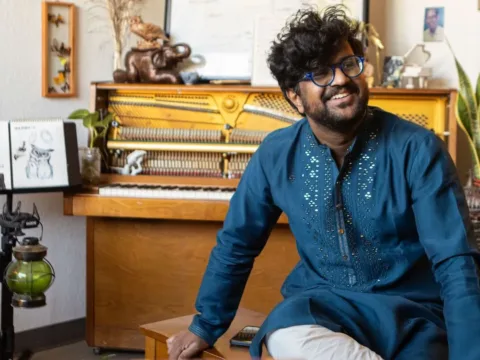
Danielle chose to honor the people and matriarchal structures she has known as an Oneida and Red Cliff Band Ojibwe. The seven movements of her deeply personal work Matriarch are a reference to the Seven Generations — you are the dream of your seventh generation ancestors; you, in turn, dream of your seventh generation descendants. The piece centers the role of women in continuing the line, not just by having children, but also through storytelling, singing of the sacred songs, and passing on their expertise.
“Our egg we grew out of was in our grandmother, so it’s a connection that is there so deeply,” she explained in our interview. ”When it comes to matriarchal traditions, it’s also because the women hold our knowledge. It’s not like Indigenous people are immune to patriarchy and to violence, but I think that where we find strength and where we come home to is really in those matriarchal values of community and building… of nurturing.”

Her percussion setup for the work features bowls of water, cretoles, dipping wood in water, and crescent wrenches tied to fishing line — the latter an homage to Danielle’s maternal uncles, grandfather, and great-grandfather, who were gill net fishermen. Through the composition’s communal and familial focus, Danielle hopes that people feel seen and empowered. “I want them to know that the Earth is holding us; our communities are holding us,” she said.
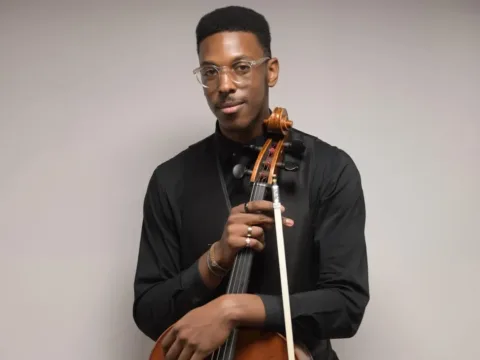
While Danielle looked to the flow of Indigenous matriarchal connection, JL talks directly to the heart of American patriarchy — or perhaps more appropriately, yells through it. The seeds for her new work Yellfire began with Hunger All the Way Down, written three years ago as a response to her clarifying realization that her disordered eating, body insecurity, and anger were directly tied to the societal chokehold placed on trans women, cis women, and transmascs — anyone socialized as a woman.
“I realized that I just worked so hard to shrink my rage into something that was palatable, and I think when we shrink the parts of us that are screaming for attention, we shrink ourselves. When we think our feelings don’t matter, we think we don’t matter.”
Written for guitar and orchestra with original text by JL, the orchestra is not only required to play their instruments, but to scream. JL recognizes that anger and rage do not need to be dangerous to oneself and others — a fact often lost in our culture’s treatment of violent masculine anger as something to be tolerated rather than prevented.

“Music is a safe space to model rage and anger and get it out, ” they explained over Zoom, “I’m here talking about systemic inequality, and that’s such a clear pathway to rage being an important and good feeling to feel. Because if I didn’t feel this rage and didn’t have a safe outlet, like music, then we wouldn’t be having this conversation.”
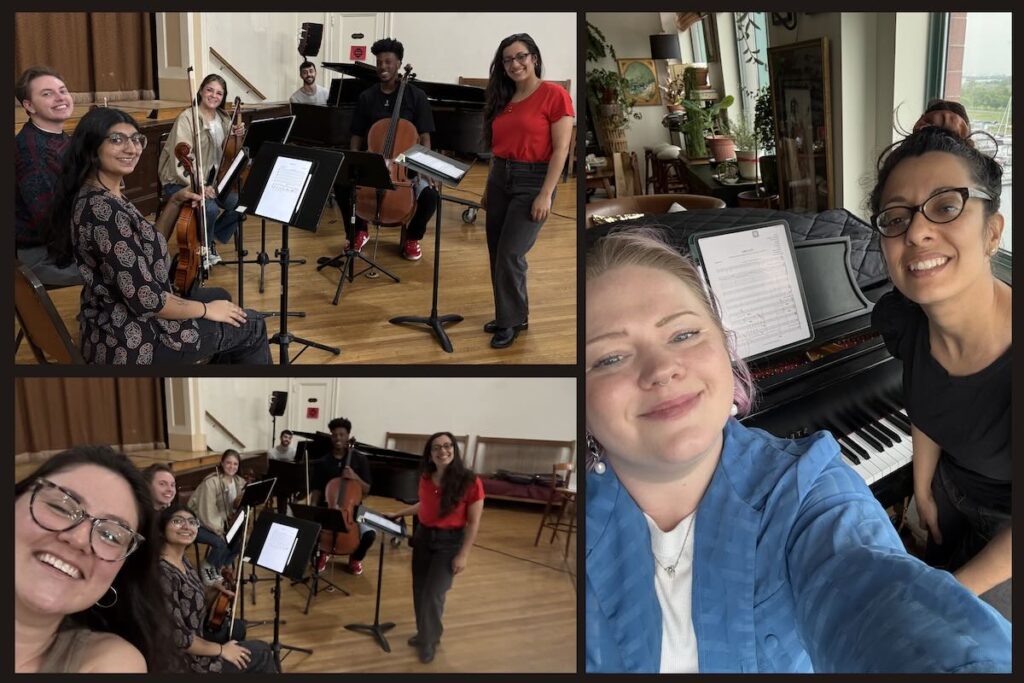
The collaboration between Danielle, JL, and PROTESTRA enhances the efficacy of music to speak to audiences at multiple registers. PROTESTRA routinely donates ticket proceeds to an organization tied to their concert’s themes, and rarely are their concerts not connected to a broader societal issue. “Founding Mothers” is no exception. As Erin Schwab, PROTESTRA’s Director of Design, observed, the program is “giving a platform to women when women’s rights are being stripped [at] every turn.”
For Danielle and JL, their commentary on the 250th anniversary of the United States is a clear-eyed reckoning with our nation’s history. They underscore the importance of a diversity of personal experiences in articulating universal truths.
“I was just thinking about the shrinking that occurred [in the Constitution],” JL reflected. “In that document, the only people who are citizens of the United States or have any say, voting rights, or power are white property-owning men.” She continued, “My hope is that girls and women can see the ways that they have shrunk themselves. The more we can bring awareness to that in their physical body is the only way that’ll be undone.”
Both composers recognize the use of shrinking — of exclusivity — to dampen the impact of women, Indigenous people, and people of color. And so they make a point to remind us that their reach is only as limited as they accept it to be, not what others determine.
“I was with First Peoples Fund a couple weeks ago,” Danielle told me, “and their president Tina Kuckkahn said that Indigenous people have always used what’s around them to create their best lives, and now we have the whole world. [The 250th anniversary] is just something that is around me that I’m using as I should.”
When we enter a concert hall, we don’t leave our problems at the door, though we may like to think so. PROTESTRA, JL, and Danielle are creating space to bring ourselves and the worlds we inhabit with us — the beauty, the mess, the anger, and the hope. It is a method to hold us accountable to ourselves and each other, and to retain the community that is so essential to our individual growth.
I CARE IF YOU LISTEN is an editorially-independent program of the American Composers Forum, and is made possible thanks to generous donor and institutional support. You can support the work of ICIYL with a tax-deductible gift to ACF. For more on ACF, visit composersforum.org.