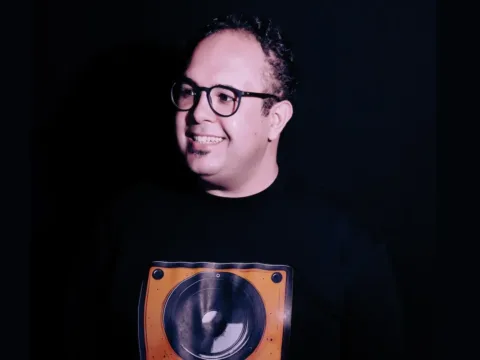
Composer, electroacoustic musician, and educator Ali Balighi seems most comfortable in the unstable zones on the fringe of conventional harmonic systems. In work that spans acoustic performance, live generative electronics, and fixed media, Balighi’s approach to building his expansive, post-tonal worlds begins at the intersection of serialism and the ancient Persian Dastgah modal system.
Serialism is often referred to as “twelve-tone” composition, in reference to the European chromatic scale. Using Persian tuning as a model, Balighi constructs his compositions by dividing the octave into even finer slivers. In his 2025 work Dastgah: Algorithmic Explorations of Persian Microtonality and Serialism, he splits the octave into a 17-note scale to create a textured, glittering soundscape of microtonal harmonies. The work was constructed and performed from within the open source SuperCollider software, a tool he has employed for much of his recent computer-based work. Additionally, space plays a role in the presentation of much of his work; Dastgah is intended to be played back quadraphonically through pairs of front and rear speakers that surround the listener.
Balighi’s forthcoming album, Micromorphosis No. 5: Algorithmic Explorations of Microtonality (Jul. 1, Post Orientalism Music), dives deep into his conceptual, generative universe with a continuous, 24-hour composition divided into hour-long segments. Using a prerecorded library of 34 violin samples manipulated by SuperCollider, the harmonic structure cycles through a sequence of equally divided octaves with 7, 14, 15 and 30 notes. Each cycle functions like a gravitational field that briefly draws the music into coherence before releasing it. Every parameter is governed randomly by the program, resulting in no two pieces in the cycle being identical. The result is a kind of electronic aeolian harp that seems to operate on a galactic scale.
Congratulations on the release of Micromorphosis No. 5! It’s easy to draw cosmic parallels to the way you’ve structured this piece, such as the rotation of the earth and the passing of day into night. Is there a deeper significance to the extreme duration of the work?
Thank you! Micromorphosis No. 5 is an open-ended piece, but open-ended within a restricted system. Composed algorithmically in SuperCollider, the work is not fixed as one definitive recording. Each realization is one possible surface produced by the same underlying grammar. I recorded twenty-four hours of the music to demonstrate how much the system can generate and how many new perspectives can emerge from a restricted microtonal environment.
The duration matters because the piece needs time for its tuning systems to gain and lose authority. Each equal division of the octave (EDO) functions as a temporary harmonic law. It appears, establishes itself through recurrence, and then begins to dissolve. A shorter realization would make those changes sound like ordinary transitions. Here, I wanted the listener to experience the ground of pitch itself becoming unstable.
The title reflects this directly. Micromorphosis combines micro, from microtonal, and morphosis, from metamorphosis. The piece is about transformation inside microtonal space. I was searching for a new logic of modulation between different microtonal scales, something not achievable with acoustic instruments alone. SuperCollider allowed me to make the tuning system itself move, not only the notes within it.
The twenty-four-hour duration is therefore not symbolic in a cosmic sense. Its significance is perceptual and procedural. How long does it take for the ear to believe in a microtonal scale? And what happens when that scale begins to transform before the listener has fully settled into it? The duration is about trust, change, and the experience of harmonic instability unfolding in real time.
There is such remarkable complexity behind the construction of the work you build in SuperCollider. How does your approach differ when writing for acoustic instruments and live performers?
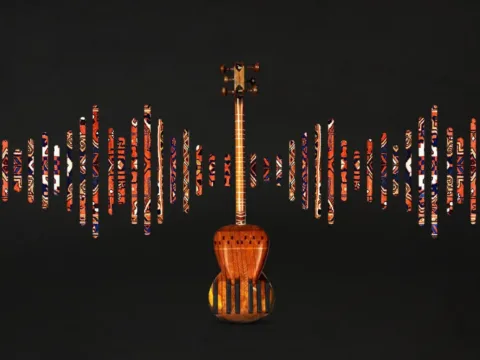
Writing microtonal music for acoustic instruments requires two fundamentally different approaches. When the instrument already carries a microtonal system within its own tradition, the process feels entirely natural. My piece Daramad for tar and fixed media, performed at the 7th Tehran Electronic Festival in 2025 and the Hot Air Music Festival at the San Francisco Conservatory of Music in 2021, illustrates this well: since Persian classical music has microtonality embedded in its foundation, I drew on that internal system organically. The result may not sound like traditional Persian music, but the approach to pitch was entirely idiomatic to the instrument.
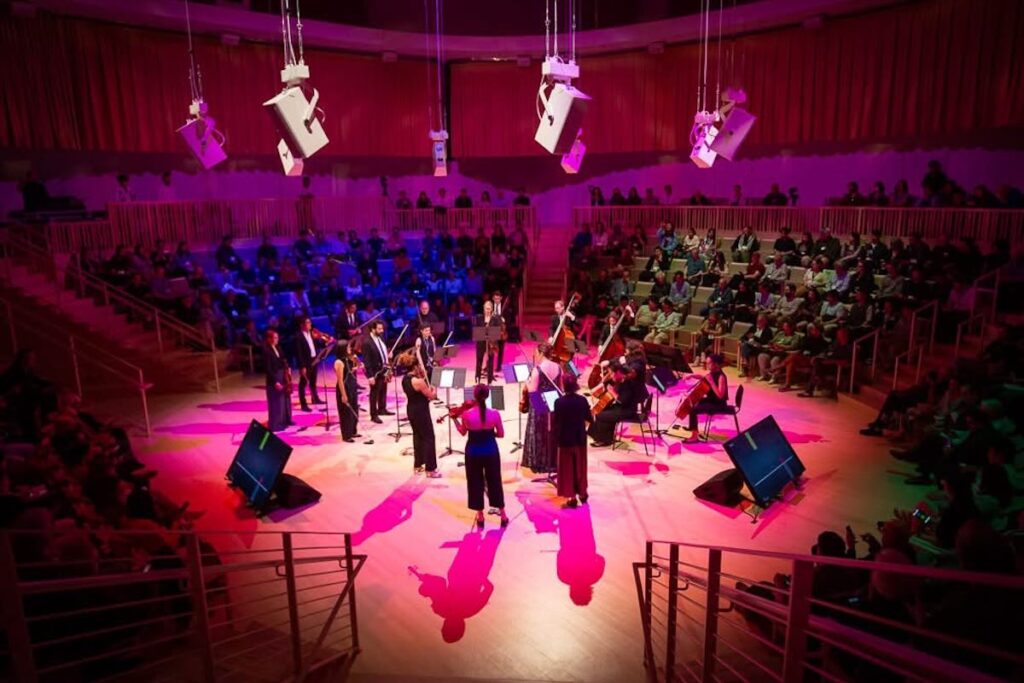
Writing for Western instruments presents fewer obstacles than one might expect. Many contemporary performers are already familiar with defined microtonal frameworks such as 24-EDO and 48-EDO, which provides a reliable common ground. In other cases, I find ways to work around strict notational demands altogether. In The Wind Will Carry Us Away for strings and fixed media, performed at the Thomas Tull Concert Hall at MIT in 2025, the 53-EDO system lives almost entirely in the electronic layer, while the string parts navigate the microtonal space through extended techniques and glissandi. This allows the performers to move fluidly through the pitch world I have constructed without being bound to precise microtonal notation.
Much of your computer-based work seems to focus on the unanticipated outcome of the randomness you incorporate into the underlying code. Where do you see your creative identity in the context of observing these outcomes?
My creative identity in this context has shifted considerably from what one might traditionally associate with the role of a composer. Throughout history, composers have redefined authorship by constructing systems of constraint rather than simply writing notes. Bach codified the laws of counterpoint into a rigorous framework, and Schoenberg later dismantled tonal hierarchy through the systematic logic of serial composition. Each, in their own way, was not merely composing music but architecting a set of rules within which music could emerge. In our own time, that tradition continues through data and algorithms, and I see myself as working within this lineage, functioning as an architect of sonic systems who shapes the behavior and potential of computational environments rather than dictating precise outcomes.
This orientation naturally leads to what I would describe as a distributed and co-creative authorship. When I observe and manage the unpredictable outputs of my code, I position myself as a mediator between human and algorithmic intention, curating processes rather than controlling them. The software is no longer a passive tool but an active participant that shapes the boundaries of what is imaginable. This is perhaps most evident in my Electropoem series, where I collaborate with AI-generated dialogue and even treat the atmospheric physics of Mars as a performer and co-composer. Ultimately, I understand my creative identity in these technological contexts as a continuous choreography of constraint and emergence, situated at the intersection of agency, authorship, and ethical design. It is an identity that is no longer singular, but plural, shared, and perpetually evolving.
You’ve talked about creating a sense of space in the music for different harmonic phenomena to arise. What role does physical space play in experiencing performances of your fixed media work?
Physical space is not a neutral container for this work. In Micromorphosis No. 5, I treat space as one of the conditions through which harmonic behaviors become audible. The piece is an algorithmic composition written in SuperCollider rather than fixed media in the strict sense. Although it draws on recorded violin samples, the sounding result emerges through procedural decisions involving sample selection, pitch degree, duration, panning, distance, filtering, and amplitude, all of which are part of the same compositional logic.
That distinction matters because space is not added after the fact but is woven into the algorithmic behavior of the piece itself. Events may be pinned, may drift, or may move so quickly that they register less as locations than as trajectories. Distance is bound to filtering and amplitude, so a sound that recedes does not simply move away in a geometric sense. It darkens and loses force. In performance, the room either sharpens or complicates these relationships. A dry, close space can make the calculated pitch relations feel exposed and immediate. A resonant space can blur them, extending the work’s preoccupation with unstable harmonic authority.
Because the piece lives in SuperCollider, the speaker configuration remains open and adjustable. This flexibility is not merely technical convenience. Expanding beyond stereo changes how events are grouped, how motion is followed, and how harmonic evidence distributes itself across the listening field. Physical space therefore participates actively in the moving ground of the work, and each room and loudspeaker arrangement becomes another way the piece is performed and encountered.
Your recent works present the computer program itself as the performer, generating unique versions of these works with each pass. Do you have any future plans to incorporate live performers into this mix, or another vision for this mode of generative composition?
So far, I have composed five pieces in the Micromorphosis series, each responding to a specific question about microtonal music and algorithmic composition. Micromorphosis No. 3, for instance, is built entirely around the Fibonacci series, shaping both the tuning systems and temporal structure simultaneously. The scales move through 13, 21, 34, 55, and 89 EDO, and the duration of each section mirrors its scale directly, so a 13 EDO section lasts thirteen seconds, a 21 EDO section lasts twenty-one, and so on. The same numerical logic extends into the spatial and visual dimensions, so that pitch, time, space, and image all share a common generative root. That kind of internal consistency is not a formal exercise but a way of ensuring the idea inhabits the whole piece rather than sitting on its surface.
Looking ahead, I want to bring live performers back into this framework while keeping the generative logic intact. I am thinking about working with new microtonal instruments, machine learning, and animated notation as a way of bridging the algorithmic and the performative. I am also drawn to the idea of an AI system functioning as a responsive accompaniment, one that listens, learns the unfolding musical situation, and reacts with genuine flexibility, not unlike a jazz pianist reading and answering a room. More broadly, I want to continue exploring algorithmic thinking in electroacoustic music, not as technical decoration, but as a way of making music that honestly reflects the spirit of our time.
I CARE IF YOU LISTEN is an editorially-independent program of the American Composers Forum, and is made possible thanks to generous donor and institutional support. You can support the work of ICIYL with a tax-deductible gift to ACF. For more on ACF, visit composersforum.org.