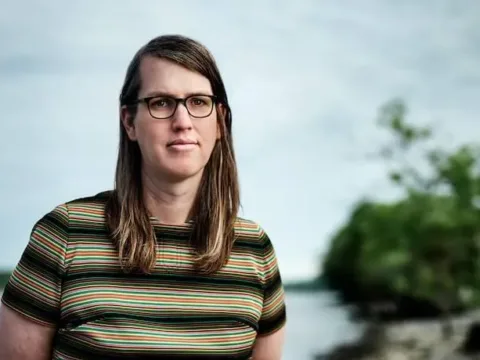
Over the past 20 years, Sarah Hennies has developed an iterative musical practice that finds sonic and conceptual niches in contemporary art ecosystems. Her near-singular approach to long-form repetition evokes subtle timbres and textures that trace ineffable, overwhelming, or often overlooked experiences. Compositions emerging from close collaboration with performers plunge audiences into queer intimate connections or the resonances of place from Slovakia to upstate New York. Drawing from personal experience, Hennies’ solo recordings for percussion, written essays, and video works reflexively give shape to the nuances texturing trans/queer lives, creating spaces for community solidarity and inviting broader reflections about socio-cultural norms.
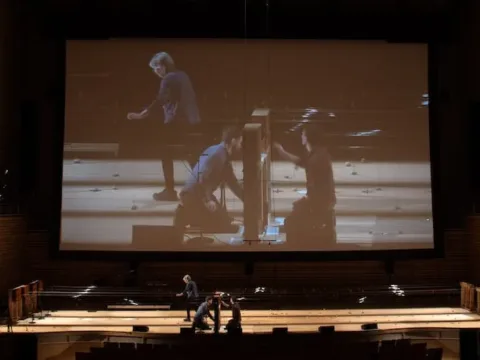
From this foundation, Hennies has rhizomatically grown this signature style to inhabit an array of forms and institutions. Collaborative compositions with Tristan Kasten-Krause create luxurious sound fields that reveal scintillating dimensions to her timbral percussion technique. Massive sculptural percussive instruments by Terry Berlier are deployed in A Kind of Ache (2024) to bring queer objects and soundscapes into institutions including EMPAC.
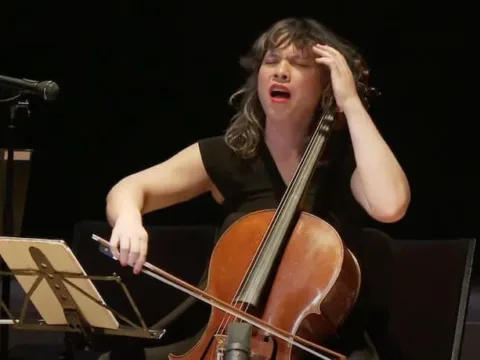
A recent outgrowth finds Hennies collaborating with increasingly large instrumental ensembles to open up new sonic and conceptual terrain. Her 2024 album Sarah Hennies: Motor Tapes features her first conducted and through-composed piece that explores psychoanalytic notions of time and memory through carefully calibrated gestures. And her string orchestra piece Falling Together (2021) deconstructs traditional playing techniques and orchestrations in an arresting meditation on the limits of musical and collective labor.
Hennies is set to continue this trajectory with her first full symphonic orchestral piece, The Grain House, premiering on Aug. 1 at the Cabrillo Festival of Contemporary Music. We caught up with Hennies to reflect on her creative practice, career, and the upcoming performance of this exciting new work.
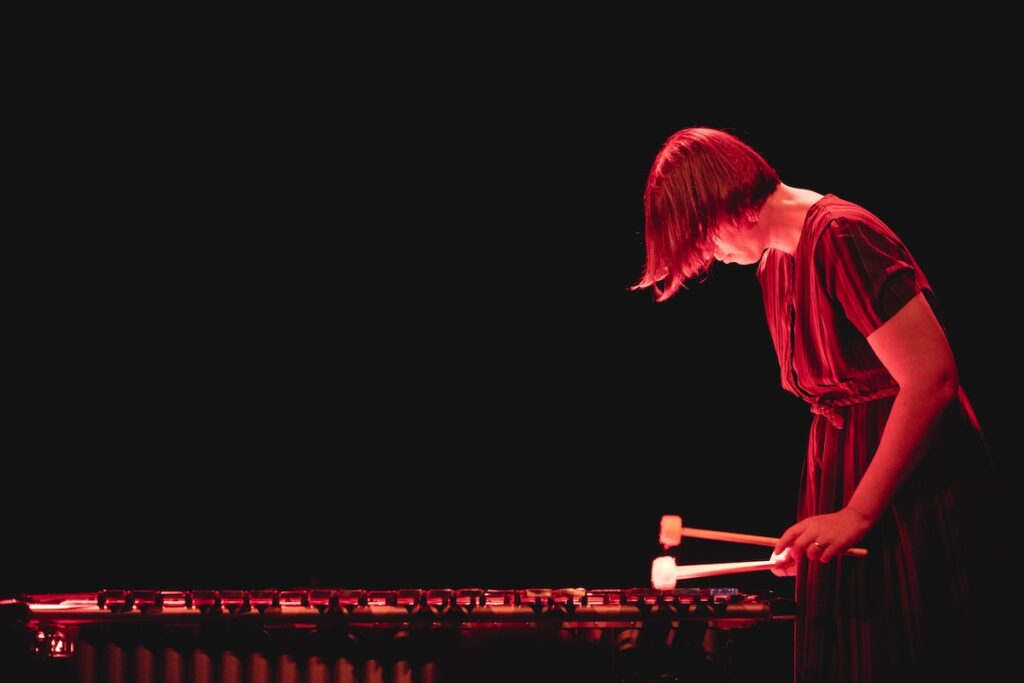
In interviews and writing, you’ve mentioned that your music often reveals a facet or part of yourself before you’re consciously aware of it. What do you feel like you’re discovering about yourself or your practice in this moment?
I’m in a funny place at the moment in that I really don’t know what I’m doing. I mean this quite literally in that I am working in a musical style that I don’t fully understand, and have been trying to more or less produce an entirely new kind of music out of thin air. Recent pieces Blindsight for [Switch~ Ensemble] and The Blue Hour for Sarah Saviet & Joe Houston are examples of this, and The Grain House continues on that path.
Scientists have an understanding of how our brains work, but in reality, we know very little about how 86 billion neurons work together to create consciousness, memory, emotions, etc. There is a vast, unknown world inside of each of us that we have an awareness of but no direct access to, and writing music in this way where I don’t make rational decisions or intellectualize the compositional process is a path to accessing some part of that unknowable place. A lot of my work has come from a place of processing difficult experiences in my life in a very direct way (although presented as abstract music), and it has become more exciting to me as I’m older to deal in these mysterious spaces than with some more specific.
Many of your projects embody a collaborative ethos that allows for intimate engagements with process, instruments, materials, and spaces. What past collaborations stand out as particularly influential?
The most rewarding collaborations have been times when the performers see something in the music that I would not have seen myself. For instance, with Nate Wooley’s trumpet piece Monologue, he slowly disassembles the trumpet over the course of the piece, which I thought would be kind of an absurd comedy while writing it. But when I saw Nate’s performance for the first time — far slower and more spacious than I had imagined — the piece took on an extremely powerful, dark, tragic quality that I had not anticipated in the music myself, but I realized was exactly the place that music was coming from when I wrote it (without being conscious of it!). I’ve had many other wonderful collaborations with people like Judith Hamann, Greg Stuart, Bent Duo, and so many more, but that one sticks out in my mind as a recent work that really became something I had not at all planned for when I wrote it, and also far better than I could have initially imagined.
My duo with bassist Tristan Kasten-Krause has been going for almost four years now and continues to be the most rewarding performance collaboration I’ve ever been a part of. We’ve been working on a long-term, very large-form piece to last approximately three hours when complete that will be premiered in fall 2027, and it has been wonderful to have that kind of clarity of purpose and vision with another person over such a long period of time. I’m normally working under a deadline and faster than I might like for the work to fully develop, so it’s been amazing to have such a large project unfold so organically over a nearly unlimited amount of time.
As a queer critic and scholar of cultural organizing, I’ve admired the ways your practice opens space for the myriad and nuanced subtleties of trans/queer experience across diverse forms (performance, composition, video work, and writing). What was it like bringing this practice to community building and mentoring through The GLISS Residency for transfeminine composers?
The GLISS Residency was borne out of conversations I’d had with inti figgis-vizueta about our perceived lack of transfemenine representation in our field (and really, the arts in general). We wanted to do something that was only for us that would also have (hopefully!) a lasting impact on the people who attend the program. Our first residency was in August 2025 with three composers — Hazel Foxræ, Alex Matterson, and Lulu West — with inti, Andrew Yee, and myself as instructors. We didn’t have much of a solid plan going into the first residency about what we would do on a day-to-day basis. We realized almost immediately that none of us really wanted to spend time with one-on-one meetings and that what was really valuable and desired was to be together. It’s extremely liberating, validating, and powerful to be in a space where there are only trans women, and there is no way to experience this without creating it yourself. I think we all came away feeling like we had done something really special and very badly needed.
The residency was also inspired by something Stuart Saunders Smith used to do — in 2000, I came to his house for a week and we talked about composing and music, and he showed me how he writes music. It was free, I ate dinner with his family, he took me to a movie. I was 20 years old at the time, and in forming GLISS, I realized that experience had stayed with me the rest of my life and I wanted to do that for trans girls.
Your orchestral pieces seem to break new ground by experimenting with the ensemble’s timbral and textural palette to explore conceptual issues around collectivity. What new opportunities are you excited about with the upcoming premiere of The Grain House at Cabrillo?
I have only had the pleasure of composing one orchestral piece prior to The Grain House, which was a much smaller piece both in terms of duration and ensemble size (it was strings only). I’m immensely excited by what’s possible with such a large ensemble, and I have tried to bring a fairly recent quasi-“melodic” approach to writing that I began in the last couple years to The Grain House. It’s extremely rare for a composer like me to get to compose for full orchestra, and I’ve been giddy at the possibilities with such a large group. I normally gravitate towards smaller, more intimate ensembles as both a composer and listener, but the sonic potential and immense power of this massive orchestra is incredibly alluring.
For the past couple years I have been trying to write “melodic” music — I realized I had simply never written a melody before — and I can’t really explain why I wanted to do this, where the idea came from, or what it means to me. It’s simply a thought I kept having over and over again, which signals to me that there is some subconscious motivation for doing this that often reveals itself after the work is made. My 2025 piece The Blue Hour for violin and piano is a 90-minute work for Sarah Saviet and Joe Houston that was my first major foray into this kind of writing (although there are some earlier attempts), and it tapped into something I am still trying to understand but am intensely excited by. So much of my past music has come from a place of processing difficult experiences in my life, and these recent works are something else (I think!) that I don’t fully understand, that is even more mysterious and thus even more thrilling to me to work on and hear. The vast size of the ensemble and full palate of available sounds of the Cabrillo Orchestra was the perfect opportunity to continue this work in a way I’ve never done before.
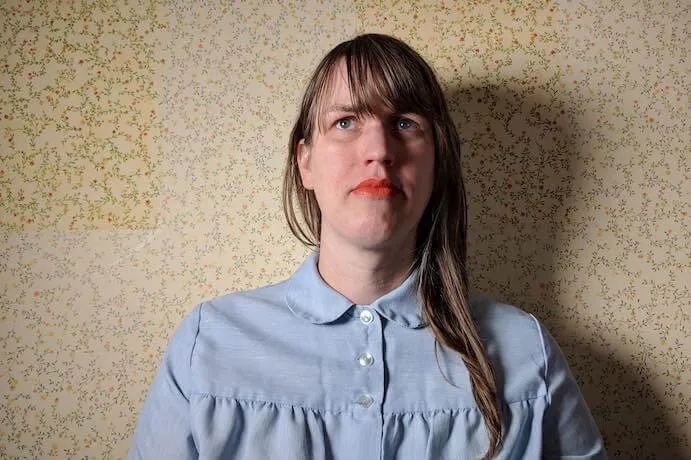
In the notes for The Grain House and your 2021 work Falling Together, you mention a desire to create something that you and the audience would not otherwise experience. What sonic, social, or conceptual experiences feel important as you dream up future projects?
I don’t mean to be evasive by answering in this way, but I really don’t know what exactly is important to me right now. I recently read Jose Esteban Muñoz’s Cruising Utopia for a class I was teaching called Queer Sound, and the author references the philosopher Ernst Bloch, “who considers astonishment to be an important philosophical mode of contemplation.” I have said for years that I am looking for experiences that make me say, “oh wow!!” and this idea of “astonishment” puts a finer point on what I was trying to say. Muñoz calls it a “utopian feeling,” and an expression of hope; a way of quite literally imagining a world better than the one we are currently in. I think music is uniquely capable of accessing and expressing those feelings and experiences.
I am not an overtly political composer but certainly see all of my work as engaged in politics and a society, if nothing more than because the world is trying to exterminate me and people like me, and it’s impossible to think that this would not have some kind of effect on how I write music since being an artist is a direct reflection on both my inner thoughts and my place in the world. I don’t think The Grain House is necessarily “about” any of these things, but in titling the piece after ant colonies who form massive communities to store food and keep each other alive, I kept returning to the idea of the orchestra as a community. Perhaps the piece is encompassing both the oppression and discrimination so many marginalized people are experiencing right now, and also a vision for a more desirable future.
I CARE IF YOU LISTEN is an editorially-independent program of the American Composers Forum, and is made possible thanks to generous donor and institutional support. You can support the work of ICIYL with a tax-deductible gift to ACF. For more on ACF, visit composersforum.org.