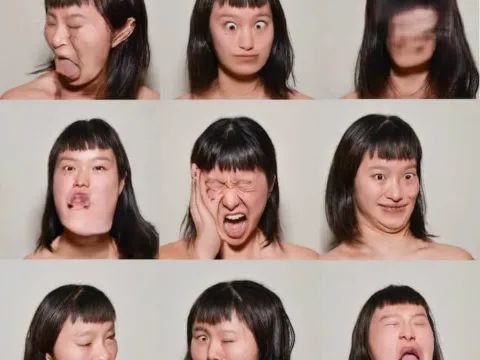
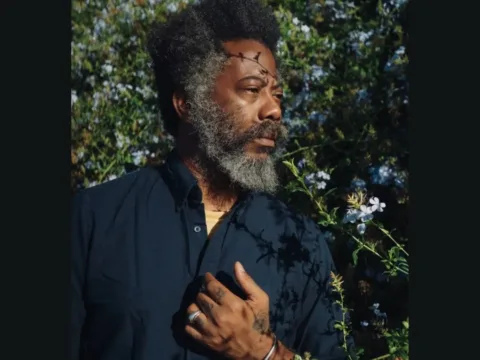
For experimental musician and artist Charmaine Lee, meaningful ideas are best expressed in a language all their own. Her practice is rooted in improvisation, where speaking a different language does not necessarily mean we won’t understand one another. Celebrating uniqueness and individuality is a critical starting point. The arresting spontaneity of her work creates a consistent sense of environmental dialog, born out of an interest in forging new ways of connecting with people, places, and cultural paradigms.
Born in Sydney to a family who migrated from Hong Kong, Lee describes her approach to music making as having a “diasporic sensibility” driven by an exploration of “the quiet complexities of belonging.” In her 2019, semi-improvisational composition Smoke, Airs, written for Wet Ink Ensemble, Lee articulates these ideas across five pages of graphic notation that serve as suggestions to the players, rather than specific instructions. The musical material consists of whistles, whispers, sandpaper, and vocal utterances that coalesce into a sensory narrative akin to moving through the rooms of an empty house.
Throughout Lee’s music, the raw ingredients are the almost primal, unstructured vocalizations that precede the formation of coherent language. Her debut record KNVF (2021) puts this practice on full display, and has been followed by an active national touring schedule with fellow experimental electronic musician Ikue Mori. Lee’s latest release, Tulpa (2025) kicked off the establishment of her new label Kou Records, which is dedicated to developing and promoting artists with highly idiosyncratic and personal musical languages.
You studied sociology at Princeton and jazz at the New England Conservatory. How has the combination of these fields primarily informed your work?
At Princeton I focused on niche cultures – a cappella groups, mushroom picking communities, religious subgroups, little league teams – how they form, proliferate, sustain themselves. That framework applies directly to how I think about the ecosystem of non-commercial music. The positives are obvious: lifelong relationships centered on art, a healthy skepticism of institutional gatekeeping. The shadow side is insularity, and a temptation toward smallness. Niche cultures can calcify and become self-referential in ways that limit them. Having that analytical distance has shaped how I build community and choose collaborators.
NEC was where the framework became embodied. I studied with Joe Morris, immersed myself in Ornette Coleman, Braxton, Eric Dolphy, and started building creative relationships that have defined my practice ever since. Joe has been my mentor for over a decade and performed with me at my New Haven stop during my 50-state tour last year. Sociology gave me the map; NEC put me inside the territory.
You describe textual sensations and vocal utterances as being building blocks for your work. Is there a fascination with any particular language that has inspired or shaped your work?
I grew up in a Cantonese and English speaking household with parents who migrated to Australia from Hong Kong. I’m not fluent, but Cantonese is the language of my home and heart, deeply embedded in my sonic and emotional life. It’s a guttural, extraordinarily expressive language with over six tones, one of the most tonally complex in the world, and that physicality lives in my body in a particular way.
But I’m less interested in language as legible content than as pure sound event. Abstracted syllables and utterances, the suggestion of a word without its literal translation, can achieve a deeper emotional precision than the word itself. Legibility outside of context can actually limit range. I’m also drawn to the I Ching as a generative language system, a structure that keeps meaning open and in motion rather than fixed.
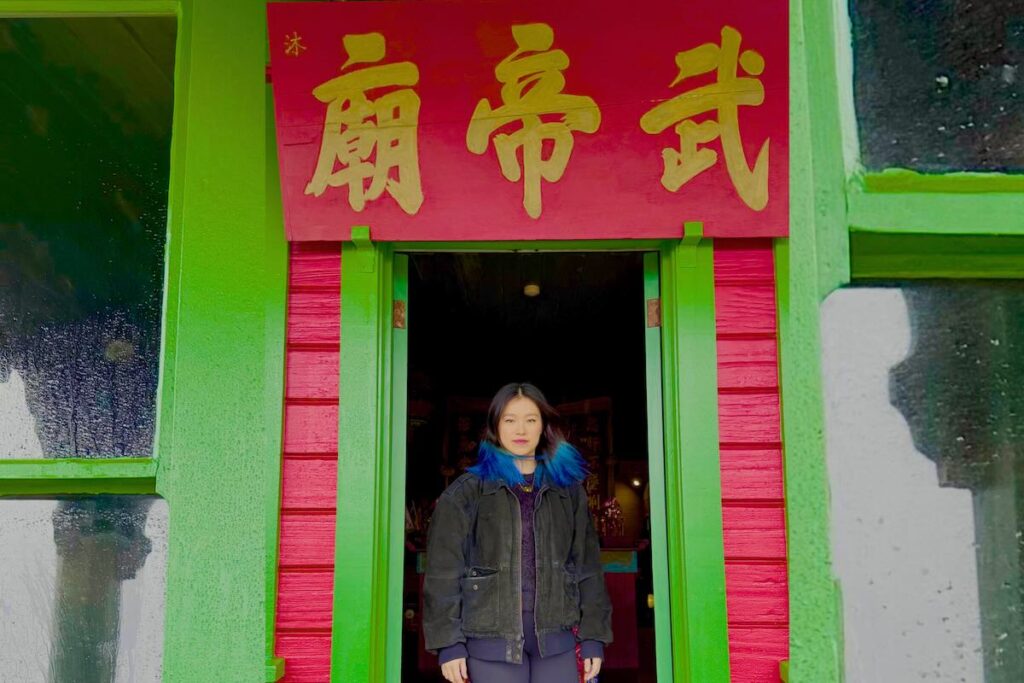
So much of your work is rooted in improvisation and the conversation music creates as it is performed. How do you capture the essence of extemporization when making recordings?
I treat them as wholly separate practices. I’m not trying to simulate liveness in the studio. That’s a losing game. What they share is a performance-driven core: decisions made in real time, on the fly. The studio just offers a different palette.
For Tulpa, Randall set up an array of five vintage amplifiers with signal split from my setup, so I could route sound to different amps with different tonal colors and feedback responses. The room became its own instrument. More recently I’ve been working with cellular automaton-based compositional frameworks, generative structures that keep the decision space open even when working from a score. Spontaneity isn’t something you capture. It’s something you build the conditions for.
Congratulations on the formation of Kou Records and establishing this platform for other unique voices! What pushed you to start a label?
I’ve spent the past decade developing what I think of as a singular musical language, through my vocal and performance practice, and became fascinated by how other artists navigate that same process. I wanted to build a context to make that visible.
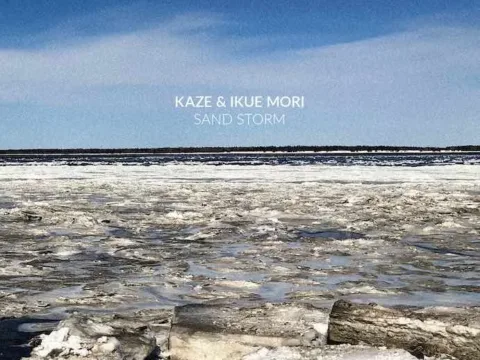
The label started as a soft launch in 2024 with a record I made with Ikue Mori, which Randall mixed. That collaboration revealed what Kou could be when the right people were in the room together. When Randall came on as co-founder and partner, he formalized what became our core methodology: every record made together at Circular Ruin, his studio in Brooklyn. We release in cohorts, four to five records in the spring, four to five in the fall, grouped by generation, practice, geography, unexpected adjacencies. Who you’re placed next to changes how you’re heard.
The broader context matters, too. The democratization of recording tools is real and mostly good, but it’s also produced a world where a lot of artists my age or younger don’t fully appreciate what happens when you make something outside your bedroom, in a room with collaborators who help you translate your ideas into something more than the sum of its parts. With AI-generated slop and algorithmically-driven feedback loops flattening everything, that feels more urgent than ever.
Kou Records lists a host of visual artists alongside your roster of sound artists (with specific mention of underground comics and illustrators). How do you view the intersection of these different disciplines, and what has been your special interest in combining them?
Randall and I are obsessives. We spend our weekends at comics conventions up and down the East Coast, big and small, and we think illustration and underground comix are as idiosyncratic and vital as any music we love. Somewhere in the past 15 years, album artwork got pretty lazy, too minimal, too literal, too photographic in an uninteresting way. We think the art shapes how people hear the music, and we take that seriously.
Every Kou release has a consistent design language built with our designers Jordan Rundle and Úna Blue, and every cohort has a distinct colored OBI strip so the records feel like they belong to something while still having their own identity. We want them to feel fun. The most personal part is the commissioned portrait on the back of every jacket, a portrait of the sound artist paired with a visual artist we curate specifically for them.
Some pairings you’d expect, some you’d never see coming. This fall we’re releasing a bassoon trio by Eric Wubbels and we had the extraordinary fantasy illustrator Julie Bell do his portrait. It looks completely unhinged in the best possible way, and I think it’s going to change how people approach the music before they even put the needle down.
I CARE IF YOU LISTEN is an editorially-independent program of the American Composers Forum, and is made possible thanks to generous donor and institutional support. You can support the work of ICIYL with a tax-deductible gift to ACF. For more on ACF, visit composersforum.org.