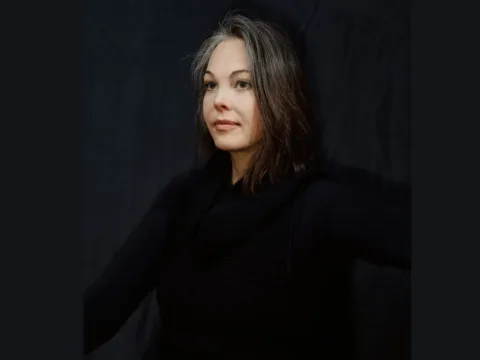
Katherine Young’s immersive practice is rooted in the art of collection: her work searches for sounds that result in imaginative modes of expression. She approaches composition, improvisation, and sound art with a collaborative spirit while also creating flexibility for bassoon and electronics in her solo performance projects. Through all of her commissioned and installation-based work with artists and organisations such as Jessica Pavone, Anthony Braxton, Linda Jankowska, the LA Philharmonic, Wet Ink, Ensemble Dal Niente, and the Goat Farm, she maintains an emphasis on connection.
Her latest album BIOMES, out on Sept. 18 on Chaikin Records, highlights her passion for gathering materials and experiences from our world and giving them new life through the lens of performance. The three works explore the different homes she has had in the New York, Chicago, and Atlanta new music communities, as well as their tangible differences in place, sound, and creation. With multi-instrumentalist and improviser Ben LaMar Gay, “BIOMES 7.4” is an ethereal but tense studio session exploring trees. In “BIOMES 8.1,” Young and media artist Olivia Block dive into their joint fascination with the swift reproduction of the asexual lichen in a meditative improvisation. The album’s only notated work, “BIOMES 6.0,” is a collection of soundworlds and installations built over years with Yarn/Wire, resulting in a multi-layered and complex depiction of the ecosystems that anchor the project.
Before the release of the album, we asked Young five questions about her compositional processes and influences.
First off, a huge congratulations on this new album! Did you know from the start that BIOMES would become a multifaceted project juxtaposing your personal relationship to place with environmental and community contexts?
Thank you! And thank you for listening and for these questions. In some ways, yes. From the beginning, I have been motivated by both a desire to learn about the so-called natural world – about trees, ecosystems, critters, etc. – and an interest in devising a musical situation for collaboration. When I began the BIOMES project in 2018 for a commission from wasteLAnd for RAGE Thormbones (Mattie Barbier and Weston Olencki), I was mostly thinking about creating a shared understanding for collaboration through musical movement through speculative environments. I wanted to make space for their creative input in a meaningful way. So, the focus on collaborative creation has definitely been there from the beginning, but I certainly didn’t imagine all the ways the project has unfolded since.
Can you share more about the collaborative process with each of the artists on the album? Specifically, I’d love to know how you discovered your shared interest in lichen with Olivia Block!
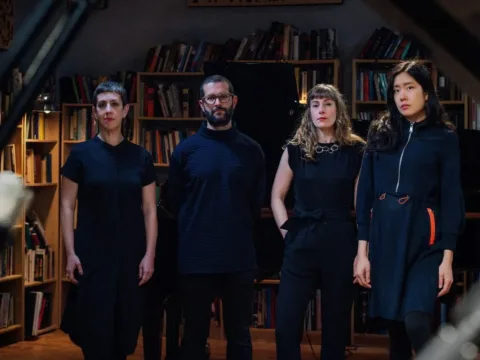
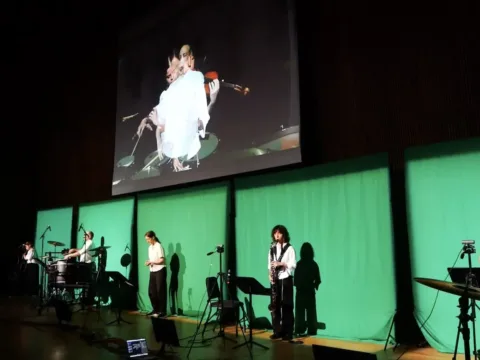
Each of the pieces on the album emerged distinctly. Yarn/Wire and I have been working on various iterations of BIOMES since 2019, so that has been gradual and taken many twists and turns. We presented a structured improvisation at The Stone back in Jan. 2019. Then, during lockdown we made an installation and outdoor performance at Pioneer Works. That generated a ton of the material, which I then kind of re-mixed and edited into the scored concert piece BIOMES 6.0.
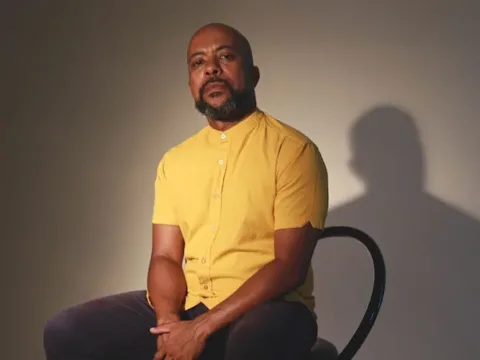
I conceived of the collaborations with Olivia and Ben specifically for this album. And both began with conversations, in which I shared some overview of BIOMES, keeping it open enough hopefully for them to find a point of entry and interest. With Olivia, she had recently traveled in Scandinavia and encountered some lichen on her travels. I have been intrigued by lichen for years, too, and so once we wound up there, the ideas just flowed! Pretty soon we were coming up with all kinds of rich connections and metaphors for how we’d like to work in the studio when making what came to be BIOMES 8.1. Specifically we were really into the slowness of lichen. How easy they are to overlook unless you slow down, and also how slow their growth, particularly in places with short growing seasons and long, difficult winters. This led us to recording to physical tape so that we could manipulate the playback speeds.
When did ecological thinking come into your practice generally?
If ecology is a study of relationships and interconnections, then I think this has always been important to my music making. I’ve always been motivated by the sociality of music: the friendships I’ve made through music, playing chamber music, playing in bands, hanging out at shows, listening to music with people I love, being in a room listening to sounds with strangers. And I’ve always worked closely with other musicians, as an improviser and a composer. Working on our boundarymind project (2013-2022), Linda Jankowska pushed me to articulate my ethics around collaboration more directly. This was really clarifying and challenging.
I also have been concerned about environmental issues since I was a kid. Actually in my suburban Atlanta high school back in the late 90s, as one of like four members of the environmental club, I collected all the paper in my school and took it to be recycled. Seems crazy, but we didn’t have any paper recycling before this initiative.
Anyway, when I moved back to Atlanta in 2020, I was all of a sudden living in this city in the forest and these concerns felt urgent and visceral again. I also found a lot of joy and energy spending time in the forests and parks around town. Gradually these threads came together for me, and I was able to think more expansively: As an artist who is deeply committed to ethical and mutually generative collaboration, I am working in an ecological way. Furthermore, not only am I part of a network of musicians, but through music I am connected to many people, and then also, of course, all of us humans are in relation with more-than-human beings, too. How we work matters and ripples through these connections. This seems so obvious, but it took me a long time to articulate this clearly for myself and connect it in a meaningful way to my creative work.
How do you process your compositional ideas? Do you use the bassoon as a point of expression, or is your practice as a performer and improvisor kept separate?
Playing the bassoon and working as an improviser is very important to my creative process. I really need both the slow burn of notating music for others to play and the immediacy and physicality of performing and improvising. But when I’m writing a piece for other instruments, I often do not use the bassoon directly. In those cases, I generally do a lot of reading and listening, and then I try to get my hands on the instruments I’m writing for, by meeting with performers and/or playing around with them myself. Then it’s a back-and-forth process connecting the sounds with the ideas I’m chewing on, for example about lichen or ecological relationships or a piece of fiction I’ve recently read.
Through this back-and-forth I refine the piece’s sound world and way of unfolding in time. I tend to make lots of sketches on paper before I start writing on staff paper. Of course, things definitely change in the writing and revising process, but I need to be able to answer for myself why I’m writing a particular series of pitches, rhythmic motive, etc. These answers get negotiated through finding connections between the conceptual ideas and the sounds and realities – idiomatic concerns and choreography – of the instruments. That being said, the way I’ve come to play the bassoon and the types of sounds I enjoy from that instrument definitely very directly inform my compositional aesthetic and approach. As a performer, I love the space of discovery that improvisation creates, and I try in different ways to build that into my notated compositions, too.
Your music covers many methods of producing sound, both improvised and notated. Do you feel at home within a particular type of sound?
Well, related to your last question, I tend to feel at home with complex, highly textured sounds with that special amount of magic and ambiguity. I like sounds with a certain amount of internal instability, which are fluctuating along the spectrum of noise, pitch, and rhythm. Think: Bassoon multiphonics! Haha. But what I love about multiphonics and other noise and interference-based instrumental techniques is that they have the potential to do something unexpected. I’m drawn to sounds that delight and surprise me – and that might be different next time.
I CARE IF YOU LISTEN is an editorially-independent program of the American Composers Forum, and is made possible thanks to generous donor and institutional support. You can support the work of ICIYL with a tax-deductible gift to ACF. For more on ACF, visit composersforum.org.