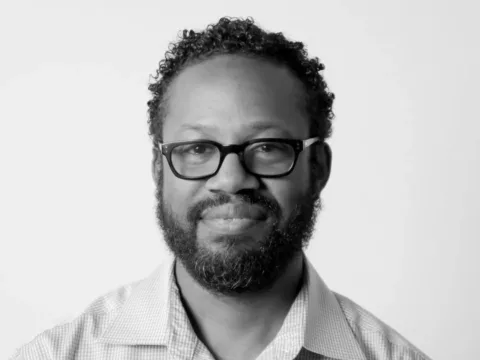
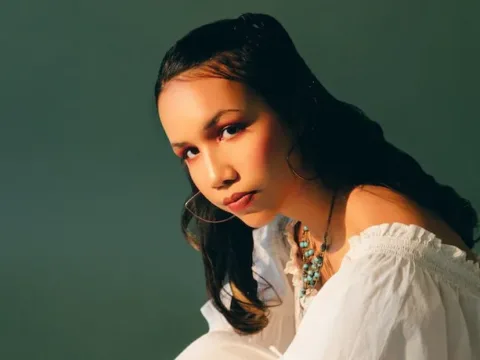
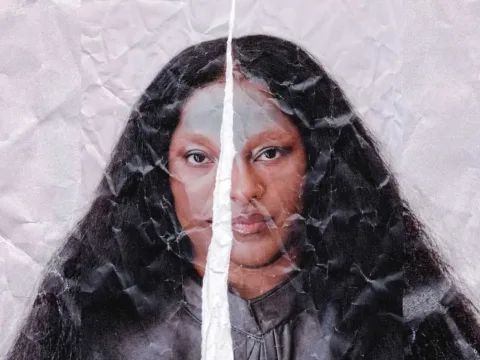
Kayvon Gordon’s love of the drums began early — at home, he was banging pots and pans; at preschool recess, he was arranging trash cans to form his own drumset. Now, the Detroit-born, Brooklyn-based drummer and composer lends his artistry to multiple groups in multiple countries. He has performed with the likes of Kalia Vandever, Immanuel Wilkins, Craig Taborn, and L’Rain, in addition to touring across Asia, Africa, and Europe.
As a student of Detroit fixtures Johnny Murray and Charley Bannister and jazz legends Marcus Belgrave, Robert Hurst, and Benny Green, Kayvon understand his artistic life as one of legacy — of honoring the knowledge of those who came before while also expanding his musical language. Through his newest albums type shit and blood memory, Kayvon has begun to expand his practice to include the role of soloist, while also continuing to explore the illuminating vagaries of group improvisation.
type shit is a dive into visceral communication within the self; born from an attempt to replicate the three-drummer Oru seco portion of bàtá repertoire, Kayvon collapses any perceived boundaries that position rhythm as secondary to melody and harmony. The African aesthetic and structural roots of African American instrumental music are clearly articulated in this album of blazingly unique improvised outtakes turned primary material.
blood memory features Kayvon with David Leon (woodwinds), Joel Ross (vibraphone), Elias Stemeseder (piano and synths), and Dean Torrey (double bass). Recorded live in March of this year, the album is “ancestral residue, cultural transmission, nervous system knowledge,” in the words of Kayvon. The quintet is not only locked into their group improvisation but becomes a five-part organism, evidence of the African, diasporic, and African American aesthetic practice of each musical part being essential to each other, in order to create the whole.
We sat down with Kayvon to learn more about his two new albums and his journey from sideman to lead artist.
Your mentors and teachers include trumpeter Marcus Belgrave, bassist Robert Hurst, and pianist Benny Green. How did their expertise on their respective instruments inform your approach to the drums?
Marcus introduced me to the richness of Black American music. He’s the only musician I’ve ever heard in person that lived inside of every single note he played. Most of us jazz musicians tend to cut our product with a little bit of bullshit.
Marcus, Hurst, Rodney Whitaker, and Benny each embodied the tradition and conveyed an understanding of what this music is supposed to be. Their impact on me had less to do with their specific instruments and more to do with how they lived it, on and off the bandstand.
Black music often highlights the expressiveness of percussion, not only as a supportive element but as a solo instrument. Are more folks getting hip to the fact that rhythm on its own is as aesthetically fascinating as melody and harmony?
Rhythm, melody, and harmony being separate is a common, but false assumption. The shape of rhythm resembles the negative space of melody, and vice versa. And I mean something more fundamental than “every melody has a rhythm.”
Think of speech — you can analyze the rhythmic organization of syllables or the contour of the voice, but they’re inseparable aspects of one utterance. Then with harmony — when two or more rhythmic structures happen at once, they create relationships. Those relationships can produce consonance, dissonance, tension, and resolution in ways that are analogous to tonal harmony. The expressive sophistication of rhythm isn’t some new recognition. From the Arará to Bud Powell to JID, the entirety of the Black musical tradition operates with this knowledge.
A few years ago, you attempted to recreate the polyphonic Oru seco on solo drumset, and you kept playing between takes to “empty your head” and “stop making something.” After shelving the original idea, when did you realize these outtakes should be their own album?
What makes any toque (bàtá rhythm) compelling lives in the conversation between three people. My singular adaptation of that bàtá repertoire just felt like a demonstration. The strict and deliberate orchestration of my limbs to cover the voices of the okónkolo, itótele, and iyá proved to be extremely technically demanding, so periodically I would improvise between takes to provide a mental reset.
A few weeks later, when I should’ve been listening back to the takes of the Oru seco, my ears kept getting pulled to things I played when I wasn’t trying to make anything — something other than what I set out to record, but more true and much more interesting.
What I ended up with was a snapshot of what I sound like alone — a poor, bare, forked animal, so to speak.
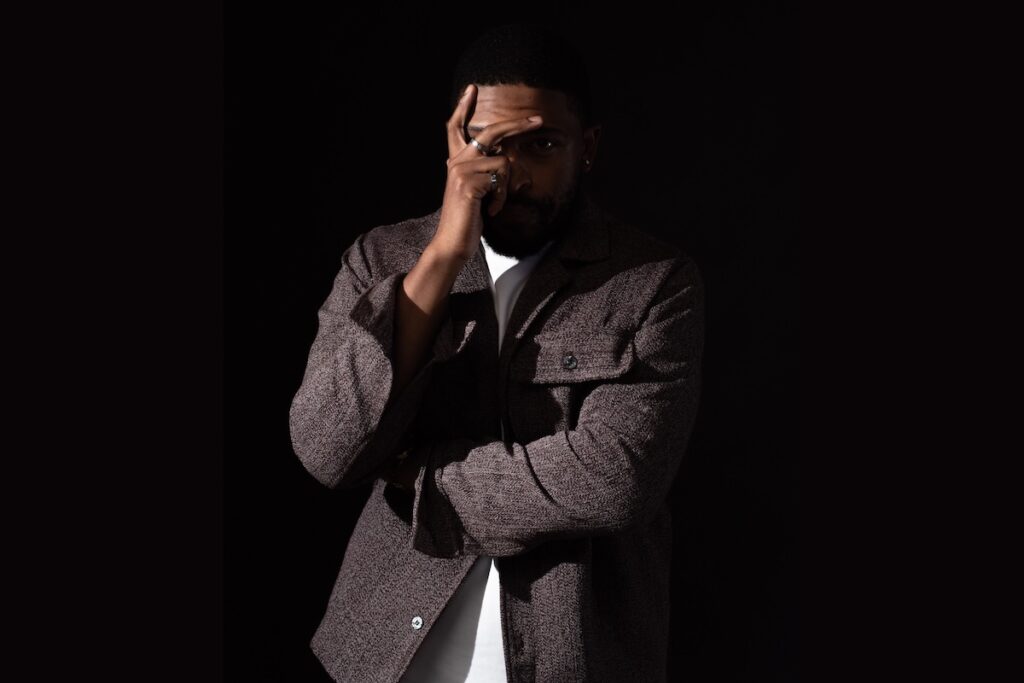
You’ve shared that type shit and blood memory are connected via questions of form and authorship. What are these questions that are explored, answered, or unresolved across these two albums?
I see a lot of this in the framing of other people’s work: “I wrote track 1 in my head while taking a walk … the song has a long, winding form and the melody possesses a slightly recursive quality. I named track 1 Journey in Time. Ya know, life is a lot like a winding path, if you think about it” — this type of direct correspondence between music and its framing is trite and saccharine, and wholly uninteresting to me.
My liner notes represent things I was thinking about while I was making the music. The records aren’t investigations of philosophical questions and the writing doesn’t necessarily explain the music. Still, they’re irreducibly connected, if for no other reason than them both coming from me, and at the same period of time no less.
With blood memory, I was thinking a lot about the body and the information it carries. We’re conditioned by society, culture, histories we inherit, and our experiences, remembered and forgotten. Music itself carries information in much the same way. Further, the musician sits at the intersection of these two palimpsests. A question I find fascinating is how a body that’s been conditioned by all of these things can participate in writing its own conditions — inscribing on itself atop inscriptions prescribed to it. And is what emerges something we’ve invented or uncovered?
With type shit, I was thinking more about the relationship between form and structurelessness. There’s a relationship between the two that’s much richer than a simple positive/negative dichotomy. If you resist resolution, structure and the lack thereof have the opportunity to communicate and possibly inhabit one coherent thing. In the realm of ideas, the most interesting discoveries come when contradiction is preserved and nuance is invited. The truth tends to reside in the tension of the gap between opposing ideas.
As you continue to do more solo work, what are some things you’re discovering about yourself as an artist?
As I get older, things people told me years ago have been revealing themselves in different ways. Gerald Cleaver once told me that virtuosity is just one texture among many — technique serves expression, not itself. I’ve carried that with me for years, and I’m continually discovering the truth of it.
Recently, I’ve become increasingly interested in the distinction between what something is and what it does. What does a particular gesture do to the music? What does it make possible? What does it limit? My understanding of what constitutes a complete and coherent musical statement is continually changing.
Playing alone also introduces an interesting set of conditions. You’re generating all of the musical information yourself, but once you’ve played something, it’s in the air — you must respond to it as though it came from somewhere outside you. You’re still engaged in a conversation, even if you’re the only person speaking.
I CARE IF YOU LISTEN is an editorially-independent program of the American Composers Forum, and is made possible thanks to generous donor and institutional support. You can support the work of ICIYL with a tax-deductible gift to ACF. For more on ACF, visit composersforum.org.