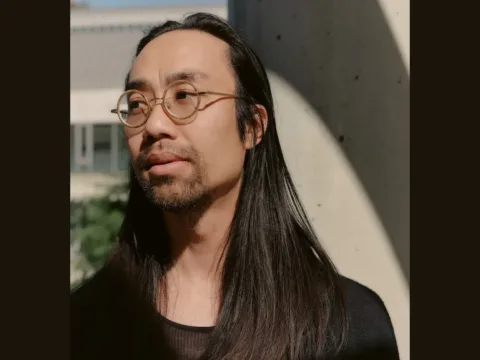
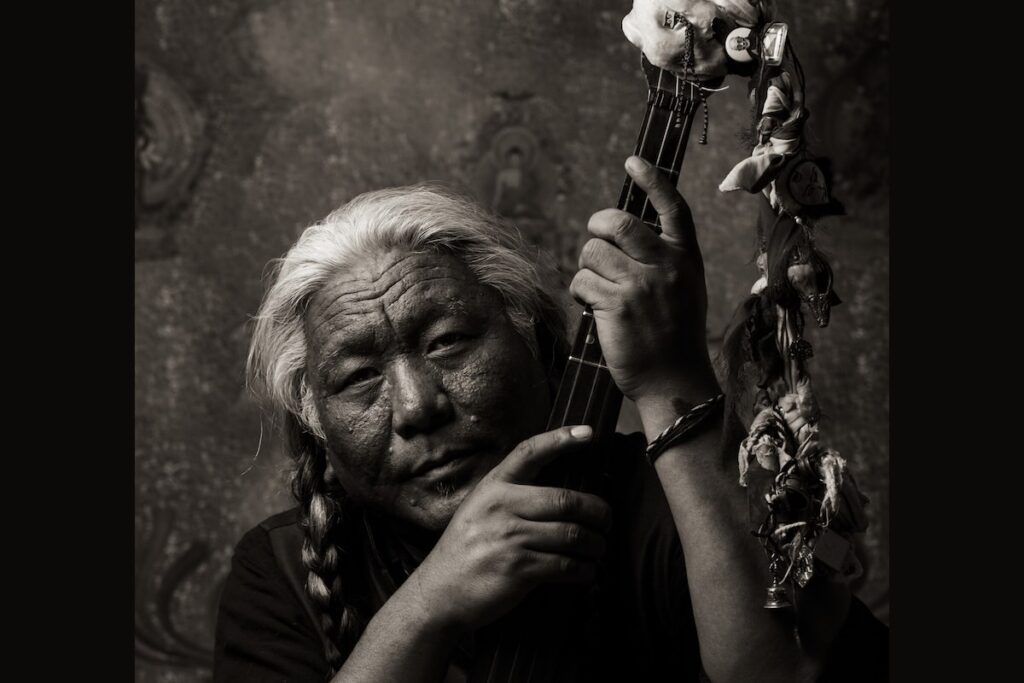
When he isn’t playing his three-stringed Tibetan dranyen, you will probably catch Tenzin Choegyal humming a tune. As he told me during our recent conversation, “Humming is something that I think we tend to forget is so beautiful, you know? When you hum, it’s like it takes you back to being a child again. So, if I’m hanging around with you, at one point you will find me humming.”
Choegyal was born into a Nomadic family in Tibet, and his first concrete musical memories recall the sound of his mother’s voice. “Traditional Nomadic mothers rise up probably around four in the morning, chanting away their daily routines,” he explained. “So, that was the initial kind of music — spiritual music — that I encountered in the half dream-state when I was young. My father, whenever he came back tired from work, would play the flute in the evenings. [The Tibetan lingbu] is one of my favorite instruments, because you can take it anywhere you want, and play anytime.”
When he was a toddler, Choegyal’s family fled the Chinese Cultural Revolution and went into exile. Having come from what Choegyal described as living in “the state of a Medieval period,” it was not until they reached Nepal in the early 1970s that his family first encountered electricity. Following the death of his father soon after they arrived, Choegyal’s mother —unable to support five children — was forced to send him to live at the Tibetan Children’s Villages in Dharamshala, India. The institution is dedicated to the care and education of Tibetan refugee children, and was, at the time, administered by Jetsun Pema, the younger sister of His Holiness the 14th Dalai Lama.

“In those days, Dharamshala was what is called a musical hub, where all the travelers would come and bring their own music,” Choegyal said. “It was the evolution of hippie times, when the Beatles were getting big; all the travelers would bring classical or rock-and-roll music. As a child, I would wonder, looking at the people hanging out in cafes and playing their guitars. During any Tibetan celebrations, my elders would break into traditional music and dance, and I think even though I came from a totally traditional Nomadic family, encountering lots of travelers in Dharamshala really broadened my worldview.”
In 1997, Choegyal left India to settle in Queensland, Australia, where he has lived ever since. He found work as an English translator for a teacher at a Tibetan Buddhist center. He said, “At that time, I was translating super philosophical Tibetan texts, while I was doing my music. So, that helped me see that my spiritual path and the musical path were exactly the same.”
Enter Philip Glass.
Since the mid-1980s, Glass has been music director of the Tibet House US Benefit Concert, a major fundraiser that takes place annually at Carnegie Hall. Choegyal recalled, “About 20 years ago, somehow, Philip and Tibet House found out about me, and they invited me to perform. That’s when I first met Philip, and we connected straightaway because of our spiritual path. I think he’s amazing, a better Buddhist practitioner than myself! When I got the invitation, I didn’t know what Carnegie Hall was or who Philip was. I just said yes, because it was a Tibet House concert. When I told my friends in Australia, they were amazed, so then I knew the value of the whole thing from the aura that they put around it.”
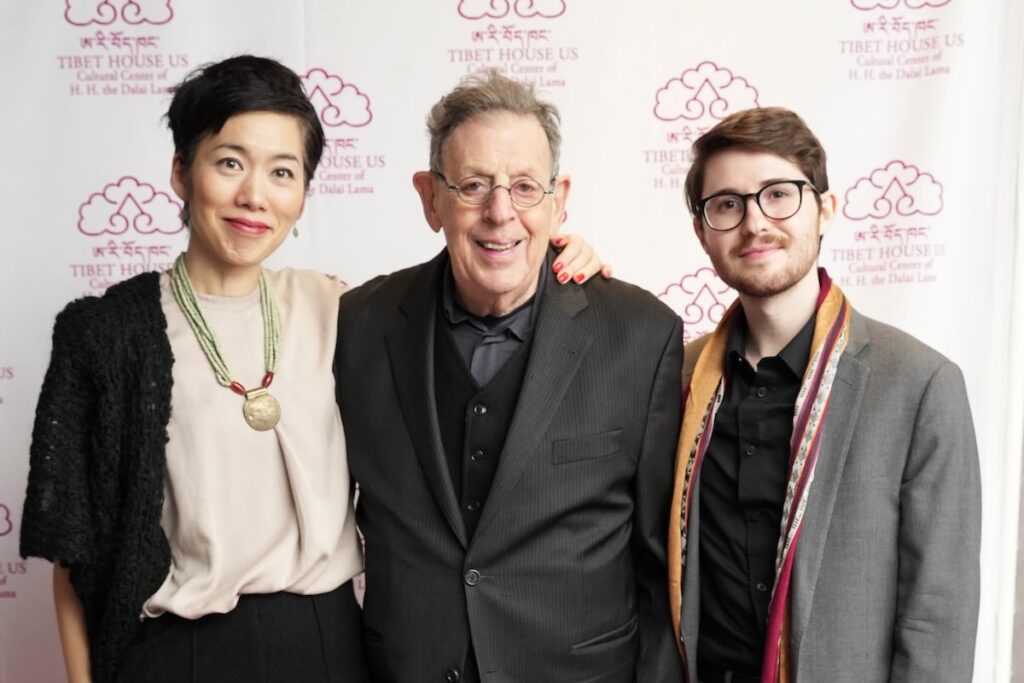
Choegyal’s ninth album marks a continuation of his collaborations with Glass. Previous albums have included Glass as co-composer — such as the soundtrack to Mickey Lemle’s 2020 documentary “The Last Dalai Lama?” — and Be the Sky, out Nov. 14, will be released on Glass’ Orange Mountain Music label.
Many of Choegyal’s recording projects feature prominent figures like Laurie Anderson and Jesse Paris Smith, who collaborated with Choegyal on Songs from the Bardo (2019), released on the prestigious Smithsonian Folkways Recordings. Choegyal explained, “One of my favorite things on this musical journey is collaboration, because I think when you leave the collaboration open and spacious, lots of listening happens. And when listening happens, magical things come to be.”
His latest project is truly a family affair, including Glass as arranger and pianist, actress Saori Tsukada (who is also Glass’ wife) reading poetry, the Scorchio Quartet, and Alex Ring Gray, who provides further arrangements and performs saxophone, piano, and bass guitar. These artists are not only Choegyal’s dear friends, but play prominent roles in the Tibet House musical community.
“Snowy Mountains – GangRi” opens the album with a chorus of children who are currently housed in the Tibetan Children’s Villages where Choegyal grew up. “It was not a choir group or anything — it’s just 100 kids brought together for an afternoon,” he explained. “As soon as they heard the notes they started singing, and I asked the mixing guy not to autotune them. Just keep them as they are, whether they are singing in key or not, keep that energy of being a kid.”
A similarly organic sensibility comes across in each of the album’s seven tracks. The contrast between the austerity of Glass’ compositional influence and piano performance, and the spaciousness of Choegyal’s vocals and his use of traditional instruments bring his recollections of Dharamshala’s diverse musical culture to life. “It’s a very spiritual kind of sound, like in the Nomadic tent when there is a song being sung by a Nomad looking at the vast horizon. We tried to keep those elements in, and added a bit of reverb to give it space like being amongst the mountains and plateaus.”
Reflections on Tibetan history are expressed in “River of Joy – Kyichu,” which recounts HH the Dalai Lama’s escape from Chinese-occupied Tibet in 1959, when he crossed the eponymous river into exile. “From a Single Thought” and “Karmic Mandala” offer pith-like instruction on finding wisdom in simplicity and concepts of universal interconnectedness from both traditional texts and Choegyal’s poetry.
On “Until Space Remains” we hear the recorded voice of HH the Dalai Lama, who recites his favorite verse by eighth century philosopher Shantideva and explains its meaning. Choegyal’s poetry, read by Saori Tsukuda on “Who Am I,” offers a reassuring message to the listener that it’s okay to question one’s ego in order to live a meaningful life. The album’s title track, “Be the Sky” brings Choegyal, Tsukuda, and Glass (performing piano) together over recitations of verses by 11th century Tibetan master Milarepa, with the performers’ distinct styles layered together in an expression of spiritual oneness.
Throughout the album, these philosophical questions of ego and belonging, of compassion and finding peace in loss are directly examined with calm optimism and reassurance. For Choegyal, this includes the loss of his country, and the urgency of bringing Tibetan culture to the rest of the world as long as exiled Tibetans are unable to return to their homeland.
“Be the Sky captures moments of quiet joy, born from music-making with dear friends,” he shared. “Amongst many emotions, the music carries me to places I can’t physically go — like Tibet. Yet Tibet resides within me. This album is a meditation, a return, and a way to stay connected — a joy in honouring the wisdom of His Holiness the Dalai Lama and our elders.”
I CARE IF YOU LISTEN is an editorially-independent program of the American Composers Forum, and is made possible thanks to generous donor and institutional support. Opinions expressed are solely those of the author and may not represent the views of ICIYL or ACF.
You can support the work of ICIYL with a tax-deductible gift to ACF. For more on ACF, visit composersforum.org.