The 2026 Rewire Festival opened not with a bang, but as a beautifully disjointed conversation. In the span of five minutes, I caught morsels of Dutch, Italian, English, French, and Arabic while sitting cross-legged on the floor of Amare — the largest cultural center in The Hague. Italian composer-performer Caterina Barbieri and ONCEIM took the stage as smoky haze filled the air. The orchestra’s gossamer ambience unfolded asynchronously, the conductor minimally sculpting density as each performer moved with their own sense of time over a faint drone. Independent gestures converged and dissipated — an apt overture for a weekend of shared moments, spontaneity, and profound solo journeys.
From Apr. 9-12, Rewire transformed the city into an international convening of live experimental, avant-garde, and electronic music; sound installations; workshops; conversations; films; and other performances. Thousands of attendees were conjured by an unreal 70+ act line-up ranging from 80s German experimentalists Einstürzende Neubauten to multiple iterations of Moor Mother’s poeticism and Kim Gordon’s questionable rage rap era — and every possible nook and cranny in-between.
My Friday began in the outdoor section of a British lunchroom surrounded by music lovers, DJs, and now, close friends from all over the globe who broadcast for the freeform pirate radio station ChuntFM. The table was a sea of toasties, bloody marys, and festival timetables, each of us attempting to define our schedules and convincing others to join in on experiencing our “must-see” artists. Festivals always require strategy and compromise unless you’re truly willing to go with the flow — many of us resolved to a mixture of both, while keeping in mind which acts we may never have the opportunity to see again for a long time, or ever.
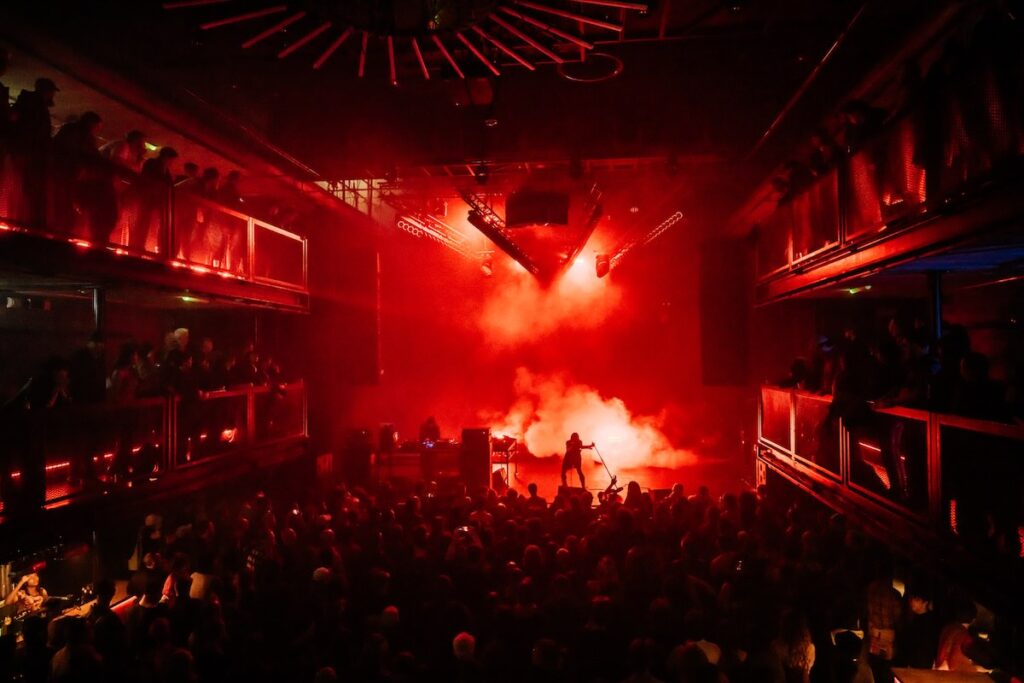
A top priority for most was the queer experimental Indigenous duo Los Thuthanaka (Chuquimamani-Condori and Joshua Chuquimia Crampton). They took the stage of Paard I donning ornate costumes, exuding the presence of both regality and rockstars. Lucky enough to stand inches from JCC’s pedalboard in the three-storied venue, we danced and healed together, putting our hands against the stage floor to feel the blissful torrent of sound. With “Quta,” the siblings melded the familiarity of cricket chirps with sentimental guitar melodies and hypnotizing teclas rhythms. After Crampton tossed his pick into the crowd, we cheered so loudly for so long that they returned for an encore.
The Bug & Dis Fig (Kevin Martin and Felicia Chen) similarly opened us towards community with a heavy, dubby set featuring Martin on the decks and Chen’s commanding vocals. My friends and I started a brief pit to the pair’s freaky, noisy trip-hoppy beats, affirming to others that they too could allow their bodies to sway into one another. The set offered a sense of unity that radiated outwards.
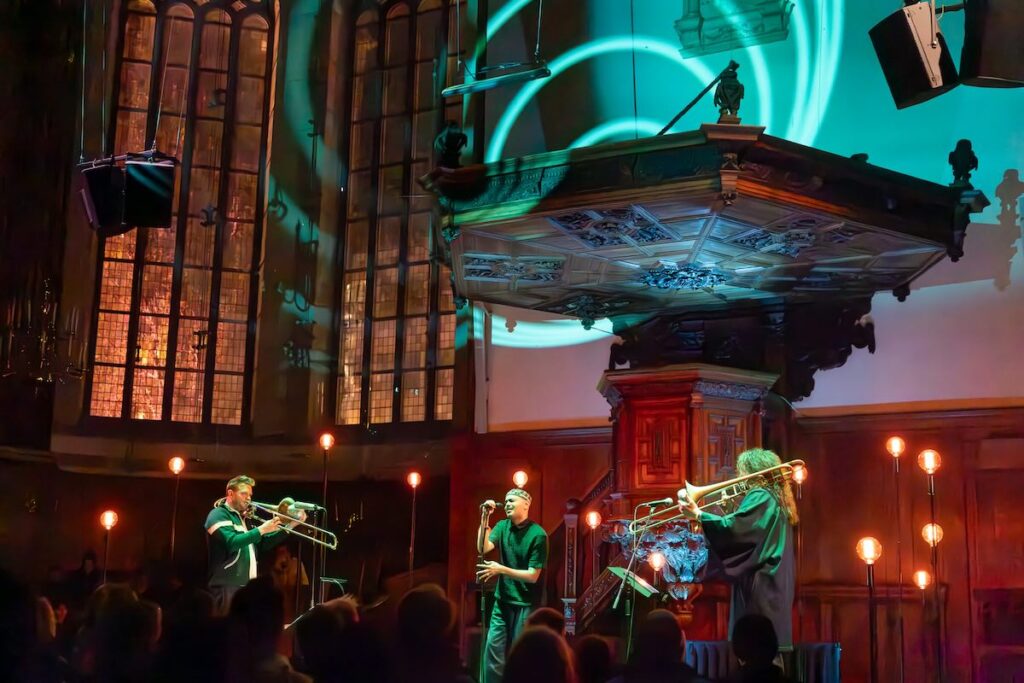
There were poignant “together-but-alone” moments, too: I found myself separated from the crew for the Abdullah Miniawy Trio’s enchanting, late-night performance in the church. The Egyptian songwriter led two trombonists in transfixing Arabic art songs, his voice ringing out with purity and sincerity. Miniawy conducted us to sing in time together before the trio left the stage, leaving us to keep time as an impromptu choir.
Rewire covers a wide spectrum of today’s musical landscape, including an authentic representation of club music. Outside the city center, DIY club Laak hosted Saturday night’s “nonstop” party scheduled through 7:00 a.m. the next morning (and ending closer to 11:00 a.m. in reality). The deceivingly large warehouse encompassed three rooms: a main room integrating the impeccably tuned Kantarion sound system; a smaller, literal washroom outfitted with decks; and a massive ambient room with a pillow pit, mellow projections, and bleachers up to the ceiling for people to chill out. OK Williams’ closing set was a highlight of the night and festival as a whole. The London-based DJ tore up the main room with perfect building and releasing of tension, tasteful chops, and pumping bass that hit squarely in the chest. We dripped endlessly with sweat and fog juice, pressed against each other — unbothered by the rising sun and instead filled with an electric joy.
Echoing this exercise in stamina: Nihiloxica was this year’s sole representative from Nyege Nyege Tapes, Uganda’s paramount label and festival dedicated to African underground and electronic music. The quintet of acoustic percussion and electronics synthesizes intricate and celebratory Bugandan drumming with the grimy syncopation of UK bass music. Their set started at 110% and stayed there, completely melting our brains with frenzied grooves, precise interlocking, and hype MC-ing that made it impossible to stop dancing. This flow of energy was extended to all corners of Rewire: artists like dilesmavis and Val Clipp were called to activate “third spaces” like the Paard foyer and The Grey Space in the Middle’s basement, respectively — the latter playing one of the most memorable sets of the weekend interspersed with fly hard groove and oldhead hip hop cuts.
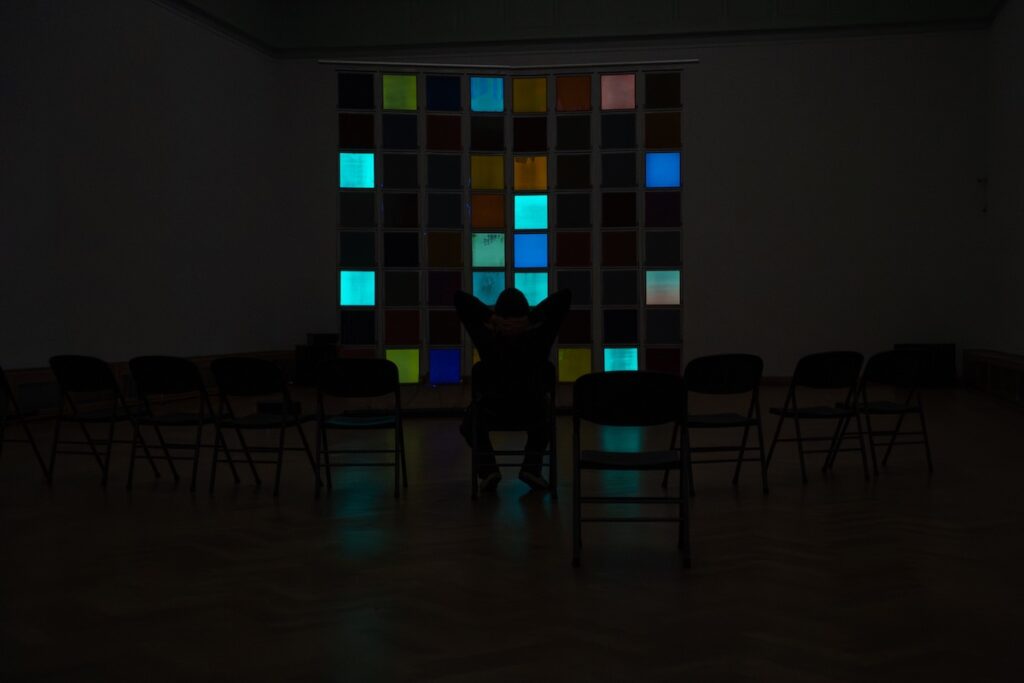
The “Proximity Music” installation programming also presented an array of tactile, relational experiences that uniquely drew attention to the performativity of objects. Anaïs Lossouarn’s De Cœer En Choeurs suspended organically jagged stones from the ceiling with wires, carrying vibrations of murmuring chords in tandem with the vibrations caused by human movement and touch. In Aernoudt Jacobs’ Humming the Ubique, a large mosaic obelisk structure stood in the center of a dark room, emitting a low, ominous hum and flickering colored lights across its 64 square fields — evoking a sense of worship or summoning.
The most engaging of the installed works was Johannes Kreidler’s Jet Whistles / The Grand Exhalation, a gallery filled with hanging aluminum sheets of varying sizes and massive blow dryers. Metallic wobbling counterpoint bounced across the space in duos and trios, followed by a full-room thunderous roar and blowing wind that compelled us to stick out our hands and move about — with smiles on our faces.
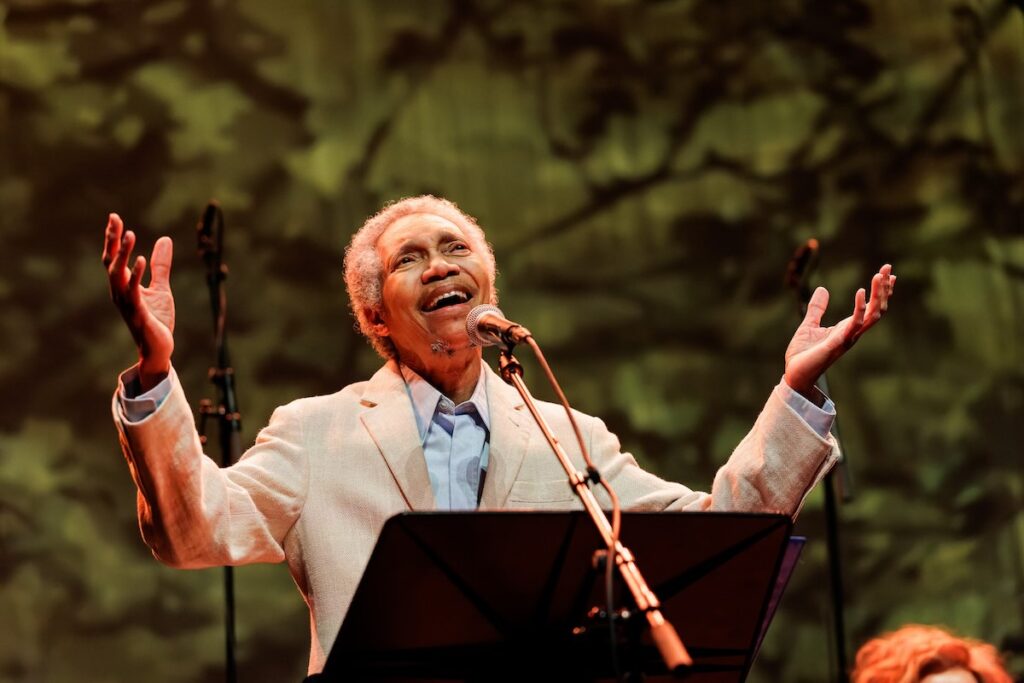
Sadly, one major blindspot of the festival was made clear by Saturday evening. The wholesome cabaret-esque performance by legendary trans songwriter Beverly Glenn-Copeland and wife Elizabeth Glenn-Copeland began late due to a miscommunication with production; Glenn is 82 with COPD, and was expecting the venue to provide and enforce masks — a request that went unfulfilled in the 1,300-person capacity venue. Over the four day festival, about two dozen folks asked me (ranging from curiously to rudely) why I masked, coming to a head at Paard, where I was nearly denied entry, searched by four security guards, and publicly interrogated about my compromised immune system. For a festival that books disabled artists like Glenn, JJJJJerome Ellis, and likely others, I was surprised by these failures in access and community care.
Despite accessibility concerns, the technical production, venue curation, and artist creativity across the fest were executed at the highest levels. WaqWaq Kingdom (vocalist Kiki Hitomi and producer Shigeru Ishihara) were joined by visual jockey VJ Kalma for WaqWaq’s “Amanogawa,” and threw down a full sensory experience. Hitomi mesmerized us with futuristic Butoh choreography and hyperpoppy vocals as Ishihara ripped clubby gagaku — all while being slammed with overwhelming visuals. Poptimists had stakes in the line-up as well: Smerz’s off-center dream pop was thoroughly produced. The Norwegian electronic duo’s sensual “cool girl” characters charmed us with ethereal vocals and clean sound, their hair blown dramatically by downstage fans as young girls screamed along: “Big, big shoes and a shirt that says ‘Feisty!’”
Drone had a huge moment at Rewire ‘26. Unfortunately, Ensemble Klang’s exceedingly delicate attempt at Éliane Radigue’s OCCAM DELTA XXIII in Nieuwe Kerk suffered forces beyond their control. Loud coughing, cell phone alarms, and slamming doors disrupted the ability for us to hold on to the slowly morphing tuning and stunningly hushed saxophone breaths.
Unyielding walls of sound fared much better throughout the weekend. The sludgy, dragged out metal from Apparitions washed over us in Theater aan het Spui on Saturday afternoon. Grumbling sub bass satisfyingly zizzed up through the soles of our feet as we swayed in clouds of hellish red. Gorgeously distorted guitar bleated while the drummer played as though his entire part was one 40-minute fill, generating tension you’d need a machete to cut through.
The best noise music is that which demands you to confront the heaviest and messiest emotions. If you camped out at Paard II on Sunday, you had a special opportunity to experience an exhausting, but once-in-a-lifetime catharsis beginning with New York’s Leila Bordreuil. Her mastery of pacing is unmatched: she sat long on a haunting loop, layering diaphanous harmonic resonance atop. Slowly, her set descended into her idiomatic extreme cello feedback, with a gritty, sticky bow scraping just above the bridge of her instrument.
Joshua Chuquimia Crampton treated us to a quietly alluring solo set of his heartfelt, blown-out guitar songs. Resounding luminescent noise filled us with an unplaced longing for beloved things just out of reach. Bathed in an unwieldy green light, the midwest father of noise (i.e. Aaron Dilloway) also built up into astonishing chaos; writhing, pacing, and gnashing contact mics between his teeth. Gnarled grooves miraculously developed as we watched Dilloway become possessed by the sound in the weekend’s most unforgettable set. As we exchanged small glances and half-grins, acknowledging the collective disorientation we endured together, Rewire’s impact became clear: within discomfort and wild experimentation, we can seek out safe havens for vulnerability, affirmation, and deeply human connection.
I CARE IF YOU LISTEN is an editorially-independent program of the American Composers Forum, and is made possible thanks to generous donor and institutional support. You can support the work of ICIYL with a tax-deductible gift to ACF. For more on ACF, visit composersforum.org.