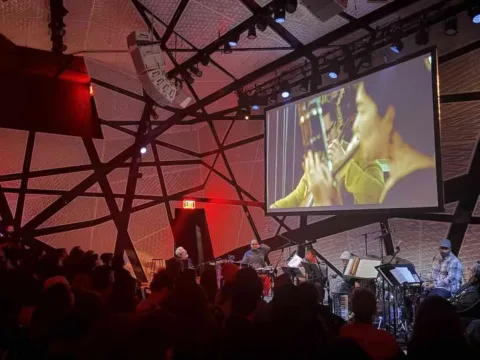
There’s often a moment in a group improvisation where musicians let go of trying to make sense of each other’s sound and begin to respond more fluidly. Lazyhorse, a new rotating collective ensemble, lives in that moment. For bassist and vocalist Mali Obomsawin, improvisation is valuable because it creates instability. “You learn to listen, embody different roles, and develop a common language,” she says. More importantly, it exposes what she calls “the cracks” — the spaces where planned ideas fail and stranger possibilities emerge.
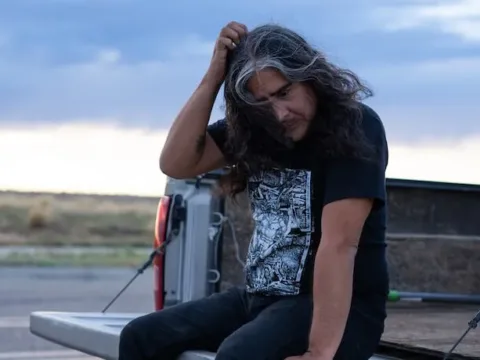
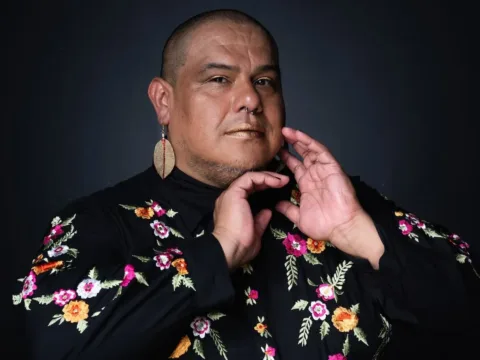
The collective — comprising Raven Chacon, Mali Obomsawin, Miriam Elhajli, Steve Hammond, and The Living Earth Show (Andy Meyerson and Travis Andrews) — emerged from a pile-up of unfinished ideas, old friendships, noise tapes, abandoned riffs, and an interest in the juncture of the incompatible. Chacon is a Pulitzer Prize-winning Diné composer whose work moves fluidly between chamber music, installation, and harsh noise, often interrogating landscape, colonial violence, and Indigenous resistance through sound itself.
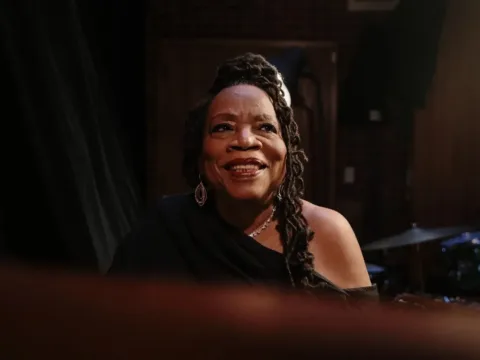
Obomsawin, who is Odanak Abenaki, has built a body of work spanning jazz, indie rock, free improv, and songwriting. The music of her friend Elhajli draws together Latin American folk traditions, improvisation, and luminous vocal textures that can feel devotional one moment and unmoored the next. The Living Earth Show is a San Francisco-based electric guitar and percussion duo that has spent more than a decade commissioning collaborative works that blur the line between concert music and underground performance culture.
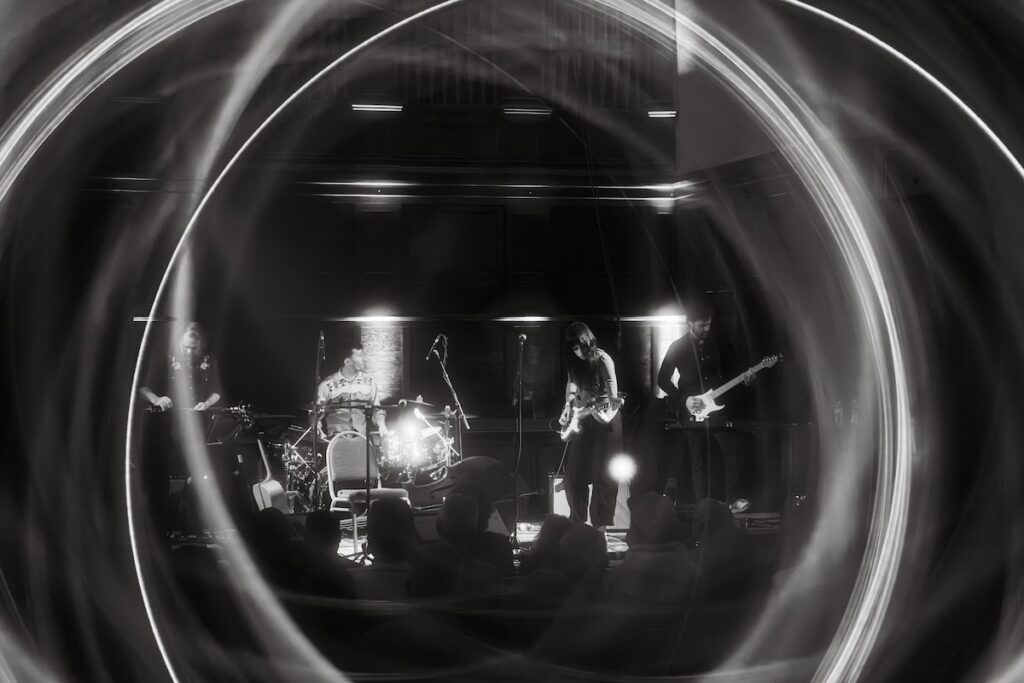
Lazyhorse began with fragments. As part of their two-year residency at EMPAC, The Living Earth Show commissioned long-time collaborator Raven Chacon to build a new project with the ensemble. Chacon had been collaborating with The Living Earth Show since 2017 on projects including Tremble Staves, a monumental site-specific work intended to be performed “at a site of ruins on a waterfront.” As they imagined what a new work could be, another process quietly emerged. Chacon began bringing Meyerson and Andrews scraps from his teenage years: surf-rock instrumentals, spaghetti-western motifs, ‘big dumb 12-tone riffs,’ half-serious ideas that had never belonged anywhere.
While many artists would abandon that kind of material, Chacon started to excavate it. Rather than polishing the fragments into something refined, the trio became interested in preserving their awkwardness — the feeling of ideas caught halfway between sincerity and parody, adolescence and experimentation. The space and time afforded by EMPAC allowed Chacon to expand the process outward. He invited Obomsawin into the sessions after meeting her at a show in Santa Fe; her band Deerlady had opened the evening, and Chacon closed it with one of his solo performances. After the show, Chacon handed Obomsawin a Walkman loaded with one of his noise tapes — an oddly perfect gesture in retrospect: intimate, slightly mysterious, and tinged with nostalgia. Later, Chacon contacted her about what he described simply as an “experiment” in upstate New York.
Along with Obomsawin, Chacon invited his old friend and bandmate Steve Hammond to join the project. Their friendship had endured across time and geography, and they shared a history in the Albuquerque noise-thrash band Tendorizor. Elhajli arrived during a second EMPAC session after Obomsawim deliberately sought her out as someone capable of changing the atmosphere in the room.
“When new musicians get together, it can be hard to let go and really improvise,” Obomsawin explains. Elhajli, she says, is someone who will go “whole hog in any situation,” transforming the atmosphere simply by refusing self-consciousness. Her presence altered the chemistry immediately, pushing the music away from cautious experimentation and toward something more instinctive, more emotionally porous.
Chacon’s method for generating improvisational “cracks” was deceptively simple. Each musician was asked to bring notebook fragments: abandoned lyrics, unused chord progressions, melodies that never found the right project, creative leftovers. “I want to hear an album of B-side material from all of these people who might not have ever found themselves collaborating before,” he explains. “Maybe one of my throwaways fits with one of Miriam’s. Improvisation and noise is glue when the peg and hole don’t quite match.”
Lazyhorse is fundamentally interested in misfit energy; not refinement, but friction. Noise functions less as sonic aggression than as connective tissue, something capable of binding radically different musical sensibilities together without smoothing out their differences. The band’s debut single, “Are There Bars in Heaven?,” perfectly captures that ethos. The track originated as the final three minutes of a sprawling 40-minute improvisation. “It felt right to start at the end,” Obomsawin says.
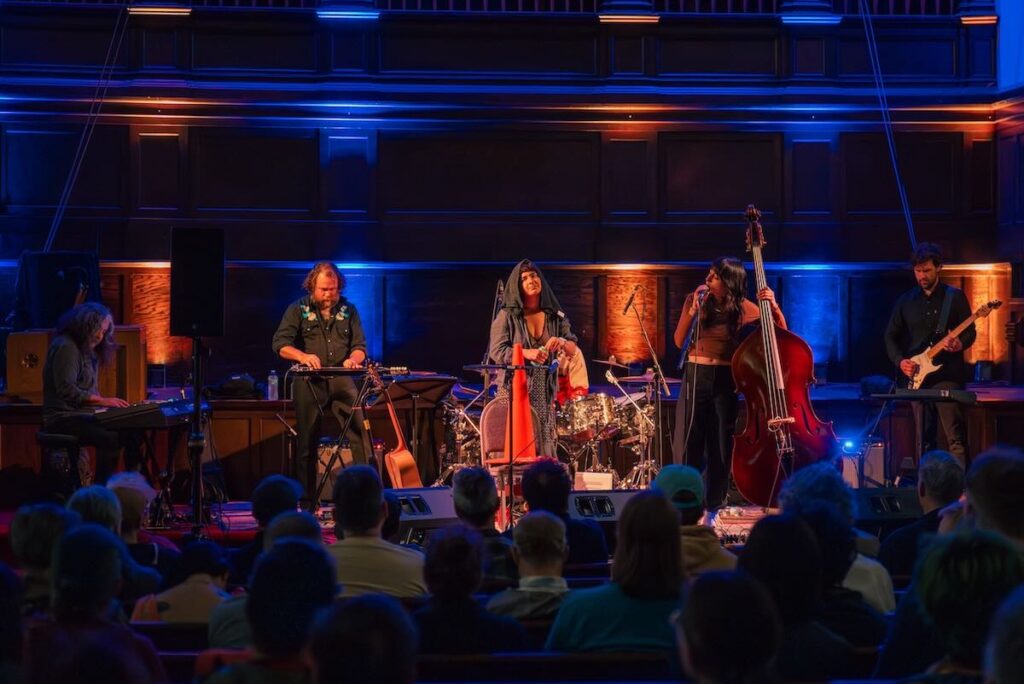
That inversion feels quintessentially Lazyhorse: foregrounding the afterthought, treating the residue as revelation. The track sounds like several histories unfolding simultaneously: free improvisation colliding with damaged Americana, slowcore drifting into ambient noise, folk song dissolving into amplifier hum.
Obomsawin recalls watching Sergio Corbucci spaghetti westerns during the early sessions, and traces of those films drift through the music: vastness, dust, tension, moments that feel cinematic and decayed. The western imagery is warped and unstable, tangled up with colonial histories and contemporary noise practices. Asked how the band contends with questions of indigeneity and empire, Obomsawin answered simply: “There are no questions.” For musicians like Chacon and Obomsawin, these concerns are not conceptual overlays applied to the music afterward; they are embedded in the conditions from which the music emerges.
What makes Lazyhorse compelling is not simply the collision of its influences, but the group’s refusal to resolve those tensions into something overtly coherent. The music remains deliberately unhemmed, preserving the instability from which it emerged. Live performance has only deepened that sensibility. Obomsawin describes the band’s concerts as an ongoing learning process that are less about reproducing material than allowing the material to keep forming and reforming. Even the forthcoming full-length record, which is currently being completed, seems unlikely to function as a definitive statement so much as another document of process; a snapshot of musicians listening closely enough to let contradiction exist unresolved.
I CARE IF YOU LISTEN is an editorially-independent program of the American Composers Forum, and is made possible thanks to generous donor and institutional support. You can support the work of ICIYL with a tax-deductible gift to ACF. For more on ACF, visit composersforum.org.