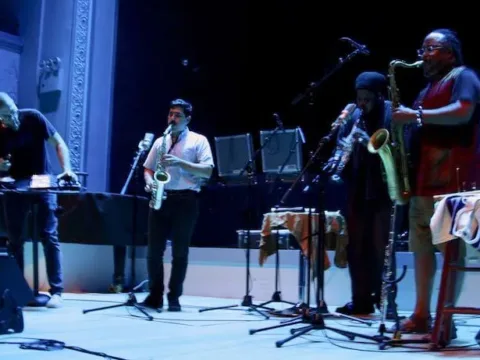
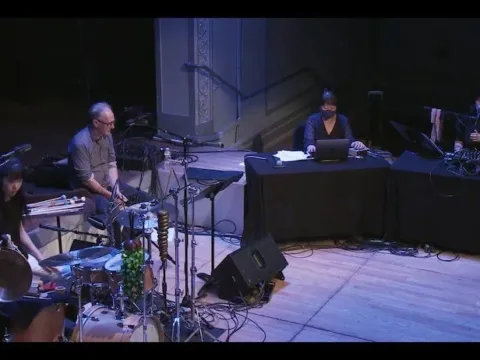
“A shifting environment of unstable systems … Signals emerge, overlap, and dissolve, forming a temporary network that resists fixed structure or control.” Planet/Tear: Early Warning Systems curated by Char Jeré more than kept this promise in its May 26 presentation at Roulette Intermedium. The fantastically-considered, stellar showcase of 15 multimedia artists was loosely grouped by sculpture and music, beginning with its use of fundamental space.
Roulette opened an hour early as a multimedia gallery before evolving into an immersive concert venue. A faceless agent with green skin and a cream, pearl-beaded bodysuit wandered throughout the space moving and stacking medium-sized empty cardboard boxes. (One stack got all the way up to the balcony before collapsing.) Projectors with visible film rolls showed animations of X-ray hands, birds, or chemistry compounds on the proscenium screen; over the loudspeaker, a voice narrated an unbroken sequence of theological, Black history, and surveillance system facts; pieces of firewood punctured by wires and electrical hardware sat at eye level under spotlights.
Eventually, Char Jeré seamlessly launched the performance by revving up synth harmonies and electronics — causing the room to turn up its conversational volume in subconscious response to that early warning system. Once the deep bass was going at full roar through speaker banks, though, there was no way to resist Char Jeré’s stunning blend of rap, spoken word, and song. The volume and distortion was so intense that many of their words were lost, but the ones that came through stung, and their vocal pathos did the rest. They say black don’t crack … Make space for me!
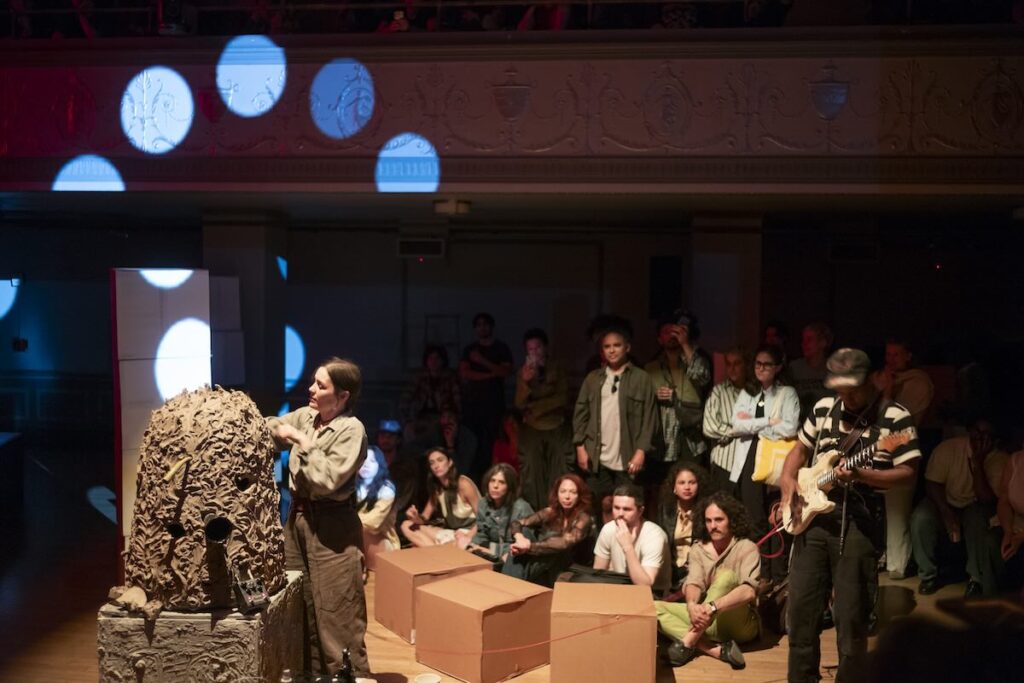
The evening didn’t pull any lyrical punches: there was anti-war protest and economic commentary; furious poetic calls of solidarity with electric guitar; a whimsical fusion of blues and country guitar from Braxton backing catchy cutting lyrics while Maggie Boyd carved the clay off of a beehive-looking amplifier sculpture. The condensed artistry of each segment was both cohesive and uniquely memorable, a testament to Char Jeré’s vision and curatorial wisdom.
The event’s complete, rotating use of space gave the listeners clear focal points without programs or supertitles; the only downsides were lost lyrics and difficulty identifying the individual artists. The interdisciplinary segments were stimulating and constant enough to satiate our attention spans that have been warped by constant stimuli, but the multimedia elements were focused enough to function as pliable textures that gently guided attention. The visuals were not at all perfunctory distractions, and it felt that the audience was considered generously even as it was challenged.
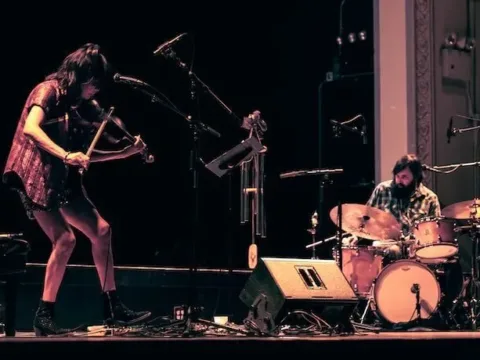
That’s largely due to the event’s sense of humor. Contrasting direct confrontation of racial surveillance and rupturing systems, Planet/Tear presented some of the most entertaining, absorbing, and mesmerizing pieces I’ve seen in a long time. Knowing its 2026 audience, the event included two whimsical and deeply philosophical moving sculptures soundtracked by musicians, and the effect flipped overstimulation and anxiety on their heads. In one, Michael Candy’s simple metal chair sitting onstage revealed itself to be capable of walking. The extended techniques from C. Spencer Yeh’s amplified violin dramatized the chair’s innocent approach to the edge of the stage and its seeming internal debate of whether or not to go off the cliff. After a few false starts, it slowly backed away from the edge to an increasingly frantic soundtrack.
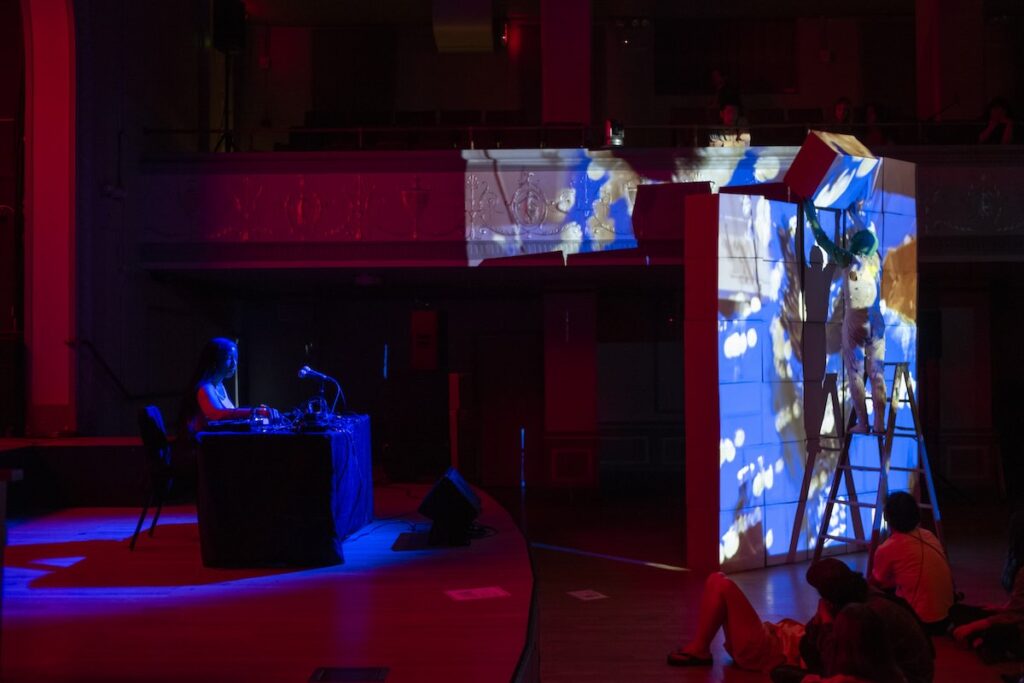
Throughout the entire evening, the green-screen and pearl-beaded actor – sculptor Pap Souleye Fall – wandered through performances, in the balcony, and across the stage carting and grouping boxes. It was somewhat disconcerting to see an unknown agent given unrestricted and unjustified access to the event, building undefined structures for no reason. But eventually, we all accepted them as a mandatory presence and ignored their behaviors as we might with surveillance technology.
As Rena Anakwe’s gentle vocal loops and calm electronics enveloped the space, Pap Souleye Fall began building the grand finale. Slowly stacking eight rows of seven boxes and creating a projection wall for another installation — climbing to the top of a shaky painter’s ladder with no safety supports — the performance was the embodied equivalent of a riveting, sustained crescendo. Even as the music stayed soothing, there was no escaping the stress of a possible crash, yet the DIY materials and childlike activity juxtaposed the silliness of our modern endeavors with their dangerous possibilities.
Char Jeré rejects the idea of linear time. They define their work as “Afro-Fractal,” which challenges colonial concepts of the future as a destination and instead convenes the future and the past into simultaneous, ritualistic happenings. True to that vision, Char Jeré transformed their location, topics, artistic approaches, and moods with a fluid plurality that pulled the future and the past into the room. Planet/Tear sets the standard for artistic confrontation that teaches us to open our eyes, embrace both joy and rage, and refresh our imaginative capacities with intuitive listening.
I CARE IF YOU LISTEN is an editorially-independent program of the American Composers Forum, and is made possible thanks to generous donor and institutional support. You can support the work of ICIYL with a tax-deductible gift to ACF. For more on ACF, visit composersforum.org.