The double bass is one of several tools that Mali Obomsawin uses in a career that spans free jazz, experimentalism, film scoring, and a punk ethos. As a kid, she initially wanted to follow in her older sister’s footsteps and play the violin, but she found her way to the largest instrument in the string family in fifth grade.
“It just felt so good physically to be close to something so big and resonant,” she told me over a Zoom call. “I was pretty sensitive and had a hard time getting out of my head, but bass was the one thing that could make me focus, and it just felt good.”
She soon merged the bass with her first love – writing – developing a practice that also included voice and composition. As a citizen of Abenaki First Nation growing up in Western Maine, her musical experiences ranged in style, but were always connected through their communal function. Her debut album, Sweet Tooth (2022), is evidence of this: the project draws on free jazz techniques and Abenaki repertoire and showcases Mali’s deft hand at writing for a group while still centering individual expression.
As a Wabanaki artist, Mali is keenly aware of the tendency for Indigenous creatives to have their work viewed through an anthropological lens — to be limited by the mainstream’s narrow understanding of Native people and people of color. However, she refuses to let this view limit her creative ideas and output.
A person’s history is a rich repository of creative ideas and execution. For people whose histories have been systemically obscured, buried, or their authority denied, the opportunity to engage with the physical, visual, and audio documentation of those that came before you is significant.
Shortly after the release of Sweet Tooth, Mali received an unexpected message from Dartmouth College, her alma mater: they asked if she would be interested in studying audio reels of Abenaki men and women recorded in the mid-to-late 1950s by anthropologist Gordon Day. Dartmouth was in the process of collaborating with the Abenaki First Nation of Odanak to repatriate the recordings, and the reels became source material for Mali’s sophomore album, Automatic.
Out Oct. 16 on Out of Your Head Records, the record features original compositions alongside re-imaginings and arrangements of pre-existing material. Automatic continues Mali’s embrace of multiple styles; major sources of inspiration include José Clemente Orozco’s mural “The Epic of American Civilization” in Dartmouth College’s Baker Library, and the work of underground rapper billy woods.
“Native people have been learning so much from Black communities about resistance and about building ourselves back up,” she explained. “So much of this record is inspired by that energy: how do I take what really comes out of my community, what really is happening on the Rez, what my friends care about, you know? Not what these institutions care about — not what we’ve seen from National Geographic about us.”

Mali downloaded the digitized recordings from Dartmouth and spent years studying them closely. As she explained to me what she was listening for, it illuminated how we often approach historical material in a one-track way: we look for it to teach us something, rather than paying attention to what it reveals about the personality of our forebears.
“Everybody wants ceremonial sacred shit,” Mali said, “and I was like, I’m interested in hearing them laugh. I want to know what they were saying to each other off the mic in the background that the ethnologists couldn’t understand. I want the fly buzzing around the room.”
Across eight tracks, Mali charts a story of archival engagement and personal aesthetic fidelity. “O’temin,” an original work, is her first using a graphic score; “Moi, quand j’y suis” is an homage to Charles Mingus’ “Myself When I Am Real.” “Kojua II” is inspired by the Kojua dance of the Mi’kmaq; “Triage” is a track especially for her Wabenaki listeners. And “Malian” honors her great-grand relative Malian Obomsawin, whose voice appears in the lead single, “Automatic.”
It would be wrong to call this album an act of preservation, even conservation. It is a living, breathing example of how history informs artistry and vice versa — a glimpse into one artist’s ingenuity, creativity, and artistic mission.
On the lead single, “Automatic,” Malian says the words “automatic sound” in English and Abenaki, which is enmeshed with a driving guitar ostinato, drumset, and saxophone. Mali was directly inspired by the communal improvisations of guembri master Mahmoud Guinia and free jazz great Pharoah Sanders on their album The Trance of Seven Colors. This is clear in the way “Automatic” sounds cacophonous and highly organized; even the album is evidence that wildness and order are not mutually exclusive.

Mali is eager to push instruments to their limits; to embrace, not hide, the tactile nature of wood, metal, bow hair, tendon, and sinew used to produce sound. To sit deeply in the technical and stylistic nuances of one’s performance. “That’s a theme going through the whole album, the pushing to the breaking point,” she told me.
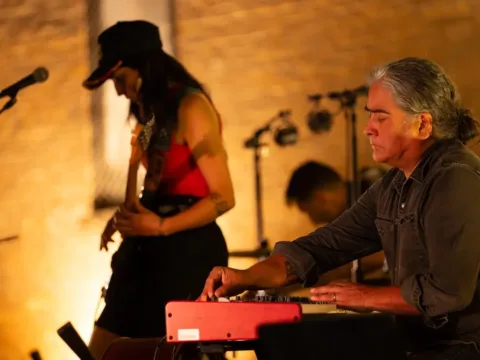
To achieve this, one must be keenly aware of their collaborator’s strengths. Guitarist Magdalena Abrego, clarinetist/saxophonist Allison Burik, cornetist Taylor Ho Bynum, and saxophonist Noah Campbell have been part of Mali’s projects for the past six years, from Sweet Tooth to her shoegaze band Deerlady and her score for the Oscar-nominated documentary, Sugarcane. Regardless of how long she’s known someone, she is able to write music that doesn’t compromise their artistry or her own. It is a stunning example of an under-acknowledged reality: that individuality and community can exist without conflict.
When asked how she’d like listeners to engage with the album, Mali isn’t firmly prescriptive. But it is clear she sees the album as something to listen to cohesively, be that top to bottom or bottom to top — the fact that the bookend tracks “Nawa” and “Venez” are the same song, featuring recorded audio of Abenaki women, is case in point.
In fact, Mali’s aim for balance and symmetry within the flow of the album is also evident in how each track sounds. It’s not about “what stylistic elements can fit together?” It is: “how can I sound most like myself?” and “Will people be able to hear me when they listen to my work?” That is an ethos that is paramount in Mali’s artistry.
“I know that all of my people from home will pick up on so much more than anyone else will about this record,” she observes. “And that feels right, given the material and the journey that it took to get there. I just hope that they’re able to appreciate some part of it in their own way. It’s just another step towards what I’m hoping to get to.”
I CARE IF YOU LISTEN is an editorially-independent program of the American Composers Forum, and is made possible thanks to generous donor and institutional support. You can support the work of ICIYL with a tax-deductible gift to ACF. For more on ACF, visit composersforum.org.