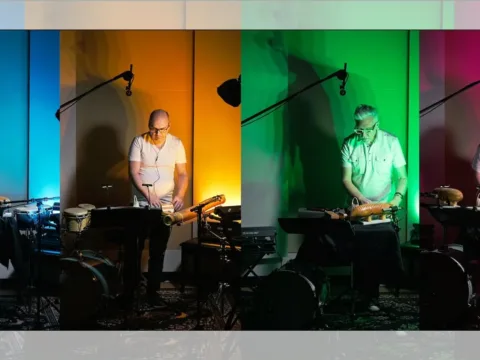
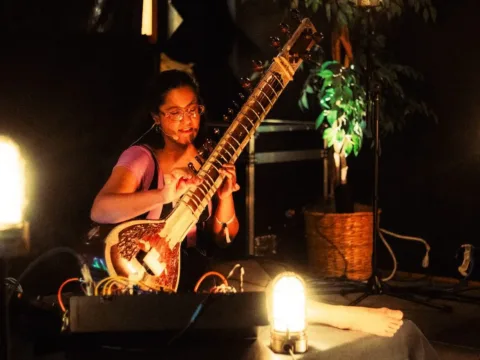
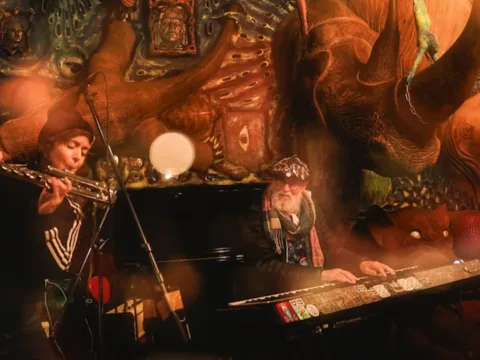
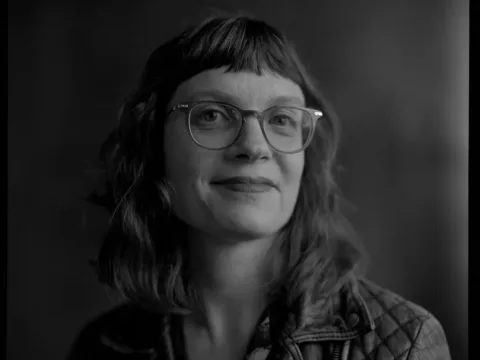
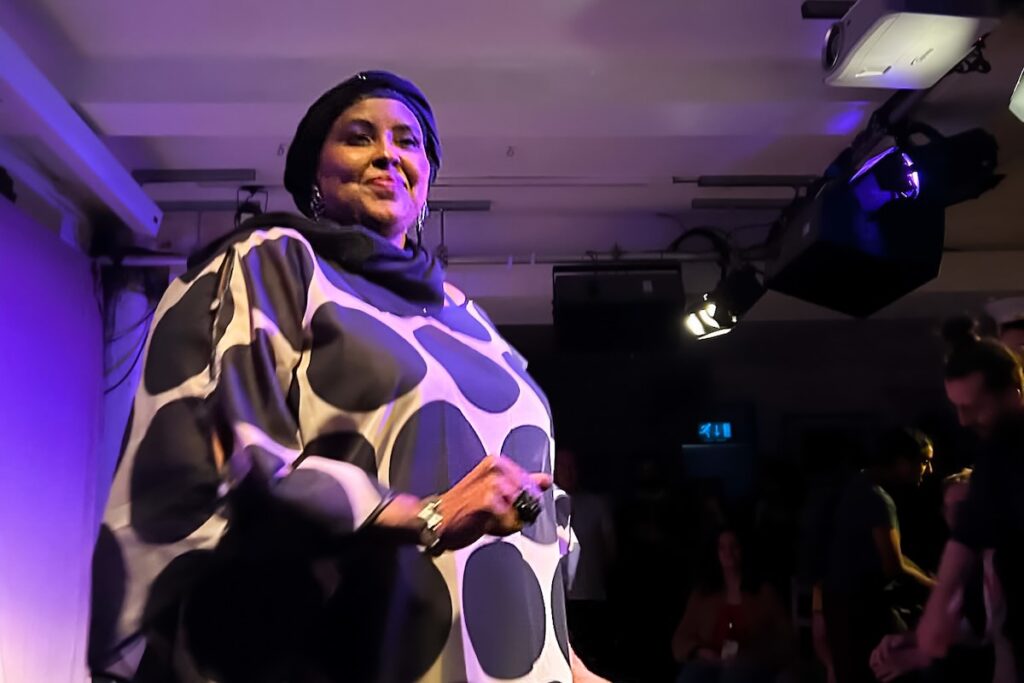
I don’t think I have ever seen the audience at Cafe Oto so animated and so joyful as they were on the opening night of the 2026 Dig That Treasure! Festival. Canab Marwo, imperious in a long black-and-white polka dot dress and headscarf, ended every track of her infectious Somali pop music with a succession of ‘wows,’ marvelling at this young and diverse crowd absolutely popping off all around her. She sang in peals of melismas over a backing track of synthesizers as fizzy as cherry cola (and just as sweet). There was a giddiness to it all, as if the music were making not just the dancing throng, but the whole room spin.
Later, Mohammad Syfkhan’s hour-plus set was, if anything, even more ecstatic. In his grey suit and wire-framed aviator-style specs, he looked more like a game show host or a used car salesman, but when he played his amplified bouzouki, it was like a rabbit-proof fence: taut, spiky and electrifying. Since fleeing Syria a decade ago, the Kurdish singer has become an abiding presence on the Irish experimental folk scene. At Cafe Oto, he largely eschewed the more reflective mode of his 2024 debut album, instead offering upbeat Kurdish, Arabic, and Turkish songs backed by electronic beats with all the syncopation and propulsion of dancehall or reggaeton. All in all, it made for a rapturous first night.
This year marks the third iteration of Dig That Treasure!, a festival of “leftfield music” taking place across four nights in venues on both sides of the Thames. Originally founded in 2023 by blogger and radio presenter Will Hall to celebrate the tenth anniversary of his Resonance FM show of the same name, the festival is now presented in collaboration with longstanding London gig promoter Baba Yaga’s Hut.
While Dig That Treasure!, the radio show, focused on private press rarities and outsider music from across the globe, the festival has developed its own identity over the years, with eclectic line-ups that are seemingly animated by a guiding principle that echoes the economic refrain of Marie Kondo: does it spark joy? That’s certainly a question to prompt a resounding ‘yes’ when asked of festival alums like Max Syedtollan, who played in 2023 with his delirious bubblegum avant-garde compositions, as well as the wonky, proggy pop of Brooklyn group Fievel Is Glauque, who played in 2024. It’s no less true of this year’s day-two headliners, Able Noise.
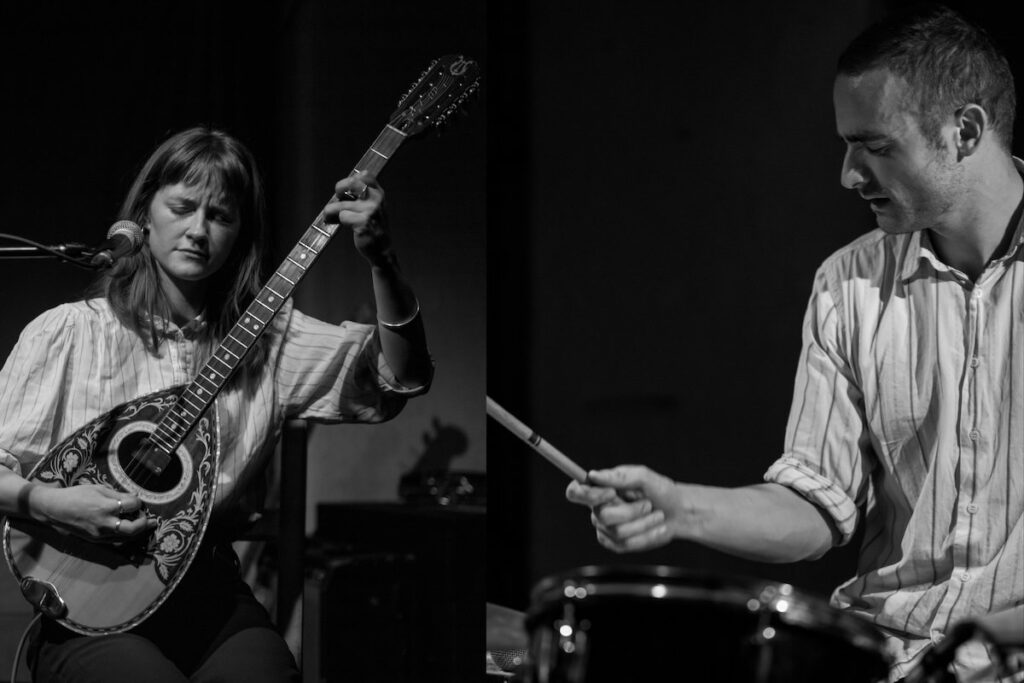
Able Noise do not write songs; they write ‘bits.’ “This is our last bit,” said singer-guitarist-bouzouki player George Knegtel before the show’s closing statement. Not the last track or the last number — certainly not their final work — but a bit, like a comedian’s skit. The label tracks. The group trade in meticulously constructed routines with the freewheeling energy of good stand-up. Some 40 minutes earlier, the set opened with a howl of feedback from a Shure SM58 laid flat on a snare drum. It was soon swooped up in the whirlwind of rolls from drummer Alex Andropoulos’ kit. The microphone became an additional drumstick, wielded by Andropoulos to whoop and scrape against surfaces across the kit while his other hand still played with a rapid-fire intensity that would take three or four hands for most. Knegtel, meanwhile, played arpeggios with a seasick swing to preclude any too-comfortable foot-tapping.
Out of this melange emerged songs somewhat in the mould of pre-millennial U.S. groups like Quasi or Gastr Del Sol, but with a restless switching through time signatures that sometimes threw the set closer to contemporary jazz or free improv than indie rock. They also have a neat trick with a pair of first generation Sony Walkmans, which they use to record each other onstage mid-song before playing it back over the live sound, thumbing the tape heads to make it slur and glitch. It doesn’t always quite work. But when it does, it’s magic.
Your granny would probably describe Scottish small pipes player Harry Górski-Brown as a ‘strapping’ lad: six foot-plus with a straggle of hair like an unpruned plane tree. Harnessed to his instrument, perched on one of Oto’s little wooden chairs, he would look ungainly were he not clearly so comfortable in his own skin. For the first number, it was just him and the small pipes singing a traditional song in Scots Gaelic in a bright and clear baritone, only a touch adenoidal. But already he was leaning into the weirdness of the instrument: the twanging slurred notes and short staccato bursts you might just mistake for 8bit electronics. For the rest, he brought out the Max patches on his Macbook, issuing great washes of digital sound that seemed to emerge from within the depths of the pipes, like a string orchestra given the full T-Pain autotune treatment. The strong set was delivered with no small amount of charisma, making a good case for the continuing potency of these old folkloric tunes.
By the time Eric Chenaux started his set later that night, the audience had grown particularly restive. He soon had them eating out of the palm of his hand, chatting away by turns affable and gnomic as he tuned his guitar and fiddled with the settings on his amp and pedals. Perhaps he came on too friendly; after a while,I started to worry he would never make it to playing any songs. In the end, he played three – each one north of 15 minutes, all apparently written “just before I came out” (he was sat behind a music stand with lead sheets and printed lyrics).
That extended runtime gave Chenaux’s fingers plenty of room to dance across the fretboard of his ring-modulated Gibson semi-acoustic, making all sorts of nice crunchy, squelching noises and generally delighting in dissonant chords and funky little rhythmic runs. There’s something warm and comforting about being in Chenaux’s presence as he plays these bruised, late-night ballads with a voice halfway between James Taylor and Chet Baker. He was even wearing exactly the same faded pink, Swiss flag cap my dad used to wear on family walks when I was a kid. It was late and I was tired, but I could have listened to this all night.
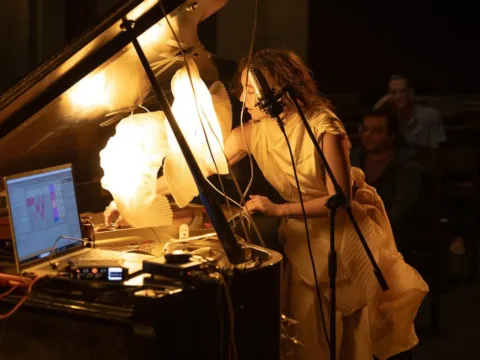
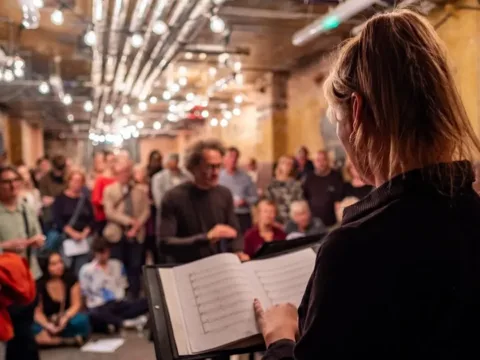
The last concert of the festival moved south to IKLECTIK, five floors up the converted multi-storey carpark, Peckham Levels. The first set was by Michelle Hromin and Tilly Coulton, co-directors of the Standard Issue ensemble, playing clarinet and flute, respectively. Sat back-to-back on stage, they began with a performance of ‘Paper’ from Jennifer Walshe’s Text Score Dataset 1.0, a collection of prose compositions generated using a machine learning algorithm trained on historical text scores by Pauline Oliveros, George Brecht, Annea Lockwood, and others. The score to ‘Paper’ begins, “Close your eyes and observe the room” and subsequently asks its performers to imagine a piece of paper and play a “note without a note.” It resulted in a music of exquisite tenderness: notes stretched thin, trembling and breathy, as brittle as eggshells.
After an increasingly fraught dialogue for bass flute and bass clarinet composed by Ailís Ní Ríain, Standard Issue finished with a piece by Lawrence Casserley called ‘The Monk’s Prayer.’ It unfolded in a single, long, almost Takemitsu-esque melody for alto flute, repeated several times with variations. As the piece unfolded, the flute line was progressively joined by its own shadows as a complex delay system, operated by Hromin from the side of the stage, diffused the echoes of each previous iteration of the melody across IKLECTIK’s surround sound speaker system. With Coulton still playing, these sonic ghosts grew into a heaving cloud of sound, trembling with all sorts of fractious internal tensions before finally thinning to a single unison pitch that stretched out to some infinite horizon. A perfect little set of finely-wrought miniatures.
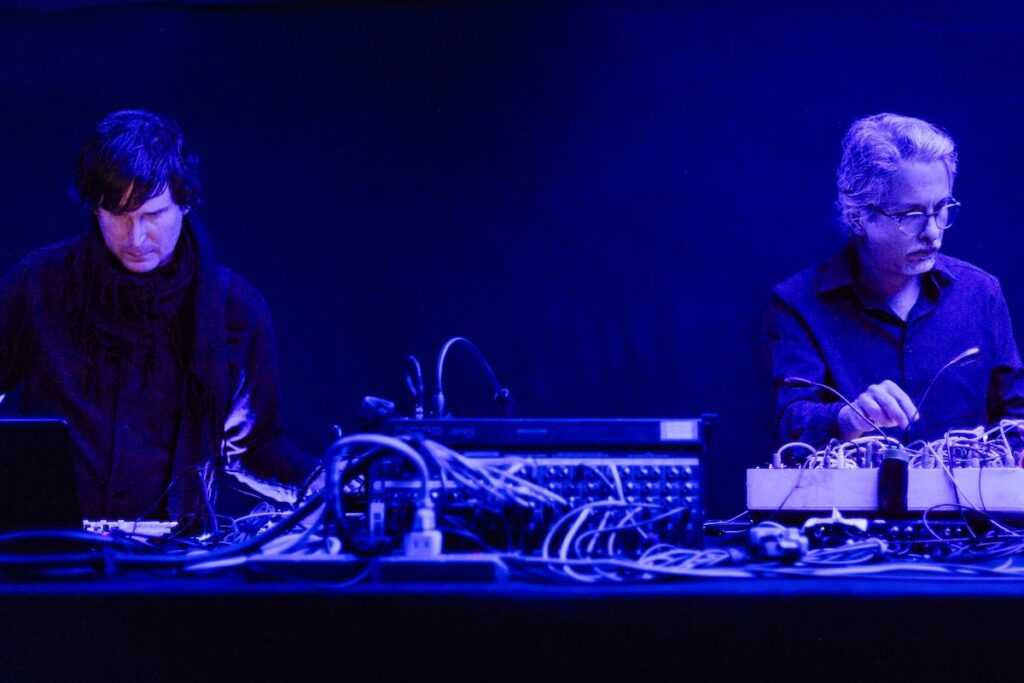
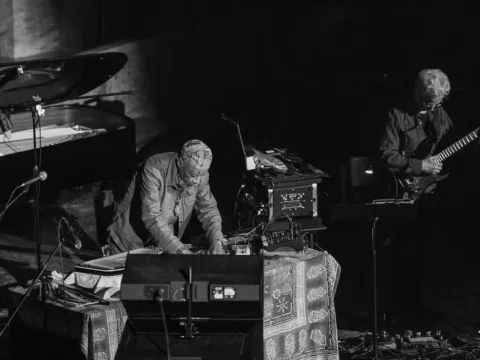
The final performance of the festival was by Abul Mogard and Rafael Anton Irisarri. Beginning with a few languidly bowed notes from Irisarri’s electric guitar, the set had an almost Wagnerian grandeur, as modular synthesizers and digital effects processing built a vast, quaking sonic edifice. The sound coming out of Iklectik’s speaker rig was immense – I can’t think of any venue in London of a comparable size where it would sound quite so lush and all-encompassing – and no doubt for many people it proved to be a truly ecstatic concert experience. But I have grown suspicious of these kinds of over-eager appeals to transcendence. There is something almost oppressive about the sheer fullness of this sound, something leaden in its self-seriousness, something gloopily romantic in the very richness of its harmonies. It made, finally, for a rather dour end to what had otherwise been a truly joyous festival.
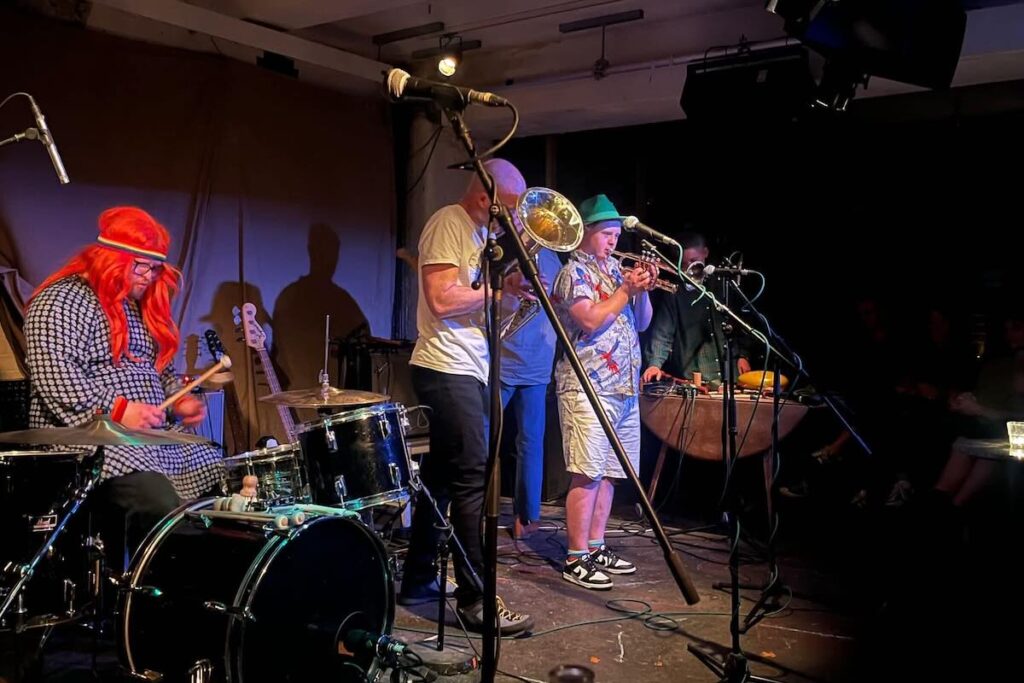
It often goes unacknowledged, the outsized part an audience plays in the success of an event like this. But from the great warmth with which they welcomed DNA? AND?, a group from Norway featuring several young people with Down syndrome, to their bantering with Eric Chenaux and ecstatic dancing to Canab Marwo, the crowd at Dig That Treasure! deserves to be counted amongst the stars of the festival. Alongside the many dazzling performances, it was also the audience, sat in the stalls or propping up the bar, that made this a festival that truly sparked joy.
I CARE IF YOU LISTEN is an editorially-independent program of the American Composers Forum, and is made possible thanks to generous donor and institutional support. You can support the work of ICIYL with a tax-deductible gift to ACF. For more on ACF, visit composersforum.org.